

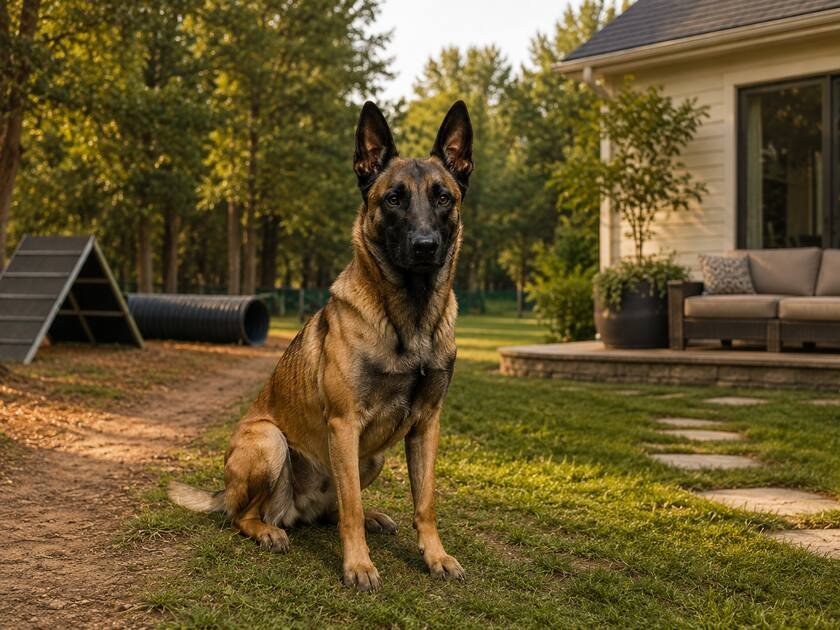
The Belgian Malinois breed fits experienced owners who enjoy structured training, active routines, and close supervision. Many homes struggle when they expect a calm pet with modest daily demands.
Traits that place the Malinois among police dog breeds can create household conflict. Chase interest, fast learning, alertness, and work motivation require controlled outlets. A secure garden does not replace training.
A Belgian Malinois can look controlled, focused, and impressive beside a police or military handler. Home life tells a different story. The same drive that supports demanding work can lead to chasing, destructive behavior, reactivity, or constant restlessness when the dog lacks structure.
The Belgian Malinois breed suits experienced owners who can provide daily exercise, focused Malinois training, mental work, and close supervision. A secure garden and occasional long walk rarely meet the needs of these high energy working dogs.
This guide examines why the Malinois ranks among recognized police dog breeds, how much activity and training the breed requires, and whether it can live safely with children or other pets. It also covers working-dog statistics, injury and heat risks, health screening, feeding, lifespan, and the practical demands of choosing a puppy or adult dog.
What is the Belgian Malinois breed?
The Belgian Malinois breed is a medium-sized Belgian herding dog developed for livestock management, property protection, and close cooperation with a handler.
The Fédération Cynologique Internationale classifies the Malinois as the short-haired variety of the Belgian Shepherd Dog. The other varieties are the Groenendael, Tervueren, and Laekenois. The American Kennel Club registers these dogs as separate breeds rather than coat varieties.
The Malinois name comes from the Belgian city of Malines, also known as Mechelen. Breeders valued dogs that could move quickly, respond to direction, guard livestock, and work for long periods.
The Fédération Cynologique Internationale breed standard calls for a square, balanced dog with dry muscle, an alert expression, and efficient movement. The Belgian Malinois has less bulk than many large working breeds.
The following table summarizes the main physical and lifespan figures associated with the breed.
| Attribute | Documented value | Practical meaning |
| Ideal male height | 62 centimeters | The FCI permits limited variation around the ideal |
| Ideal female height | 58 centimeters | Females usually carry less overall mass |
| Typical male weight | 25 to 30 kilograms | Healthy males usually maintain lean muscle |
| Typical female weight | 20 to 25 kilograms | Body condition matters more than maximum weight |
| Coat | Short, fawn with black overlay | The coat includes a protective undercoat |
| AKC lifespan estimate | 14 to 16 years | This figure represents a general breed range |
| UK median lifespan | 12 years | Registry data reflects dogs within a defined population |
| 2025 AKC popularity | 32nd | Popularity does not indicate household suitability |
The lifespan figures measure different outcomes. A breed estimate provides a broad range. A median lifespan study calculates survival within a specific group of recorded dogs.
Individual lifespan depends on inherited health, body condition, veterinary care, activity, injury history, and disease exposure.
Why do police and military units use Belgian Malinois?
Police and military units use Belgian Malinois because selected dogs combine trainability, athletic movement, search focus, environmental confidence, and sustained interest in work.
These traits support several operational roles, including:
- Explosive detection
- Narcotics detection
- Suspect tracking
- Patrol work
- Search and rescue
- Property protection
- Military detection work
Breed alone does not create a successful service dog. Professional programs assess health, recovery after surprise, scent interest, object possession, motor control, handler engagement, and confidence in unfamiliar environments.
A 2021 review of 33 working-dog studies found that successful protection and detection dogs often displayed energy, focused searching, assertiveness, object interest, environmental stability, and responsiveness.
These findings explain why Malinois appear frequently among police dog breeds. They also explain why the breed can become difficult in an unstructured home.
Not every Malinois qualifies for operational work. Some dogs lack environmental stability. Others show unsuitable health, weak recovery, excessive fear, poor concentration, or uncontrolled aggression.
Early puppy testing cannot guarantee adult working performance. The same scientific review found mixed evidence for using assessments conducted at 12 weeks or younger to predict later success.
A 2025 study of 1,230 United States military working dogs examined dogs that left service between 2019 and 2021. Belgian Malinois averaged 6.25 years of recorded service among dogs with sufficient data.
The overall average across included breeds reached 6.38 years. Only 34.4% of the military working dogs remained in service for eight years.
Neuromusculoskeletal disease, fear and anxiety, training outcomes, cancer, and heat injury affected service length. These figures show that even carefully selected working dogs face physical and behavioral limits.
Does working ability make a Belgian Malinois an easy pet?
Working ability does not make a Belgian Malinois easy to live with. It increases the dog’s ability to learn both desirable routines and unwanted behavior.
A Malinois that repeatedly runs along a fence becomes more efficient at fence running. A dog that regularly chases bicycles develops better speed, timing, and persistence.
Intelligence does not create sound household judgment on its own. The dog learns from repetition, reinforcement, access, and consequences.
Research connects successful working performance with chase behavior, object interest, search stamina, activity, boldness, and close handler engagement. These traits serve detection, patrol, and protection roles.
The same traits can produce household problems, including:
- Chasing children, cats, vehicles, or livestock
- Guarding balls, tug toys, or food
- Jumping at moving people
- Reacting to unfamiliar dogs
- Escaping weak fencing
- Destroying household items
- Struggling to settle after activity
Effective Malinois training therefore includes emotional control. The dog learns to wait, release objects, disengage from movement, accept handling, and rest while activity occurs nearby.
What makes a Belgian Malinois demanding at home?
A Belgian Malinois becomes demanding when working traits lack a defined job, clear boundaries, or enough recovery. The dog often learns unwanted routines as efficiently as formal commands.
Fence running shows the pattern. Repetition strengthens noticing, accelerating, barking, and pursuing, even without owner praise.
The pattern also affects bicycle chasing, door rushing, and toy guarding. More exercise can build fitness without changing the trigger.
Most households face six practical demands:
- Daily structure: Meals, training, exercise, rest, and visitor routines work better on a predictable schedule.
- Active supervision: Children, doors, other animals, and outdoor access require adult management.
- Secure containment: Strong gates, suitable fencing, crate training, and vehicle restraint reduce preventable escapes.
- Mental work: Scent searches, obedience tasks, tracking foundations, and controlled play engage the dog’s working system.
- Recovery practice: The dog learns to settle while people cook, work, talk, or move around the home.
- Professional support: Early guidance costs less than repairing rehearsed aggression, chasing, or resource guarding.
A yard gives space, not instruction. Many high-energy working dogs remain restless outdoors without a task.
How much exercise does a Belgian Malinois require?
A Belgian Malinois requires daily physical activity, skill training, and low-arousal recovery. Research does not support one universal number of exercise minutes for every Malinois.
Age, surfaces, conditioning, injury history, and weather change the safe workload.
Use activity categories instead of chasing one daily mileage target:
- Build aerobic fitness with controlled walking, hiking, swimming, or running suited to veterinary advice.
- Train movement control through recalls, position changes, loose-leash work, and direction cues.
- Use scent tasks to add concentration without repeated high-impact turns.
- Develop strength gradually with stable surfaces and controlled body-position exercises.
- Schedule quiet recovery after hard work, exciting play, travel, or visitors.
Repetitive jumping and sharp turns create a different load from steady walking. A 2024 Swedish study surveyed 1,582 sporting and utility dogs. Across all participating dogs, 58.7% had an injury history. Belgian Malinois showed the highest breed-specific proportion at 72.9%, with a 95% confidence interval of 64.0 to 80.4%.
The adjusted odds of injury history reached 2.51 against the reference group. The study involved active sport and utility dogs, so 72.9% does not represent every pet Malinois.
The figure supports progressive conditioning and recovery, not inactivity.
How serious is heat risk during exercise?
Heat risk becomes serious when exercise produces more body heat than the dog can release. High drive can delay self-limiting behavior.
A VetCompass study examined 905,543 UK dogs and identified 1,259 heat-related illness events. Among 879 events with a recorded trigger, exertion caused 74.2%. Environmental heat caused 12.9%, while vehicle confinement caused 5.2%.
Walking preceded 67.5% of exertional events with a specified activity. High-intensity activity caused 17.6%, and play caused 13.8%. Heat illness occurred in every month of the study period, although July produced the largest share.
Stop activity when coordination, gait, awareness, or breathing changes. Move the dog to a cooler place and contact a veterinarian. Do not wait for it to collapse.
Military records also found a breed difference within that working population.
German Shepherd dogs had a 73.98% lower likelihood of heat-injury discharge than Belgian Malinois. The authors called for more research before treating that association as a universal genetic rule.
What does effective Malinois training involve?
Effective Malinois training uses clear cues, appropriate rewards, gradual difficulty, controlled distractions, and planned recovery.
The Belgian Malinois often learns new behavior quickly. Fast learning creates a hidden problem. Owners may raise expectations before the behavior becomes reliable.
A dog that recalls inside the house has not mastered recall around livestock, traffic, wildlife, children, or unfamiliar dogs.
Reliability requires practice across different:
- Surfaces
- Distances
- Locations
- Noise levels
- Weather conditions
- People
- Animals
- Movement patterns
Working-dog research identifies trainability, concentration, responsiveness, environmental confidence, and motor inhibition as relevant performance traits.
5 foundation skills provide more household value than advanced protection exercises:
- Build a reliable recall before allowing off-leash freedom.
- Teach the dog to settle while people eat, work, cook, or receive visitors.
- Reinforce loose-leash walking around traffic, dogs, and sudden movement.
- Train release cues for toys, food, stolen objects, and interrupted play.
- Condition cooperative handling for paws, ears, teeth, restraint, grooming, and veterinary examinations.
Reward selection also affects performance. Food can support accurate repetition. Tug toys and balls can produce stronger effort, but they may also raise arousal.
The handler controls when the reward appears, which behavior earns access, and how the dog returns to calm activity.
The American Veterinary Society of Animal Behavior recommends reward-based training methods. Its position statement links aversive methods with stress, welfare concerns, and weaker long-term outcomes.
Reward-based training does not mean removing rules. It teaches the dog which behavior provides access to food, movement, play, attention, and environmental freedom.
When does Malinois socialization start?
Malinois socialization starts during the first three months, when puppies form responses to people, animals, handling, surfaces, sounds, and unfamiliar places.
The American Veterinary Society of Animal Behavior identifies this period as the primary socialization window. Puppy classes can start at 7 to 8 weeks after one vaccine set given at least seven days earlier and an initial deworming.
Socialization does not mean greeting every dog or person. The goal is stable observation and recovery. A family puppy gains more from watching running children calmly than joining the chase.
Is a Belgian Malinois suitable for children and other pets?
A Belgian Malinois can live with children and other pets, but suitability depends on the individual dog, household control, and behavior history. No accredited dataset provides a universal “safe with children” percentage for the breed.
Breed descriptions cannot replace assessment of pursuit, guarding, fear, frustration, and recovery.
The table separates lower-risk conditions from patterns that increase management pressure.
| Household area | Lower-risk condition | Higher-risk condition |
| Children | Calm interaction with active adult supervision | Running games with unrestricted dog access |
| Cats | Early controlled exposure and reliable barriers | An adult dog with a rehearsed chase history |
| Other dogs | Gradual introductions and separate resources | Forced sharing despite tension or guarding |
| Visitors | Place training, gates, and planned entry | Door rushing and uncontrolled greeting |
| Outdoor access | Secure fencing and supervised activity | Unchecked yard time near roads or livestock |
| Rest | A protected sleeping area | Constant interruption by children or guests |
Children cannot control an adult Malinois during over-arousal or conflict. Adults manage access and separation.
Early cat exposure can improve familiarity, but obedience does not erase chase patterns. Use physical separation after fixation, stalking, or pursuit.
Which health problems require documented screening?
Belgian Malinois breeding decisions require documented hip, elbow, and eye screening, plus open discussion of epilepsy and other family health problems.
The American Belgian Malinois Club advises buyers to check both parents after two years of age because final hip and elbow certifications start at that age. The club also asks for an eye examination from a veterinary ophthalmologist within the previous 12 months.
Epilepsy can appear after breeding age. The breed club notes that inherited problems such as epilepsy may not become visible until three years or later. A young seizure-free parent does not prove a seizure-free family line.
Ask for records rather than verbal reassurance:
- Registered names and identification details for both parents
- Hip and elbow evaluation results
- Current ophthalmology results
- Seizure history across close relatives
- Previous litter health and temperament information
- Written veterinary records for an adult rescue
A Canine Health Information Center number confirms completed public tests. It does not mean every result was normal.
How does body condition affect an active Malinois?
Body condition affects joint load, heat production, and long-term health. A working dog gains no advantage from excess fat.
Muscle condition requires a separate check. An overweight dog can still lose muscle along the spine, shoulder blades, skull, and pelvis.
A long-term study of 24 Labrador littermate pairs found a 1.8-year longer median lifespan in the lean-fed group. This result offers context, not Malinois-specific proof.
Do not copy a calorie restriction percentage from another breed. Use measured meals, count training rewards, track weight, and ask a veterinarian to assess body and muscle condition.
Can a first-time owner manage a Belgian Malinois?
A first-time owner can manage an individual Malinois, but the breed remains a high-risk default choice for an inexperienced household.
Previous ownership does not guarantee skill. A prepared beginner can make sound decisions, but preparation requires time and professional support.
Use this 8-question ownership audit. It is a planning tool, not a validated behavioral test.
- Can you schedule training and activity every day?
- Can you teach rest rather than chase exhaustion?
- Can you secure doors, fencing, crates, and vehicles?
- Can you separate the dog from children or pets when required?
- Can you fund veterinary care, training, equipment, and boarding?
- Can you accept restricted off-leash freedom?
- Can you access a reward-based trainer familiar with high-drive herding dogs?
- Can you enjoy repetitive daily practice after the novelty disappears?
Treat each “no” answer as an unresolved ownership gap. Do not assume the dog becomes easier after adolescence.
How much food does a Belgian Malinois need?
A Belgian Malinois needs enough complete food to maintain ideal body condition, stable energy, healthy stool, and lean muscle. No fixed feeding amount suits every dog. Age, workload, reproductive status, climate, health, and food energy density change calorie requirements.
Feeding labels provide a starting estimate. Regular body-condition checks provide better adjustment data. Do not feed toward the top of the breed’s weight range. Standard weight figures describe typical structure. They do not set a target for every dog.
Assess muscle separately from body fat. A dog can carry excess fat while losing muscle after injury, aging, or reduced activity. Working dogs also require feeding routines that match activity. Large meals immediately before intense exercise can cause digestive discomfort.
Owners can divide daily food across measured meals and training rewards. Training treats count toward total calorie intake.
How do you choose a Belgian Malinois puppy?
Choose a Belgian Malinois puppy through verified health records, documented temperament, realistic placement advice, and a clear match between the breeding line and your household.
The American Belgian Malinois Club recommends breeding dogs aged at least two years with hip and elbow clearances. The club also asks for recent eye examinations and open discussion of seizure history.
Buyers can verify many results through official health databases. A verbal claim that both parents passed their tests does not replace certificates or searchable records.
Ask which activities the breeder prioritizes. Herding, detection, patrol, protection sport, conformation, and companion breeding can create different behavioral tendencies.
The term “working line” provides limited information without records from parents, relatives, and earlier litters.
Early temperament testing also has limits. Working-dog research does not support using one puppy test as a guaranteed prediction of adult performance.
Observe how the puppy:
- Recovers after a mild surprise
- Responds to handling
- Engages with people
- Releases objects
- Explores unfamiliar surfaces
- Settles after play
- Redirects away from movement
High excitement can appear impressive. Recovery shows whether that excitement remains manageable.
How do you assess an adult Belgian Malinois?
Assess an adult Belgian Malinois through medical records, behavior history, direct observation, and a qualified professional evaluation.
Request information about:
- Bite incidents
- Escape behaviour
- Resource guarding
- Previous training methods
- Reactions to children
- Reactions to unfamiliar dogs
- Behaviour around cats or livestock
- Medication history
- Previous injuries
- Household routines
Arrange an independent veterinary examination before placement. A qualified behavior professional can assess triggers, recovery, handling tolerance, and environmental responses.
A short meeting in a quiet location may not reveal the dog’s normal behavior. Observe the dog across movement, confinement, handling, unfamiliar people, and recovery after excitement.
Is the Belgian Malinois too demanding for most homes?
The Belgian Malinois breed is too demanding for many homes because ordinary pet routines rarely match its working drive, speed, sensitivity, and management needs.
The right home does not rely on exhaustion. It provides structured Malinois training, controlled exercise, daily mental work, and calm routines.
Management also remains part of normal ownership. Gates, crates, leashes, secure fencing, supervision, and professional coaching support safe behavior.
Choose the Belgian Malinois for the daily work, not the public image.
Police dog breeds can look controlled and powerful during short demonstrations. Home life occupies the remaining hours, when the dog still requires boundaries, judgment, recovery, and useful engagement.
A well-matched Belgian Malinois can become a capable sport partner, working dog, or active companion.
A poor match can turn the same traits into chasing, destruction, reactivity, escaping, guarding, and household conflict.
The uniform does not create the Belgian Malinois work ethic. The breed carries that intensity into ordinary home life.
The real question is whether your routine fits the breed
The Belgian Malinois breed is not difficult because it lacks intelligence. It is difficult because intelligence, speed, sensitivity, and working drive remain active throughout ordinary home life.
A suitable owner provides structured Malinois training, controlled exercise, mental work, secure management, and daily recovery. A large garden, occasional run, or basic obedience course does not replace that routine. These high-energy working dogs notice movement, repeat rewarding behavior, and learn unwanted habits quickly when nobody gives that energy a clear direction.
Choose the dog for the life it lives after the training field closes. Police dog breeds look impressive during short demonstrations, but a household manages the remaining hours. A well-matched Malinois can become a focused companion or capable sport partner. A poor match can leave both the dog and owner under constant pressure.
Can a Belgian Malinois learn to relax indoors?
Yes, a Belgian Malinois can relax indoors when settled, training, predictable routines, mental work, and quiet recovery begin early.
Does a large garden reduce the breed’s exercise needs?
No, a large garden provides space, but it does not replace directed exercise, scent work, training, supervision, or structured interaction.
Is protection training suitable for a family Malinois?
Protection training is unsuitable for most family homes unless a qualified professional first confirms stable temperament, strong control, and a genuine working purpose.
Is an adult Belgian Malinois easier than a puppy?
An adult can be easier to assess because its behavior is visible, but bite history, chasing, guarding, injuries, and previous training require careful review.
What matters more than a Belgian Malinois working-line label?
Verified health records, recovery after excitement, household behavior, parent temperament, and the dog’s ability to disengage matter more than a working-line label.