


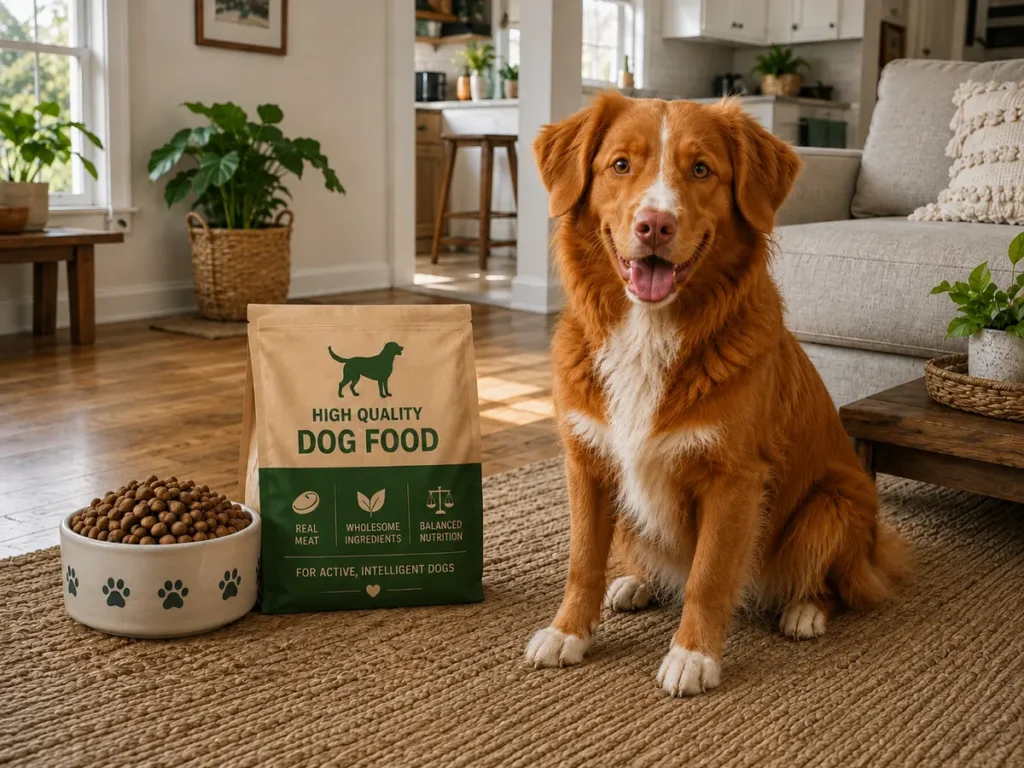
The best dog food for a Nova Scotia Duck Tolling Retriever depends on age, activity level, body condition, digestive tolerance and individual health needs. Active Tollers generally need a complete and balanced diet that provides appropriate protein, fat, calories and essential nutrients, while puppies, seniors, overweight dogs and Tollers with sensitive stomachs may require different nutritional approaches. This guide compares kibble, fresh and raw options and explains how to choose an appropriate food for your Toller.
A Nova Scotia Duck Tolling Retriever can spend one day swimming, retrieving, hunting, or competing and another day resting at home. Those activity changes affect calorie use. A fixed portion does not suit every day or every Toller.
Dog food labels create another problem. Claims such as “premium,” “natural,” “holistic,” and “high protein” attract attention but do not confirm nutritional adequacy. The World Small Animal Veterinary Association pet food guidelines place greater value on qualified formulation, quality control, calorie disclosure, nutrient analysis, and research.
This informational guide explains how to find the best dog food for a Nova Scotia Duck Tolling Retriever. It covers protein, fat, calories, life stages, food allergies, grains, feeding quantities, food formats, and established dog food brands.
What is the best dog food for a Nova Scotia Duck Tolling Retriever?
The best Toller food is complete, balanced, life stage appropriate, calorie controlled, digestible, and matched to the individual dog’s health and activity.
No single recipe fits every Nova Scotia Duck Tolling Retriever. A puppy requires growth nutrition. An active field dog can use a calorie-dense performance formula. A less active adult may maintain a better body condition on standard adult food.
The nutritional adequacy statement provides the first selection point. The AAFCO pet food label guidance explains that recognised adequacy claims depend on nutrient profiles or feeding protocols. Food intended only for intermittent or supplemental feeding cannot form the complete daily diet.
Why does the Toller’s breed profile affect food selection?
The Toller’s medium size, muscular build, working history, and variable activity make calorie control central to food selection.
The Canadian Kennel Club Toller profile classifies the breed as a medium-sized sporting dog. Adult males generally weigh 45 to 51 pounds. Adult females generally weigh 37 to 43 pounds.
The breed was developed to toll and retrieve waterfowl. Tolling involves running, jumping, playing along shorelines, swimming, and retrieving. The official Canadian Kennel Club breed standard connects the breed with agility, endurance, and working drive.
These traits do not create one breed-specific nutrient formula. They create different energy requirements among individual Tollers.
What 8 features identify high-quality Toller dog food?
Eight features identify suitable Toller dog food: nutritional adequacy, correct life stage, qualified formulation, quality control, digestible protein, appropriate energy density, calorie disclosure, and measurable physical results.
1. Does the food state complete and balanced nutrition?
Select food labelled complete and balanced for the Toller’s current life stage.
A complete food supplies the required nutrients. A balanced food supplies those nutrients in suitable proportions relative to energy content.
The adequacy statement identifies whether the formula covers:
- Growth
- Adult maintenance
- Gestation and lactation
- All life stages
According to the Merck Veterinary Manual pet food label guide, snacks, treats, toppers, and supplements can lack a complete nutrition statement. These products cannot replace the principal diet.
2. Does the formula match the Toller’s life stage?
Match the formula to puppy growth, healthy adult maintenance, reproduction, senior condition, or a diagnosed medical requirement.
A Toller puppy requires higher nutrient concentrations than a healthy adult. The Merck Veterinary Manual nutritional requirements list a minimum of 22.5% protein on a dry-matter basis for puppy growth and reproduction. Adult maintenance diets contain a minimum of 18% protein on a dry-matter basis.
These figures represent minimum requirements. They do not prove that the food with the highest protein percentage provides the best nutrition.
3. Who formulates the dog food?
Select manufacturers that employ qualified veterinary nutrition or animal nutrition professionals.
Relevant credentials include:
- Board certification in veterinary nutrition
- A doctorate in animal nutrition
- A master’s degree in animal nutrition
- Advanced food science and formulation expertise
The WSAVA pet food selection guide also recommends checking whether the qualified expert works directly for the company or acts only as an external consultant.
4. What quality controls does the manufacturer use?
A credible manufacturer explains ingredient testing, finished-product analysis, bacterial screening, nutrient verification, and shelf-life testing.
The Pet Nutrition Alliance manufacturer evaluation identifies six useful questions:
- Does the company employ a qualified nutrition expert?
- Does a qualified expert formulate the products?
- Where does manufacturing occur?
- Which quality controls test ingredients and finished foods?
- Can the company provide requested nutrient and calorie data?
- Has the company conducted product research?
These questions provide more information than package claims such as “carefully crafted” or “made with premium ingredients.”
5. Does the food provide digestible protein?
Suitable protein supplies all 10 essential canine amino acids in digestible amounts.
Dogs require arginine, histidine, isoleucine, leucine, lysine, methionine, phenylalanine, threonine, tryptophan, and valine.
The Merck Veterinary Manual classifies protein digestibility into four ranges:
- Below 80%: low digestibility
- 80% to 85%: average digestibility
- 86% to 93%: high digestibility
- Above 93%: very high digestibility
The guaranteed analysis lists a minimum crude protein percentage. It does not disclose digestibility, amino acid balance, or actual average nutrient content.
6. Does the fat and calorie density match activity?
Match fat and calorie density to the Toller’s workload, body condition, age, neuter status, and digestive tolerance.
Fat supplies concentrated energy. A working Toller can use more dietary energy during hunting, agility, flyball, dock diving, or sustained retrieving.
Higher fat does not automatically indicate better dog food. A companion Toller can gain weight when calorie intake exceeds activity. Compare kilocalories per cup or per 100 grams rather than comparing fat percentages alone.
7. Does the package disclose calories?
Choose food that states kilocalories per cup, can, tray, kilogram, or serving unit.
Calorie disclosure permits accurate portion calculations. Two dry foods can fill the same measuring cup but provide different calorie totals.
The AAFCO label requirements require basic guaranteed-analysis values. These include minimum crude protein, minimum crude fat, maximum crude fibre, and maximum moisture. The ingredient list appears in descending order by pre-processing weight.
8. Does the food produce measurable results?
Suitable food maintains ideal body condition, stable muscle, normal stool, healthy skin, and consistent energy.
Assess 6 physical indicators every 2 to 4 weeks:
- Record body weight.
- Feel the ribs.
- View the waist from above.
- Check the abdominal tuck from the side.
- Examine stool consistency.
- Check muscle over the shoulders, spine, and hips.
The WSAVA Global Nutrition Guidelines support individual nutrition plans based on the animal’s condition, diet, environment, life stage, and health.
How much protein does a Toller require?
Adult Toller food contains at least 18% protein on a dry-matter basis, while growth food contains at least 22.5%.
Protein percentage alone does not establish food quality. Total calorie intake, amino acid composition, digestibility, health status, and the amount consumed also affect protein delivery.
A high-protein formula can suit an athletic Toller when the completed diet remains balanced. A less active adult does not automatically benefit from performance food.
The ingredient named first cannot confirm protein quality. The Merck Veterinary Manual dog food guide states that animals require nutrients rather than particular ingredient-list positions.
How many calories does a Nova Scotia Duck Tolling Retriever eat?
A healthy adult Toller commonly starts near 813 to 1,309 kilocalories daily, depending on weight and maintenance category.
The Merck Veterinary Manual calorie method starts with resting energy requirement:
RER = 70 × body weight in kilograms^0.75
Maintenance estimates then use these multipliers:
- Obesity-prone adult: 1.4 × RER
- Neutered adult: 1.6 × RER
- Intact adult: 1.8 × RER
- Puppy younger than 4 months: 3 × RER
- Puppy older than 4 months: 2 × RER
The table applies the formula to common Toller weights.
| Body weight | 1.4 × RER | 1.6 × RER | 1.8 × RER |
| 37 lb | 813 kcal | 929 kcal | 1,045 kcal |
| 40 lb | 862 kcal | 985 kcal | 1,108 kcal |
| 45 lb | 941 kcal | 1,076 kcal | 1,210 kcal |
| 50 lb | 1,018 kcal | 1,164 kcal | 1,309 kcal |
These figures provide starting estimates. Dog food calculator calculates exact food required for dog according weight, age type. Dogs of equal weight can differ by approximately 30% in the calories required to maintain ideal condition. Activity, age, environment, lean mass, and neuter status affect the final amount.
How do calories convert into cups?
Divide the daily calorie target by the food’s stated calories per cup.
Example:
- Daily target: 985 kcal
- Food density: 400 kcal per cup
- Calculation: 985 ÷ 400
- Daily amount: 2.46 cups
Subtract calories from treats, dental chews, table food, toppers, and training rewards.
What is the best food for a Toller puppy?
The best Toller puppy food is complete for growth, calorie controlled, digestible, and suitable for a medium-sized dog.
A Nova Scotia Duck Tolling Retriever puppy food requires:
- A growth nutritional adequacy statement
- At least 22.5% protein on a dry-matter basis
- Declared calories
- Balanced calcium and phosphorus
- Digestible protein
- Essential fatty acids
- Feeding directions based on age and expected adult weight
Growth food generally continues until the puppy reaches about 90% of expected adult size. The Merck Veterinary Manual feeding guidance describes this point as an appropriate stage for moving toward a less nutrient-dense adult diet.
Feed measured meals. Unrestricted access can produce unnecessary weight gain in puppies that do not regulate their intake.
What is the best food for an active or working Toller?
An active Toller benefits from food that maintains body weight, muscle condition, stamina, digestion, and recovery during sustained work.
Performance food provides more calories in a smaller volume. This feature can help hunting dogs, canine athletes, and Tollers completing repeated high-intensity training.
Consider performance dog food when 3 conditions apply:
- The Toller completes sustained exercise several times each week.
- Standard adult food does not maintain ideal weight.
- Larger meal volumes reduce appetite or stool quality.
Occasional walks, short play sessions, or weekend activity do not automatically justify a 30% protein and 20% fat performance formula.
What is the best food for a senior Toller?
The best senior Toller food maintains lean muscle while controlling calories and addressing diagnosed age-related conditions.
Senior dogs differ in activity, body condition, dental health, digestion, kidney function, and muscle mass. A universal senior formula does not fit every older Toller.
Compare 5 attributes:
- Digestible protein
- Appropriate calorie density
- Complete vitamin and mineral balance
- Suitable food texture
- Nutrients connected to diagnosed conditions
A senior gaining body fat can benefit from lower calorie density. A thin senior with reduced appetite can require more calories per gram. Veterinary assessment separates normal ageing from disease-related weight loss.
Which top dog food brands are worth comparing for a Toller?
Purina Pro Plan, Hill’s Science Diet, Royal Canin, Eukanuba, and Iams are established brands worth comparing, but no brand ranks first for every Toller.
The following comparison is informational. It does not represent sponsorship or a universal product ranking.
The Pet Nutrition Alliance manufacturer report compares manufacturer disclosures such as nutrition expertise, manufacturing control, and nutrient information. The report reflects information gathered mainly in 2022, so current product labels and company disclosures remain essential.
| Brand | Useful formula categories | Toller profile to compare | Main verification point |
| Purina Pro Plan | Puppy, adult, sensitive digestion, weight management, sport | Active adults, puppies, sensitive dogs | Calories and workload match |
| Hill’s Science Diet | Puppy, adult, mature, weight, digestion | Companion adults, seniors, weight-prone dogs | Life stage and energy density |
| Royal Canin | Medium puppy, medium adult, mature, veterinary diets | Medium-sized puppies and adults | Exact age and weight range |
| Eukanuba | Puppy, adult, active, performance | Working and competitive Tollers | Protein, fat, and training volume |
| Iams | Puppy, adult, senior, weight-focused | Healthy companion dogs | Adequacy statement and calories |
When does Purina Pro Plan fit a Toller?
Purina Pro Plan provides standard, sensitive, puppy, and sport formulas for different activity and life stage requirements.
The official Purina Pro Plan Sport Performance 30/20 formula contains 30% protein and 20% fat. That concentration targets highly active dogs rather than every household Toller.
Compare the adult, puppy, sensitive skin and stomach, weight management, and sport categories according to the individual dog’s condition.
When does Hill’s Science Diet fit a Toller?
Hill’s Science Diet provides life stage and condition-focused options for puppies, adults, older dogs, digestion, and weight management.
The official Hill’s Science Diet Adult formula states that AAFCO feeding tests substantiate complete and balanced nutrition for adult maintenance.
Check the age range, calories per cup, body condition response, and suitability for the individual dog.
When does Royal Canin fit a Toller?
Royal Canin provides medium-dog formulas that align with the Toller’s adult weight range.
The official Royal Canin Medium Adult formula covers adult dogs weighing 23 to 55 pounds. The official CKC range places most adult Tollers within that category.
Breed size alignment does not replace calorie assessment. Compare the exact formula with age, activity, body condition, and health.
When does Eukanuba fit a Toller?
Eukanuba provides active and performance formulas for Tollers completing regular sport or working activity.
The Eukanuba performance dog food range includes formulas aimed at canine athletes. Some products contain substantially more fat than standard maintenance food.
Select the formula according to actual exercise volume. Performance branding alone does not justify higher calorie intake.
When does Iams fit a Toller?
Iams provides complete puppy, adult, and senior categories for healthy companion dogs.
The official Iams life stage range separates formulas for puppies, adults aged 1 to 6 years, and senior dogs aged 7 years or older.
Verify calories, the nutritional adequacy statement, portion guidance, and individual tolerance.
Does a top brand guarantee the best Toller food?
No. A strong manufacturer can still produce a formula that does not fit a particular Toller.
Evaluate each product separately. Check:
- Nutritional adequacy
- Life stage
- Calories per serving
- Protein and fat concentrations
- Manufacturer expertise
- Quality-control disclosure
- Digestive response
- Body-condition response
A recognised brand provides a comparison starting point. The individual formula determines suitability.
Does the first ingredient identify high-quality dog food?
No. The first ingredient does not establish nutritional balance, digestibility, safety, or finished-product quality.
Ingredients appear in descending order by weight before processing. Fresh meat contains water and can appear above a dry concentrated ingredient because of its moisture weight.
The AAFCO ingredient-list guidance states that the ingredient list does not quantify the absolute amount of each ingredient. It also prohibits quality or grade claims within that list.
Evaluate nutrients and manufacturer evidence rather than one ingredient position.
Is grain-free dog food better for a Toller?
Grain-free food is not nutritionally superior for a healthy Toller without a diagnosed dietary indication.
Grain-free formulas commonly replace corn, wheat, rice, barley, or oats with peas, lentils, chickpeas, beans, or potatoes.
The FDA guidance on non-hereditary canine dilated cardiomyopathy states that reports involve both grain-free and grain-containing foods. Many reported diets contained non-soy pulses high in their ingredient lists. The FDA has not established one definitive cause or stated that legumes are inherently dangerous.
Texas A&M veterinary experts also report that grain intolerance is relatively uncommon compared with other food-related conditions. The Texas A&M grain-free diet guidance explains that removing grain does not automatically improve skin or digestive health.
What protein is best for a Toller with suspected food allergies?
No protein is universally hypoallergenic because a dog can react to any protein previously consumed.
Possible adverse-food-reaction signs include:
- Persistent itching
- Recurrent ear inflammation
- Paw licking
- Facial rubbing
- Vomiting
- Diarrhoea
- Frequent soft stool
- Excessive flatulence
The NC State University Veterinary Hospital food allergy guidance identifies a controlled elimination diet as the most reliable diagnostic method. Blood and skin tests for food allergens produce unreliable results.
A veterinary trial commonly uses:
- A hydrolysed-protein diet
- A controlled novel-protein diet
- Exclusive feeding for 6 to 10 weeks
- A dietary challenge after improvement
The NC State hydrolysed-diet guide also explains that prescription diets apply tighter manufacturing controls than many over-the-counter limited-ingredient products.
Is dry, wet, fresh, homemade, or raw food best?
Dry, wet, and correctly formulated cooked diets can feed a Toller successfully when they remain complete, balanced, safe, and calorie appropriate.
Is dry food suitable for a Toller?
Dry food provides concentrated calories, convenient storage, and measurable portions.
Dry dog food normally contains 3% to 11% water. Its calorie density can benefit active dogs but can also increase overfeeding when portions are estimated rather than weighed.
Is wet food suitable for a Toller?
Wet food provides more moisture and often contains fewer calories per unit of volume.
Canned pet food commonly contains 60% to more than 87% water. Confirm that the product provides complete and balanced nutrition rather than supplemental feeding only.
Is commercial fresh food suitable?
Commercial cooked fresh food is suitable when its label confirms nutritional adequacy and the manufacturer provides formulation and testing information.
Check refrigeration requirements, safe handling, calories per gram, and the amount required each day.
Is homemade food suitable?
A homemade Toller diet requires formulation by a credentialed veterinary nutrition specialist.
Limited-ingredient homemade diets often lack essential minerals. The Merck Veterinary Manual homemade-diet guidance states that meat-only and hamburger-and-rice diets can cause calcium deficiency and secondary nutritional hyperparathyroidism.
Is raw food suitable?
Raw food creates documented bacterial risks for dogs, handlers, household members, utensils, and preparation surfaces.
An FDA study of raw pet food tested 196 commercial raw samples and found raw products more likely to contain disease-causing bacteria than other tested food types.
The American Veterinary Medical Association raw-diet policy discourages feeding raw or undercooked animal-source proteins because of human and animal health risks.
How can misleading dog food claims be identified?
Treat front-label claims as marketing until measurable nutritional evidence supports them.
Seven common claims require closer examination:
- Premium: The term does not confirm a superior nutrient profile.
- Holistic: The term does not identify a regulated nutritional standard.
- Natural: The term does not prove completeness or digestibility.
- Human-grade: The phrase does not replace the adequacy statement.
- High protein: The phrase does not disclose digestibility or calorie balance.
- Breed-specific: The phrase does not prove a unique Toller nutrient requirement.
- Veterinarian recommended: The phrase does not disclose the survey size or comparison method.
The WSAVA food-selection document specifically identifies terms such as “premium” and “holistic” as having limited practical value in nutritional assessment.
How can a Toller change to a new food safely?
Transition a healthy Toller to new food gradually over approximately 7 days.
The American Animal Hospital Association transition guide recommends beginning with 25% new food and gradually increasing the amount according to acceptance.
Use this schedule:
- Days 1 and 2: 75% previous food and 25% new food
- Days 3 and 4: 50% previous food and 50% new food
- Days 5 and 6: 25% previous food and 75% new food
- Day 7: 100% new food
Extend the transition when soft stool, vomiting, reduced appetite, or abdominal discomfort develops.
Which signs indicate that the Toller’s diet requires reassessment?
Reassess the food when weight, digestion, skin, appetite, energy, coat, or muscle changes persist.
Eight relevant warning signs include:
- Unplanned weight gain
- Unplanned weight loss
- Persistent loose stool
- Recurrent vomiting
- Chronic itching
- Recurrent ear inflammation
- Reduced muscle over the spine or hips
- Appetite loss lasting more than 24 hours
A food change cannot correct every medical condition. Parasites, endocrine disease, dental pain, skin disease, pancreatitis, and intestinal disorders can produce similar signs.
Does the food pass this 8-point Toller food test?
A strong dog food candidate scores at least 7 out of 8 points.
Award 1 point for every “yes” answer:
- Does the food state complete and balanced nutrition?
- Does the formula match the Toller’s life stage?
- Does the label disclose calories?
- Does the company identify qualified nutrition professionals?
- Does the manufacturer explain quality-control testing?
- Does the food match the dog’s activity level?
- Does the food maintain normal digestion?
- Does the food maintain ideal weight and muscle?
Score interpretation
- 8 points: Strong product and manufacturer evidence
- 6 to 7 points: Suitable candidate with limited unanswered questions
- 4 to 5 points: Important information remains unavailable
- 0 to 3 points: Compare another food or obtain veterinary nutrition advice
How do you choose the best Toller food?
Choose Toller food by evaluating the dog first, the adequacy statement second, and marketing claims last.
Follow this order:
- Record age, weight, neuter status, health, and weekly activity.
- Select the correct nutritional life stage.
- Confirm complete and balanced status.
- Check calories per serving.
- Review manufacturer expertise and testing.
- Calculate the starting portion.
- Count treat and topper calories.
- Monitor weight, waist, ribs, stool, skin, and energy.
This sequence applies to kibble, wet food, fresh food, and mixed feeding.
Conclusion: Let the Toller’s condition confirm the choice
The best dog food for a Nova Scotia Duck Tolling Retriever is not defined by one ingredient, brand name, or protein percentage. Nutritional adequacy establishes the foundation. Life stage, calories, digestibility, manufacturer expertise, and quality control refine the choice.
Start with a measured portion. Review the Toller’s ribs, waist, weight, muscle, stool, skin, and energy every 2 to 4 weeks. Increase or reduce calories according to those results.
Purina Pro Plan, Hill’s Science Diet, Royal Canin, Eukanuba, and Iams provide useful comparison points. The final decision remains product-specific and dog-specific. A suitable diet earns its place through stable health and measurable condition, not the claims printed on the front of the package.
Frequently asked questions
Does a Toller require breed-specific dog food?
No. Life stage, calories, activity, health, and nutritional adequacy matter more than a Toller image or breed name on the package.
How many times per day does an adult Toller eat?
Most healthy adult Tollers eat 2 measured meals daily. Puppies commonly receive 3 or 4 smaller meals according to age and total daily calories.
Can a Toller puppy eat adult dog food?
Adult-maintenance food does not provide the growth nutrient profile represented by the 22.5% minimum dry-matter protein requirement for puppies.
Is salmon dog food suitable for a Toller?
Salmon can supply protein and omega-3 fatty acids, but suitability depends on the completed formula, calories, nutritional adequacy, and individual tolerance.
How much of a Toller’s diet can come from treats?
Treats, chews, toppers, and table food generally remain within 10% of total daily calories, leaving at least 90% for complete and balanced food.
Is expensive dog food always better for a Toller?
No. Price does not confirm nutritional adequacy, digestibility, formulation expertise, quality control, or suitability for the individual dog.