

The Vizsla combines the stamina of a hunting dog with the close attachment of a devoted family companion. This athletic Hungarian breed is affectionate, intelligent, and highly trainable, but its demanding exercise needs and sensitivity can overwhelm an unprepared household.
Daily movement, mental stimulation, consistent training, and regular companionship shape a Vizsla’s behavior and well-being. Without that structure, boredom, overexcitement, poor recall, and separation-related problems may develop.
This guide examines the Vizsla’s history, personality, exercise requirements, training, family compatibility, grooming, feeding, health risks, and lifespan. It also compares the Vizsla with other active dog breeds, including the Australian cattle dog, to clarify which working style may better suit different households.
What is a Vizsla?
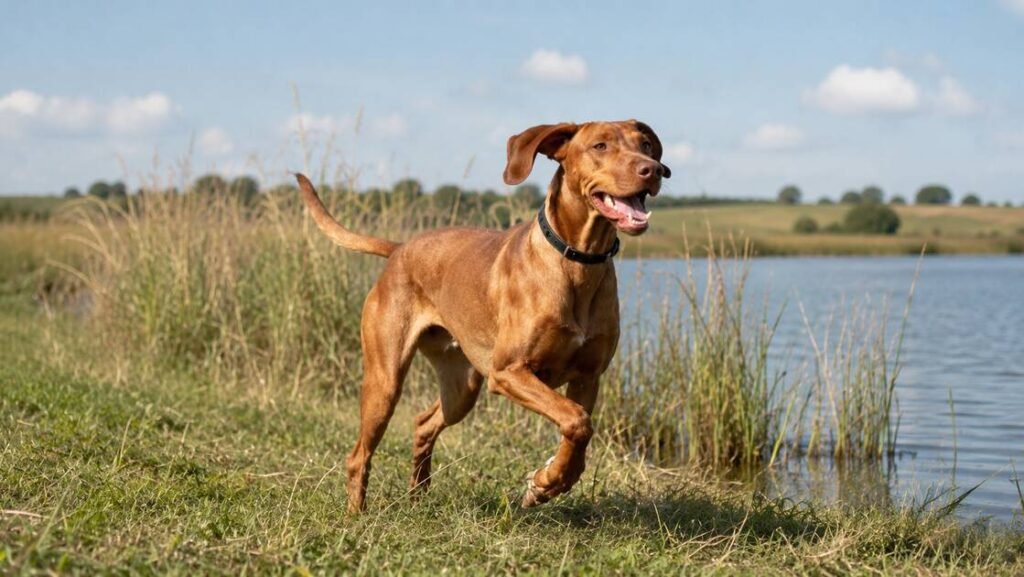
A Vizsla is a shorthaired Hungarian gundog bred to locate, point, and retrieve game on land and in water. The breed combines athletic movement with a sensitive, people-focused temperament.
The Fédération Cynologique Internationale classifies the Hungarian Short-Haired Pointer or Vizsla in Group 7 for pointing dogs. The breed’s country of origin is Hungary, and the standard includes a working trial. The American Kennel Club places the Vizsla in the Sporting Group.
The table summarizes the main breed attributes that affect daily ownership.
| Attribute | Vizsla profile |
| Origin | Hungary |
| Original function | Pointing and retrieving game |
| Male height | 22 to 24 inches |
| Female height | 21 to 23 inches |
| Male weight | 55 to 60 pounds |
| Female weight | 44 to 55 pounds |
| Life expectancy | 12 to 14 years |
| Coat | Short, smooth, dense, and close-lying |
| Standard colour | Golden rust or russet gold |
| Exercise level | More than 2 hours per day for many adults |
| Core temperament | Lively, gentle, affectionate, sensitive, and trainable |
The height, coat, color, and dentition figures come from official breed standards. These numbers describe a lean working dog, not a low-maintenance pet. Exercise and companionship take far more time than coat care.
Why is the Vizsla called an affectionate athlete?
The Vizsla earns that description because the breed combines field endurance with strong social attachment. Official standards describe the dog as lively, gentle, demonstratively affectionate, sensitive, and responsive to training.
Hunters selected Vizslas for close cooperation. The dog ranges ahead, reads scents, responds to direction, and returns with game. The breed standard also describes work across difficult terrain, forests, fields, and water.
That cooperation appears inside the home. Many Vizslas follow family members between rooms, seek body contact, and rest beside a person. The nickname “Velcro dog” refers to this persistent desire for proximity.
Close attachment does not equal a clinical behavior disorder. Separation-related distress involves signs such as repeated vocalization, escape attempts, drooling, house soiling, or panic during absence. A sociable dog may simply prefer company without showing distress.
Why did hunters develop the Vizsla?
Hunters developed the Vizsla as a close-working dog that could search, point, track, and retrieve. That history still shapes the breed’s movement, attention, and daily behavior.
Royal Kennel Club records link russet-gold Vizslas with falconry on Hungary’s central plains during the 14th century. The breed later survived severe population decline during the late 19th century and both World Wars. Hungarian refugees helped establish surviving bloodlines outside Hungary.
The breed standard describes a dog bred for hunting fur and feathers. It points and retrieves from land and water. That broad task explains why a modern Vizsla often enjoys scent work, field training, tracking, retrieving, agility, and long outdoor sessions.
What is the Vizsla personality like?
The Vizsla personality is affectionate, energetic, sensitive, and highly responsive to human attention. The breed often works best beside a person rather than independently at a distance.
Vizsla is lively, gentle-mannered, demonstratively affectionate, fearless, and trainable. Harsh handling can therefore create confusion, avoidance, or reduced confidence instead of better control.
Many owners call the breed a “Velcro dog.” The Vizsla Club of America uses this nickname because many Vizslas prefer close physical contact and follow family members through the home. Close attachment does not automatically equal separation anxiety. A dog with separation anxiety shows distress or panic during absence, while a clingy dog may simply prefer company.
How much time does a Vizsla require each day?
A realistic Vizsla care budget includes at least two hours of activity, plus feeding, training, grooming, supervision, and quiet interaction. Direct owner involvement can therefore reach three or four hours across a normal day.
The Royal Kennel Club lists more than two hours of daily exercise. The Vizsla Club of America advises owners to expect at least seven hours of active exercise each week and regular mental work.
The total changes with age, weather, health, and working level. Puppies require more supervision, while senior dogs often need lower intensity and additional recovery time.
A practical 120-minute activity plan
This sample divides two hours into manageable blocks. It provides an ownership framework rather than a veterinary prescription.
| Time block | Activity | Main purpose |
| 45 minutes | Brisk walking, hiking, or controlled running | Aerobic activity |
| 15 minutes | Recall, heelwork, or retrieve drills | Training under movement |
| 20 minutes | Scent search or tracking game | Mental work |
| 30 minutes | Evening walk or swimming | Second activity period |
| 10 minutes | Mat work and calm settling | Recovery and self-control |
The schedule totals 120 minutes. Some adult Vizslas require more, particularly dogs involved in field work, agility, canicross, or distance hiking. Heat, injury, age, and disease can reduce safe intensity.
How much exercise does a Vizsla need?
A healthy adult Vizsla commonly needs more than two hours of combined physical and mental activity each day. Age, fitness, health, weather, and working intensity change the exact amount.
A practical adult schedule can divide activity across the day:
- Start with 45 to 60 minutes of brisk walking, running, controlled off-leash movement, or field work.
- Add 10 to 15 minutes of scent work, retrieving, or obedience during the middle of the day.
- Finish with 45 to 60 minutes of walking, training, swimming, or structured play.
- Include short calm periods on a mat or bed after each active block.
This example reflects the breed’s published exercise range. It is not a fixed prescription. A working field dog, a senior, and a young household pet have different capacities.
How much exercise does a Vizsla puppy need?
A Vizsla puppy needs controlled play, exploration, social exposure, and short training sessions rather than forced endurance work. The American Kennel Club advises against long-distance running before physical maturity, which occurs around 18 to 24 months in this breed.
How do you exercise a Vizsla in hot weather?
Exercise a Vizsla during cooler hours, with water, shade, breaks, and close observation. Stop activity when excessive panting, drooling, unsteadiness, abnormal gum color, or collapse appears.
The American Veterinary Medical Association advises walking and running during cooler periods. The guidance also warns against hot surfaces and exercise during the hottest part of the day. These points matter in hot regions, including Pakistan, the Gulf, and southern Europe.
How do you train a Vizsla?
Train a Vizsla with reward-based methods, clear cues, short sessions, and daily repetition. Sensitive dogs learn faster when the handler rewards correct choices and prevents repeated mistakes.
The American Veterinary Society of Animal Behavior supports reward-based training for all dogs. Its position statement finds no evidence that aversive tools are necessary and links punishment-based methods with welfare and relationship costs.
Start with 6 practical skills:
- Teach recall around gradually harder distractions.
- Teach a settled cue for cafés, travel, guests, and home routines.
- Teach loose-leash walking before adolescent strength develops.
- Teach leaving it for wildlife, food, and household objects.
- Teach place training to separate rest from constant interaction.
- Teach handling tolerance for ears, feet, teeth, and veterinary checks.
Keep early sessions brief. End after a correct response rather than waiting for boredom. The breed’s official guidance describes Vizslas as intelligent, curious, sensitive, and responsive to consistent positive training.
Recall deserves special attention. A pointing dog detects movement and scent before you notice the trigger. Build recall on a long line, reward heavily, and increase freedom only after repeated success.
Can a Vizsla stay home alone?
A Vizsla can learn to stay alone, but long and sudden absences can create distress in poorly prepared dogs. Independence training belongs in puppyhood and continues through adolescence.
Begin with seconds, not hours. Ask the dog to settle behind a gate while you remain nearby. Increase distance and duration gradually. Use a safe resting area, a food toy, and a calm departure routine.
Watch for persistent barking, destructive escape attempts, drooling, house soiling, pacing, or refusal to eat during absence. These signs can indicate separation-related distress. A veterinarian or qualified veterinary behavior professional can rule out medical causes and create a treatment plan.
Crating does not cure panic. A crate works as a safety tool only after positive conditioning. A frightened dog can injure teeth, nails, or skin while trying to escape confinement.
How does Vizsla temperament affect training?
Vizsla temperament favors reward-based training because the breed combines sensitivity with quick learning. Clear cues and timely rewards provide information without adding fear or conflict.
The American Veterinary Society of Animal Behavior recommends reward-based methods for all dog training and behavior treatment. Its evidence review found no requirement for aversive tools or punishment-based techniques.
That advice fits the breed. The Vizsla Club of America describes Vizslas as intelligent, easily bored, sensitive, and persistent. Harsh handling can produce avoidance, resistance, or reduced engagement.
Prioritise these 7 skills:
- Name response: The dog turns toward you after hearing its name.
- Recall: The dog returns despite scent, movement, or distance.
- Loose-leash walking: The dog moves without constant pulling.
- Settle: The dog rests on a bed or mat.
- Leave it: The dog disengages from wildlife, food, or rubbish.
- Handling consent: The dog accepts checks of ears, feet, mouth, and skin.
- Alone-time skills: The dog remains calm during short, planned absences.
Train in short rounds. Three focused minutes can produce cleaner responses than twenty distracted minutes. End after success, then repeat the skill later in another setting.
Is a Vizsla a good family dog?
A Vizsla can suit an active family that provides supervision, training, exercise, and regular company. The breed’s enthusiasm can overwhelm very young children without household rules.
The Vizsla often lives socially with people and other dogs when early experiences remain positive. Individual prey drive still matters around small pets, because the breed was developed to find and pursue game.
First-time owners can succeed with a Vizsla, but the learning curve is steep. A quieter adult from a rescue or breeder rehoming programme may fit better than a high-drive puppy for some households.
The breed fits family life most successfully when adults divide exercise, training, feeding, and supervision duties. Relying on one family member often creates an unstable routine.
Can a Vizsla stay alone?
A Vizsla can learn to stay alone when owners build duration gradually and avoid sudden full-day absences. The breed’s social nature makes independence training a core household skill.
Start with a gate or separate resting space while you remain nearby. Add distance, close a door briefly, then return before distress appears. Increase duration or distance separately rather than changing both at once.
Seek veterinary behavior support when a dog repeatedly howls, damages exits, urinates, defecates, drools heavily, or injures itself. Medical problems can also cause house soiling, pacing, or sudden behavioral change.
A crate provides safe management after positive conditioning. Confinement does not treat panic. A distressed dog can damage teeth, nails, or skin while attempting to escape.
Is a Vizsla similar to an Australian cattle dog?
A Vizsla and an Australian cattle dog share high activity and trainability, but the breeds perform different work. The Vizsla points and retrieves game. The Australian cattle dog controls livestock.
The Australian cattle dog belongs among herding dog breeds. The breed is also called the Blue Heeler, Red Heeler, or Queensland Heeler. The American Kennel Club describes the breed as loyal, intelligent, tenacious, alert, and sometimes wary of strangers.
The term “blue heeler personality” does not describe a separate temperament type. Blue and red Australian cattle dogs belong to the same breed, and official guidance states that coat color does not create a temperament difference.
The Vizsla often shows greater social sensitivity and physical closeness. Both rank among active dog breeds, but their instincts differ.
| Trait | Vizsla | Australian cattle dog |
| Working category | Sporting or pointing gundog | Herding breed |
| Historic task | Find, point to, and retrieve the game | Drive and control cattle |
| Common challenge | Overexcitement and weak settling | Nipping and movement control |
| Social style | Often openly affectionate | Often more reserved and watchful |
| Coat | Short, solid golden rust | Short, blue or red speckled coat |
| Typical weight | About 44 to 60 pounds | About 35 to 50 pounds |
How do you feed a Vizsla and monitor body condition?
Feed a Vizsla according to age, body condition, activity, and veterinary guidance rather than a fixed cup amount. Two dogs at the same weight can use different amounts of energy.
The World Small Animal Veterinary Association uses a nine-point body condition score. Scores 4 and 5 represent an ideal condition, with palpable ribs, a visible waist, and an abdominal tuck. Scores 6 to 9 indicate increasing excess fat.
Check body condition every 2-4 weeks:
- Feel the ribs without pressing hard.
- View the waist from above.
- Check the abdominal tuck from the side.
- Record weight on the same scale.
- Adjust food after repeated trends, not one reading.
Training treats count toward daily calories. Use part of the dog’s measured meal for recall and scent games. Discuss unexplained weight loss, rapid gain, vomiting, diarrhea, reduced appetite, or exercise intolerance with a veterinarian.
A lean outline does not always mean underfeeding. Vizslas carry less bulk than many working breeds. Body condition score, muscle condition, weight trends, and veterinary examination provide better evidence than visual comparison alone.
What health tests matter before buying a Vizsla?
A responsible Vizsla breeder documents health screening before mating. Appearance, show awards, and athletic performance do not replace test results.
The Vizsla Club of America recommends screening breeding dogs for hips, elbows, eyes, thyroid function, cardiac conditions, and sebaceous adenitis. Eye screening repeats annually, while thyroid screening repeats every two years.
The Royal Kennel Club lists hip, elbow, and eye testing with gonioscopy. Buyers need records that match the breeder’s country and registration system.
| Health area | Record to request | What the record adds |
| Hips | OFA, PennHIP, or recognised national score | Evidence of hip evaluation |
| Elbows | Recognised elbow grade | Evidence of elbow evaluation |
| Eyes | Current specialist eye examination | Screening for inherited eye disease |
| Thyroid | Laboratory thyroid evaluation | Evidence of thyroid assessment |
| Heart | Cardiac examination | Evidence of cardiac assessment |
| Skin | Sebaceous adenitis evaluation where used | Additional breed-club screening |
A Canine Health Information Center number confirms that the required tests were completed and released publicly. The number does not mean every result was normal. Buyers must read each recorded result.
What does Vizsla research say about cancer and gonadectomy?
A 2014 retrospective cohort study analyzed owner-reported data for 2,505 Vizslas born between 1992 and 2008. Researchers found associations between gonadectomy and several cancers, storm fear, and some behavioral disorders.
The dataset included 267 dogs reported with three named cancers. These cases comprised 148 mast cell cancers, 73 hemangiosarcomas, and 46 lymphomas or lymphosarcomas.
The study relied on an anonymous online survey. The findings therefore show statistical associations rather than proof that surgery caused each outcome.
The researchers advised individual veterinary discussion because health, sex, intended use, and pregnancy risk affect the decision. The findings do not support one universal sterilization age for every Vizsla.
What is Vizsla inflammatory polymyopathy?
Vizsla inflammatory polymyopathy is a serious muscle disorder associated with swallowing difficulty, regurgitation, drooling, and loss of chewing muscle mass.
A published case series reviewed 369 medical records and identified 77 Vizslas with confirmed or probable disease. The mean onset occurred at 2.4 years. Dysphagia affected 90%, eating or drinking difficulty affected 90%, and drooling affected 87%.
Among 47 dogs with creatine kinase results, 87% had values above 190 international units per liter. 53% had values above 1,000 international units per liter. Mean survival after diagnosis was 3.9 years.
Those figures describe affected cases, not prevalence across the Vizsla population. Seek veterinary assessment when swallowing, chewing, drooling, or repeated regurgitation changes.
How do you feed a Vizsla without losing athletic condition?
Feed a Vizsla according to body condition, life stage, activity, reproductive status, and veterinary assessment. A fixed cup amount cannot account for differences in food energy or daily work.
Check condition every 2-4 weeks:
- Feel the ribs with light pressure.
- View the waist from above.
- Check the abdominal tuck from the side.
- Record weight on the same scale.
- Review treats and meal size.
- Adjust intake after a repeated trend.
Training food counts toward daily intake. Use part of the measured ration for recall, scent work, and calm behavior.
A lean outline does not automatically indicate underfeeding. Vizslas carry less bulk than many working breeds. Body condition score, muscle condition, weight trends, and veterinary examination provide better evidence than visual comparison.
How much grooming does a Vizsla require?
A Vizsla requires light coat care but regular nail, ear, dental, and skin checks. The short coat sheds and offers limited protection in cold weather.
Brush once each week to remove loose hair. Check the thin ears for redness, odor, discharge, or irritation. Trim nails before they alter foot placement or click heavily on the ground. The Royal Kennel Club lists weekly grooming, while the breed standard describes a short, dense, smooth coat.
The Vizsla’s low grooming burden can mislead buyers. Less brushing does not mean low maintenance. Exercise, training, companionship, and preventive care consume far more time than coat care.
How long does a Vizsla live?
Breed authorities place Vizsla life expectancy around 12 to 14 years. Individual lifespan varies with inherited disease, accidents, body condition, preventive care, and access to veterinary treatment.
A 2024 Scientific Reports study analyzed 584,734 dogs in the United Kingdom and found a 12.5-year median lifespan across the full population. Size, sex, facial structure, and breed lineage affected longevity, so the population median cannot predict one Vizsla’s lifespan.
The American Animal Hospital Association defines the senior stage as the last 25% of the estimated lifespan. Under that framework, a Vizsla with a 12 to 14-year expected lifespan enters its senior period at roughly 9 to 10.5 years.
Senior care starts before visible frailty. Record weight, appetite, thirst, mobility, behavior, skin changes, and new lumps between veterinary visits.
Is a Vizsla right for a first-time owner?
A committed first-time owner can manage a Vizsla, but the breed gives little room for a passive routine. Daily exercise and training remain part of ownership for more than a decade.
A suitable household can answer yes to most of these questions:
- Can you protect at least two hours for daily activity?
- Can you train recall and calm behavior every week?
- Can you arrange care during long workdays?
- Can you manage a hunting dog around wildlife?
- Can you fund health screening, routine care, and emergencies?
- Can you tolerate shedding, mud, wet feet, and close contact?
- Can you maintain the routine during heat, winter, illness, and busy periods?
A different breed may fit better when several answers are no. Breed selection works best when daily behavior matches the owner’s routine, not just the owner’s preferred appearance.
A Vizsla Needs More Than an Active Owner
A Vizsla can bring warmth, energy, and remarkable companionship into the right home. Its short coat and graceful appearance may suggest an easy breed, but daily life tells a different story. This dog needs room to move, regular training, meaningful interaction, and enough quiet structure to switch off after activity.
The best match is not simply someone who enjoys an occasional run. It is a household prepared to maintain the routine through busy weeks, bad weather, changing work schedules, and every stage of the dog’s life. Exercise builds fitness, but patience, recall training, calm-time practice, preventive healthcare, and dependable companionship shape the dog that lives inside the home.
Among active dog breeds, the Vizsla stands out for its close attachment and sensitive working style. It differs from the Australian cattle dog and other herding dog breeds, which were developed to control livestock through pressure, movement, and persistence. Choosing between them should come down to everyday compatibility rather than color, popularity, or appearance. A well-matched Vizsla becomes an affectionate partner for years. A poorly matched one spends those same years struggling against a routine that never meets its needs.
Can a Vizsla live happily without a large garden?
Yes, provided it receives substantial outdoor exercise, mental work, training, and regular opportunities to move beyond the home.
What helps a Vizsla relax after exercise?
A predictable cool-down routine, such as water, a quiet resting place, a chew, and short mat training, helps the dog move from activity to rest.
Why does a Vizsla often follow one person everywhere?
The breed was developed to cooperate closely with a handler, so physical proximity and frequent social contact remain natural parts of its behavior.
How can owners tell when a Vizsla needs mental stimulation?
Restlessness, repeated attention-seeking, destructive behavior, poor settling, and obsessive play can signal a need for scent work, problem-solving, or focused training.
How does a Vizsla differ from an Australian cattle dog at home?
A Vizsla is generally more openly affectionate and people-focused, while the Blue Heeler personality is often more watchful, independent, and inclined to control movement.