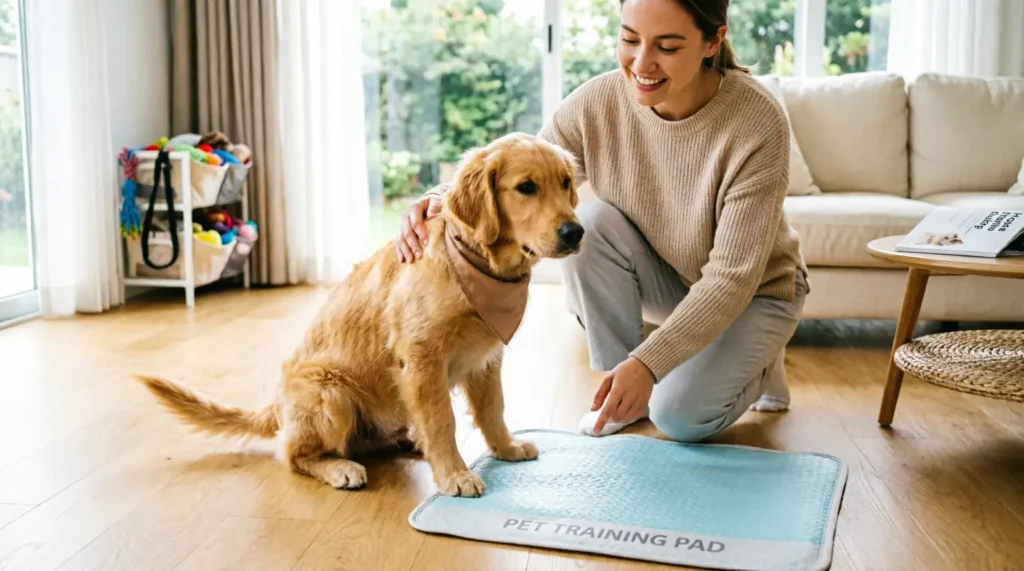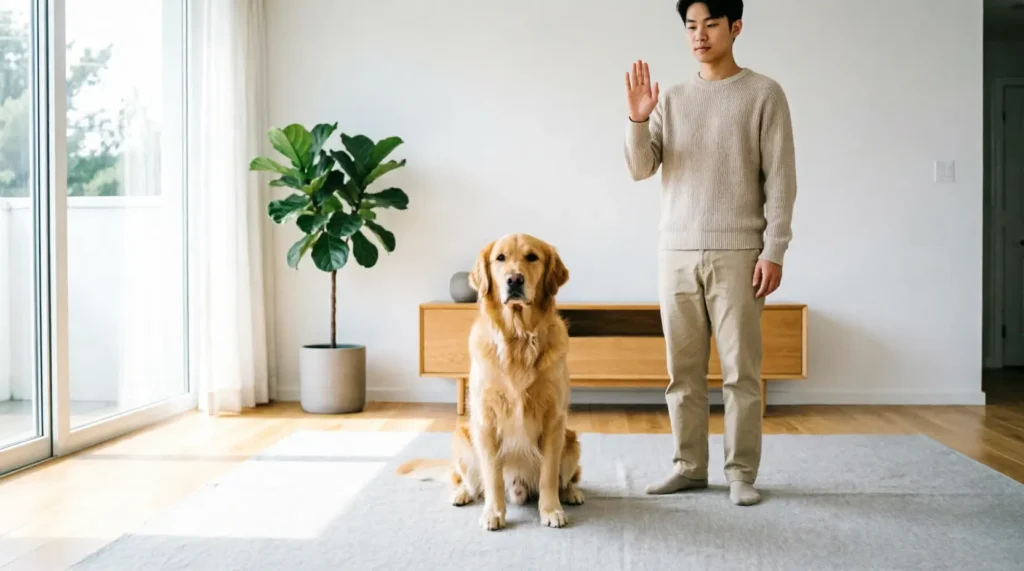


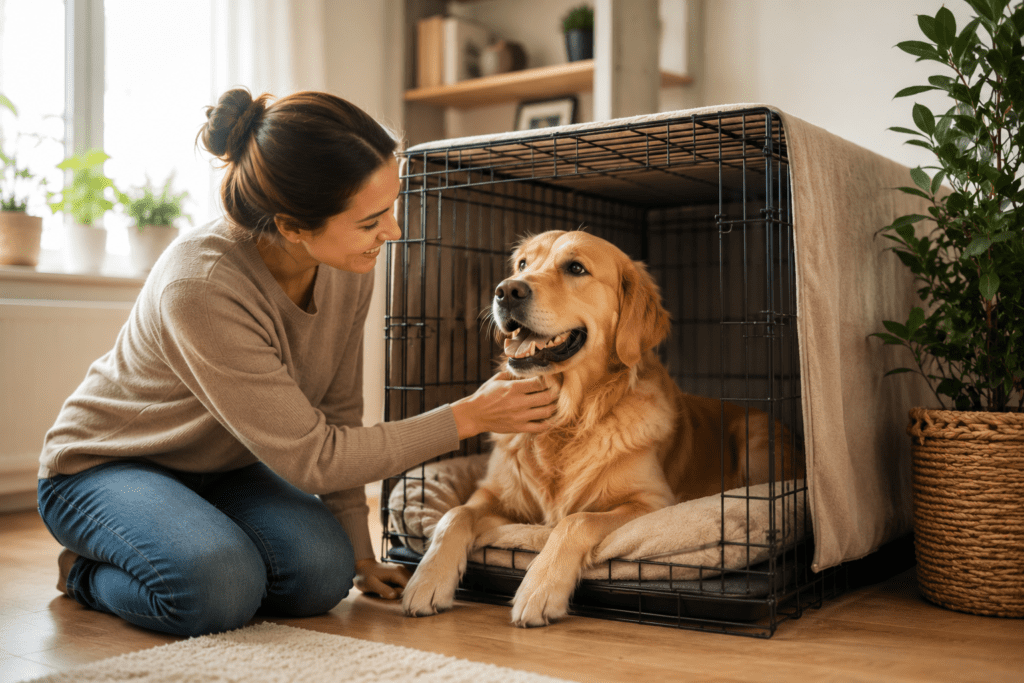
Kennel training tips for a calm and happy dog work when your dog links the kennel with safety, food, rest, and predictable release. Force-free crate training uses rewards, short sessions, gradual duration, and calm routines instead of fear, punishment, or pressure.
Kennel training helps your dog rest, travel, recover, sleep, and stay safe during unsupervised moments. The method matters. A crate can become a secure den, or it can become a stress trigger. Your training choices decide that outcome.
This guide explains how to kennel train a puppy or adult dog without fear or force. You get practical crate training steps, data-backed behavior guidance, safety limits, troubleshooting tables, and signs that your dog needs professional help.
What is kennel training?
Kennel training is the process of teaching your dog to enter, stay, rest, and exit a crate or kennel calmly through positive reinforcement.
A kennel can mean a wire crate, plastic travel crate, soft-sided crate, recovery crate, boarding kennel, or indoor confinement pen. In household search terms, “kennel training” and “crate training” often describe the same skill.
The goal is not long confinement. The goal is calm, short-term management. Crating or planned confinement is a management tool for times when your dog cannot receive supervision or needs quiet rest. Extended confinement is not healthy for animals.
Your dog learns the kennel’s meaning through repetition. Food, chew toys, soft bedding, calm praise, and predictable release make the crate emotionally safe.
Why does kennel training matter now?
Kennel training matters because millions of dogs live in homes where crat
es support house training, travel, boarding, veterinary care, and daily routines.
The population of pet dogs in the United States has grown since 1996, from an estimated 52.9 million dogs to 87.3 million in 2025.
These numbers show why crate training advice affects more than puppies. It affects rescue dogs, adult dogs, senior dogs, veterinary patients, boarding clients, and pet-care staff.
Behavior data also supports careful training. A Scientific Reports study of 13,700 Finnish pet dogs found that 72.5% had some form of highly problematic behavior. Noise sensitivity affected 32%, fearfulness affected 29%, aggression affected 14%, and separation-related behavior affected 5%.
That data does not mean every dog has crate anxiety. It means fear, sensitivity, and stress-related behavior are common enough to make gentle kennel training the safer default.
Why does force-free kennel training work?
Force-free kennel training works because positive reinforcement increases wanted behavior without adding fear.
Positive reinforcement is adding something pleasant after a behavior, so that the behavior increases in the future. Reward timing, consistency, and a clear relationship between behavior and reward make reinforcement effective.
For kennel training, the wanted behavior is clear. Your dog steps into the crate, stays relaxed, chews calmly, lies down, or waits quietly. You reward that behavior with food, praise, a safe chew, or release.
This method protects crate confidence. Current scientific evidence supports only reward-based training for all dog training, including behavior problems. Aversive training damages animal welfare and the human-animal bond.
The practical meaning is simple. Reward the behavior you want repeated. Do not make the kennel predict fear.
What does the evidence say about fear and force?
Fear and force create welfare risks and do not lead to better training results.
There is no evidence that aversive methods are more effective than reward-based methods in any context. The organization advises against aversive methods in animal training and behavior treatment.
A Frontiers in Veterinary Science study tested 63 dogs with off-lead behavior problems. The dogs were split into 3 groups of 21. Each dog received up to 150 minutes of training across 5 days. The positive reinforcement group achieved better responses to “Sit” and “Come” after a single instruction and showed shorter response latency than the electronic-collar group.
This evidence matters for kennel training because many owners still believe pressure creates faster results. The data support a different conclusion. Reward-based training can be effective without adding avoidable welfare risk.
What are the best kennel training tips for a calm and happy dog?
The best kennel training tips are correct crate size, voluntary entry, food pairing, short closed-door sessions, calm release, and gradual duration.
Use this table as your quick training map. Each row connects one kennel training action with the behavior result and the risk it reduces.
| Kennel training tip | What it teaches your dog | What to consider |
| Choose the correct crate size | The crate fits a normal posture | Your dog can stand, turn, and stretch in a suitable crate |
| Feed meals in the crate | The crate predicts food and safety | Meals must be near and then inside the crate to create a pleasant association |
| Start with the door open | Entry remains voluntary | Some dogs need a few minutes, while others need several days. |
| Close the door during eating | Door closure becomes normal | Open the door after the meal at first, then add minutes |
| Build to 30 calm minutes | Absence training starts after comfort | Use about 30 minutes of calm crating as the threshold for short-absence practice |
| Avoid excessive crating | The crate stays healthy | Gives 4 to 5 daytime hours as a general upper guideline for adult dogs |
| Watch anxiety signs | Training pace matches welfare | Canine anxiety traits are common, with 32% noise sensitivity in one 13,700-dog study |
The strongest pattern is consistency. Your dog learns faster when each crate session has the same emotional sequence: enter, receive reward, rest, exit calmly.
How do you choose the right kennel?
Choose a kennel that lets your dog stand, turn around, lie down, and stretch without struggling.
Your dog needs enough room for a normal posture. A crate that is too small creates physical discomfort. A crate that is too large can weaken house training for some puppies because one end may become a toilet area.
Crate training works best when you associate the crate with positive and relaxing experiences, including treats, chew toys, bedding, feeding, scheduled rest, and sleep.
Skipping the sizing step creates a training problem before training starts. A dog cannot feel calm in a space that blocks normal movement.
How do you introduce the kennel without force?
Introduce the kennel by leaving the door open and rewarding every voluntary step toward the crate.
Your first goal is curiosity, not confinement. Put the crate in a room where your family spends time. Humane World recommends placing the crate in a shared living area, adding bedding, securing the door open, and letting your dog explore at their own pace.
If a dog refuses to go fully inside at first, do not force entry. This stage may take minutes or several days.
That timeframe gives you a useful benchmark. A slow start is not failure. It is data about your dog’s comfort level.
How do you build a positive crate association?
Build a positive crate association by pairing the crate with meals, food puzzles, safe chews, and quiet rest.
Food has training value because it creates repeated, predictable crate exposure. Feed meals inside the crate using an interactive toy or a slow-feeding bowl. Edible chews, food-stuffed toys, safe chew toys, and periodic rewards for quiet behavior.
The crate becomes valuable when the best low-arousal rewards happen there. Your dog starts entering the kennel because the kennel predicts good outcomes.
Avoid high-excitement play inside the crate. The crate works better as a rest location than an activity arena.
How long can a dog stay in a kennel?
A dog can stay in a kennel only as long as age, bladder control, health, comfort, and training history allow.
Puppies need more frequent breaks, and the “age in months plus one hour” rule is a general puppy limit.
Use this table as a practical planning guide, not a medical rule. Health conditions, medications, anxiety, water intake, and age change the safe duration.
| Dog type | Practical crate duration focus | Training note |
| Young puppy | Very short sessions plus frequent toilet breaks | Use the age-in-months-plus-one-hour guideline as a ceiling, not a goal |
| Adolescent dog | Short rest periods after exercise | Add duration only after calm behavior. |
| Adult dog | Often up to 4 to 5 daytime hours as a general limit | Provide exercise, social contact, and toilet access |
| Senior dog | Shorter, comfort-led sessions | Arthritis, urgency, and medication can reduce tolerance. |
| Anxious dog | Seconds to minutes at first | Build confidence before absence. |
The safe number is not the longest possible duration. The safe number is the duration your dog can complete without distress, soiling, or physical discomfort.
What does a force-free 14-day kennel training plan look like?
A force-free kennel training plan builds one skill at a time: entry, eating, door closure, distance, absence, and routine use.
Use this plan as a flexible framework. Repeat any stage until your dog stays calm.
| Day range | Goal | Session structure | Success sign |
| Days 1 to 2 | Open-door exploration | Treats near the crate, then inside the crate | The dog approaches without hesitation |
| Days 3 to 4 | Full-body entry | Cue, toss treat, reward 4 paws inside | The dog enters voluntarily |
| Days 5 to 6 | Meal pairing | Feed meals inside with the door open | The dog eats inside comfortably |
| Days 7 to 8 | Brief door closure | Close the door for 5 to 30 seconds during chewing | The dog keeps eating |
| Days 9 to 10 | Short calm stay | Sit near the crate for 5 to 10 minutes | The dog settles or lies down |
| Days 11 to 12 | Distance practice | Step away, return, reward calm behavior | The dog stays relaxed |
| Days 13 to 14 | Short absence | Leave room for seconds to minutes | The dog remains quiet and loose-bodied |
One variable at a time creates cleaner learning. Do not increase duration, distance, and absence in the same session.
How do you stop barking and whining in the kennel?
Stop kennel barking by identifying the cause, then changing the setup, timing, or training level.
Whining can mean toilet need, fear, loneliness, frustration, over-tiredness, or learned attention-seeking. Nighttime whining may reflect either a desire to exit the crate or a need to eliminate. The source also states that you never punish whining.
Use this troubleshooting table.
| Sign in the kennel | Likely cause | Better response |
| Whining after a nap | Toilet need | Take your dog outside for a quiet toilet trip. |
| Barking when you leave | Absence distress | Train distance in seconds before minutes. |
| Pawing at the door | Duration too long | Return to shorter sessions. |
| Refusing food | Fear or stress | Open the door and restart at easier steps. |
| Drooling or escape attempts | Panic risk | Stop crating and contact a veterinarian or behavior specialist. |
| Barking at household noise | Location sensitivity | Move the crate to a calmer area or add visual screening. |
Exercise and a chance to eliminate before training sessions reduce barking caused by energy or physical discomfort.
Do not treat all barking as defiance. Barking is information. Your job is to identify the variable your dog cannot handle yet.
How do you use kennel training for house training?
Use kennel training for house training by combining crate naps, scheduled toilet breaks, supervision, and immediate outdoor rewards.
Crate training supports house training because many dogs avoid eliminating in their sleeping area. Crate training helps teach elimination control, and recommends taking your dog to the designated toilet area immediately after crate release.
The crate does not house train your puppy by itself. The schedule teaches the pattern. The reward confirms the correct location.
How do you prevent crate anxiety?
Prevent crate anxiety by keeping early sessions short, voluntary, food-based, and socially supported.
A dog with crate anxiety may freeze, drool, pant, tremble, refuse food, bark continuously, dig, bend crate bars, or injure teeth and nails. That behavior signals panic, not stubbornness.
Canine anxiety data explains why sensitive training matters. In the Scientific Reports study of 13,700 dogs, noise sensitivity affected 32%, fear affected 29%, fear of fireworks affected 26%, inattention affected 20%, hyperactivity or impulsivity affected 15%, compulsive behavior affected 16%, aggression affected 14%, and separation-related behavior affected 5%.
Do not attempt to resolve separation anxiety, as dogs may injure themselves during escape attempts. Counterconditioning, desensitization, and professional behavior help for separation anxiety.
How do you kennel train an adult dog?
Kennel train an adult dog by treating the crate as a new skill, even if the dog has used a crate before.
Adult dogs bring history. A rescue dog may connect crates with shelter stress. A boarding dog may connect kennels with isolation. A veterinary patient may connect crates with pain, medication, or handling.
Start with low pressure. Keep the door open. Feed meals near the entrance. Move the bowl deeper only when your dog enters comfortably. Use short sessions after exercise and a toilet break.
Do not assume an adult dog resists the crate out of dominance. Fear, novelty, pain, and past learning explain many crate problems.
How do you kennel train a puppy at night?
Kennel train a puppy at night by placing the crate near you, giving a toilet break before bed, and responding calmly to genuine toilet signals.
Puppies often need nighttime toilet breaks. Keep a puppy’s crate in your bedroom or nearby at first, so you can hear the puppy when elimination is needed.
The crate location matters. A puppy that feels abandoned may cry from social isolation, not only from bladder pressure.
How do you use the kennel during guests, cleaning, or deliveries?
Use the kennel as a planned calm station before the exciting event starts.
Dogs bark, jump, grab food, or crowd doors when the environment becomes too stimulating. A kennel can prevent rehearsal of those behaviors. It works only when the crate already predicts good things.
Crating a dog with an interactive toy when guests arrive is different from crating the dog after unwanted behavior. The second approach risks turning the crate into punishment.
Prepare the kennel 5 to 10 minutes before guests arrive. Add a chew, cue entry, reward calm posture, and release after the first excitement passes.
This strategy works for owners, groomers, boarding teams, and veterinary staff.
What are the biggest kennel training mistakes?
The biggest kennel training mistakes are forced entry, rushed duration, punishment use, excessive confinement, and ignoring anxiety signs.
Reward-based training is the recommended method for dog training and behavior treatment, while aversive methods damage welfare and the human-animal bond.
Mistakes matter because the crate’s emotional meaning is cumulative. Each forced session makes the next session harder.
When does your dog need professional help?
Your dog needs professional help when crate training causes panic, injury attempts, persistent food refusal, aggression, or severe distress.
Serious behavior problems such as fear, aggression, separation anxiety, noise phobia, and compulsive disorders need veterinary evaluation. Medical causes also need exclusion before behavior treatment proceeds.
Positive reinforcement training increases communication and predictability in a dog’s environment as part of behavior treatment.
Contact a veterinarian, veterinary behaviorist, or certified reward-based trainer if you see:
Professional support protects your dog and your household. It also prevents a manageable crate problem from becoming a broader anxiety pattern.
How can pet-care businesses use force-free kennel training?
Pet-care businesses can use force-free kennel training through intake questions, reward-based handling, stress scoring, and escalation rules.
This matters for boarding kennels, dog daycares, grooming salons, veterinary clinics, shelters, rescues, and trainers. These businesses handle dogs with unknown crate histories and varied stress thresholds.
The business case is practical. Clear crate handling reduces inconsistent staff behavior, bite risk, customer complaints, and welfare incidents.
Final takeaways
Kennel training tips for a calm and happy dog work when your dog experiences the kennel as a safe, predictable resting place. The strongest method is simple: correct crate size, voluntary entry, food pairing, short sessions, gradual duration, and calm release.
The evidence supports that approach. Use reward-based training. A 63-dog training study found positive reinforcement effective without the welfare risks linked to electronic-collar training. Canine anxiety data also show that fear-related traits are common, which makes gentle training more than a preference. It is a welfare-informed choice.
A calm dog does not come from a locked door. A calm dog comes from a crate that predicts safety, rest, food, and trust.
Frequently Asked Questions
Is kennel training good for dogs ?
Kennel training is good for many dogs when the crate is correctly sized, reward-based, time-limited, and never used for punishment.
How long does kennel training take ?
Kennel training may take minutes, days, weeks, or longer, depending on age, crate history, anxiety level, and training consistency. Early crate introduction may take a few minutes or several days.
At what age is best for kennel training ?
Kennel training can start in puppyhood, but adult dogs can learn it through the same reward-based steps.
Is it okay to let a puppy cry in a crate ?
Puppy crying needs assessment because the puppy may need a toilet break, comfort, or a slower training step. Puppies often need nighttime elimination breaks and that whining must never receive punishment.
Can a crate help with separation anxiety ?
A crate does not solve separation anxiety. A crate may prevent destruction, but a dog with separation anxiety can get injured while trying to escape.