

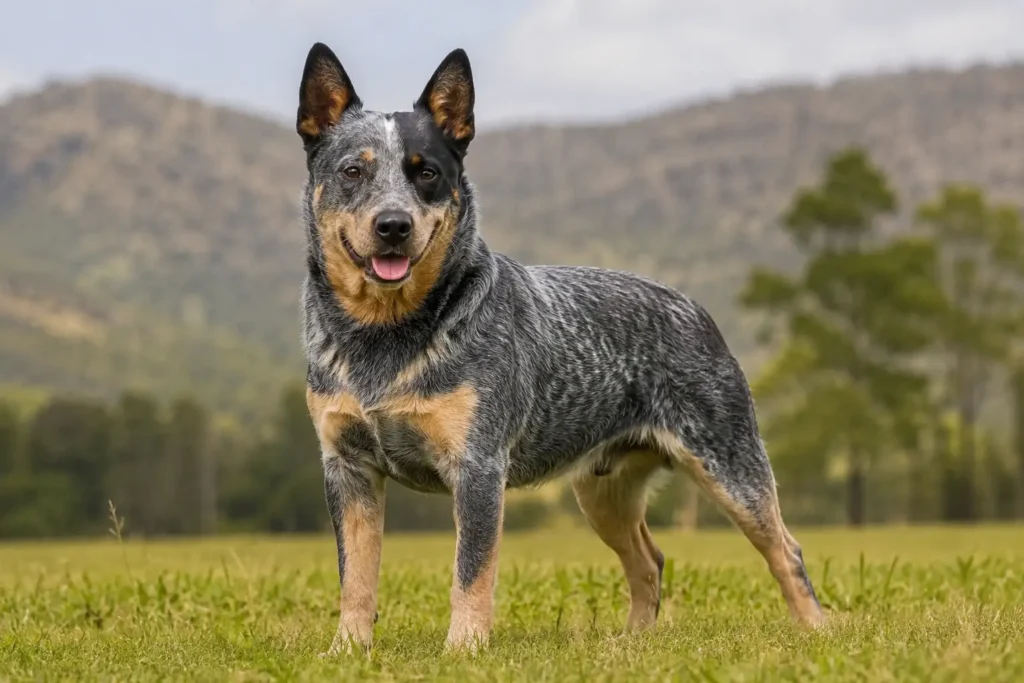
The Australian Cattle Dog may look compact, but its loyalty, alertness, and energy can challenge an unprepared household. Bred to control resistant livestock across demanding terrain, this breed carries strong stamina, sharp awareness, and persistent working instincts into modern family life. These traits explain why the Australian Cattle Dog often follows one person closely, reacts quickly to movement, and needs more than a daily walk to stay settled.
This guide examines:
- The working origins behind the Blue Heeler personality
- How the breed compares with other herding dog breeds
- Why it ranks among the most active dog breeds
It also covers exercise needs, heel-nipping, reward-based training, health factors, and the household routines that help this intelligent working dog thrive.
What explains the Australian Cattle Dog’s personality?
The Australian Cattle Dog combines close handler attention, environmental awareness, physical stamina, and persistent task behavior. Cattle work rewarded dogs that stayed near the stockman, noticed movement early, tolerated pressure, and kept working when cattle resisted.
The official breed standard describes the Australian Cattle Dog as alert, intelligent, watchful, courageous, trustworthy, and naturally suspicious of strangers. The standard identifies cattle control as the breed’s original function and emphasizes stamina, strength, and working ability.
The following table connects five breed traits with their working origins and household expression.
| Trait | Original working value | Common household expression | Main management goal |
| Loyalty | Maintained cooperation with one handler | Following one person, checking location, fast response to familiar cues | Build independence alongside attachment |
| Alertness | Detected livestock movement and approaching threats | Watching doors, reacting to visitors, scanning outdoor spaces | Reward observation without escalation |
| Energy | Covered ground and worked for long periods | Restlessness, intense play, demand for activity | Combine physical work with thinking tasks |
| Herding drive | Controlled cattle through movement and heel pressure | Chasing, circling, blocking, or nipping moving people | Redirect the motor pattern into safe games |
| Tenacity | Continued working when cattle resisted | Persistence during play, training, or unwanted behavior | Teach stopping cues and calm recovery |
The same trait can help or hinder. Loyalty can support recall or become constant shadowing. Alertness can support safe observation or repeated barking when the dog lacks guidance.
Read More : What is force-free dog training? A step-by-step guide for new dog owners
How did cattle work shape the Australian Cattle Dog?
Cattle work shaped the Australian Cattle Dog through selection for stamina, physical confidence, independent judgment, and cooperation. Early Australian conditions required a dog that could move difficult cattle across wide land and restricted yards.
The Fédération Cynologique Internationale identifies Australia as the breed’s origin and cattle work as its purpose. Its standard explains that early imported working dogs lacked enough endurance for local conditions and demanding livestock.
Physical structure supported that job. The standard sets male height at 46 to 51 centimeters and female height at 43 to 48 centimeters. It also calls for strong bones, muscular hindquarters, compact feet, and efficient movement.
The Australian Cattle Dog works differently from many herding dog breeds. A heeler moves behind cattle and applies pressure near the lower legs when necessary.
That close-contact role explains familiar behaviors:
- Heel targeting: Fast feet attract attention.
- Body blocking: The dog steps across a path to influence direction.
- Movement scanning: The dog notices runners, bicycles, animals, and doors quickly.
- Rapid re-engagement: A short pause may not end the task.
- Handler checking: The dog looks back for information or another cue.
Research on Australian stock dogs adds useful context. A national survey covered 4,027 dogs from 812 owners and reported a mean working success rate of 80%. Breed, housing, trial participation, acquisition age, training tools, treatment spending, and owner conscientiousness related to reported success.
The result matters in pet homes. Genetics create a starting point, while handling and environment influence how working traits develop.
Related Article : Puppy potty training in 7 days: A day-by-day plan for fewer accidents
Why is the Australian Cattle Dog so loyal?
The Australian Cattle Dog is loyal because stock work rewarded sustained attention to a familiar handler. A dog that ignored direction could scatter cattle, miss a route change, or create danger.
This loyalty often looks selective rather than broadly social. Your dog may reserve intense attention for one person while remaining neutral or cautious around visitors. The breed standard recognizes devotion to work alongside a naturally watchful response to unfamiliar people.
Common signs include:
- Following you between rooms
- Resting where the dog can watch you
- Checking your position during walks
- Responding quickly to familiar routines
- Bringing toys to the same person
Loyalty does not equal obedience. A loyal dog can remain independent or choose movement over a weak cue. Cattle work required cooperation and judgment.
Large-scale genetics research supports a careful interpretation. A 2022 Science study used 18,385 owner surveys and genetic data from 2,155 dogs. Researchers found 11 behavior-associated genetic regions, but breed explained only about 9% of individual behavioral variation.
Therefore, “loyal Australian Cattle Dog” describes a tendency, not a guaranteed personality. Social experience, reinforcement history, health, routine, and individual genetics still matter.
Build balanced attachment through 4 practices:
- Reward rest on a bed several meters away.
- Provide food puzzles without constant interaction.
- Practice brief, calm departures.
- Let several family members deliver cues and enrichment.
These habits preserve the bond while reducing dependence on one person.
Why is the Australian Cattle Dog so alert?
The Australian Cattle Dog is alert because cattle control required immediate detection of movement, obstacles, strangers, and changes in the herd. Delayed observation could let cattle split or challenge the dog.
The official standard links the breed’s eyes, ears, and expression with alertness. It describes dark, oval eyes that convey intelligence and pricked ears that react sensitively to activity.
At home, alertness often appears before barking. The dog may freeze, close its mouth, turn its ears, shift weight, or stare. These early signals provide a better training moment.
Alertness, fear, aggression, and arousal are different:
| Term | Meaning | Typical signs |
| Alertness | Focus on a changing stimulus | Orientation, scanning, brief pause |
| Fear | Response to perceived threat | Retreat, lowered posture, avoidance |
| Aggression | Behavior that increases distance or controls access | Growling, lunging, snapping |
| Arousal | Increased physical and mental activation | Panting, vocalizing, reduced cue response |
Hearing status also matters. A study used brainstem auditory evoked response testing in 899 Australian Cattle dogs. Deafness affected 10.8%, including 7.5% with one affected ear and 3.3% with both ears affected.
Unilateral deafness can look like inattention because the dog may respond differently according to direction. Brainstem auditory evoked response testing provides an objective result and forms part of breed health screening.
Manage alertness through a simple sequence:
- Let the dog notice the trigger.
- Mark the first calm glance.
- Cue a turn toward you.
- Reward disengagement.
- Increase distance when the dog cannot respond.
This sequence teaches observation followed by recovery.
Why is the Australian Cattle Dog so energetic?
The Australian Cattle Dog is energetic because breeders selected it for sustained movement and repeated work. The breed’s energy includes physical output, mental persistence, and readiness to restart a task.
This distinction separates work drive from simple excitement. A dog can run for an hour and still pace indoors because running requires little decision-making. Herding work includes route selection, pressure control, response inhibition, and attention to moving targets.
Research across 4,436 dogs found that dogs receiving less than one hour of daily exercise had higher odds of repetitive behavior than dogs in higher exercise categories. Odds ratios reached:
- 1.53 against the one-to-two-hour group
- 1.85 against the two- to three-hour group
- 2.01 against the group of more than three hours
The study reported an association, not an Australian Cattle Dog exercise prescription.
More mileage does not solve every behavior. Age, joint health, temperature, surface, fitness, arousal, and recovery change the safe activity load.
Among active dog breeds, the Australian Cattle Dog often stays interested in household movement. Running children, bicycles, livestock, cats, and wheeled equipment can trigger orientation or pursuit. Training and management determine how the dog expresses that herding pattern.
Read More : Nose work training for dogs: Beginner scent games for anxious, bored, and active dogs
What does the Blue Heeler personality look like at home?
The Blue Heeler personality often appears as intense observation, selective affection, fast learning, movement control, and persistence. “Blue Heeler” and “Australian Cattle Dog” name the same breed, while “red heeler” describes the red-speckled color variety.
You may notice the dog lying quietly while tracking every person in the room. The dog may rise when someone changes direction, approaches a door, or starts an established routine.
Herding behavior may appear through circling, heel targeting, body blocking, or chasing. Veterinary breed guidance notes that the Australian Cattle Dog’s herding instinct can extend to people through heel nipping.
Do not treat every nip as a dominance problem. Identify the trigger. Fast movement, overarousal, frustration, fatigue, and weak impulse control create different training plans.
Use this 4-step response:
- Stop the movement that triggered pursuit.
- Create distance without grabbing or shouting.
- Cue a known behavior, such as “touch,” “place,” or “find it.”
- Reward calm disengagement from the moving target.
An adult must supervise interactions with children, separate the dog during chaotic play, and prevent rehearsal of chasing or heel contact.
How much activity does an Australian Cattle Dog require?
An Australian Cattle Dog requires daily physical activity, problem-solving, training, and rest. No universal number fits every dog because age, health, climate, work history, and intensity change the actual load.
A practical adult routine uses 4 activity blocks:
- Movement: Brisk walking, hiking, controlled running, or structured fetch
- Search work: Scent trails, hidden food, object searches, or tracking games
- Skill work: Recall, directional cues, cooperative handling, or heelwork
- Recovery: Chewing, mat work, quiet enrichment, and uninterrupted sleep
Here is an example for a healthy adult pet. The table provides a planning framework rather than medical advice.
| Time | Activity | Duration | Main purpose |
| Morning | Brisk walk with cue practice | 30 to 45 minutes | Movement and attention |
| Midday | Food search or puzzle task | 10 to 15 minutes | Scent use and problem-solving |
| Evening | Hiking, controlled fetch, or agility foundations | 30 to 60 minutes | Physical work and drive control |
| Later evening | Mat settle or chew activity | 10 to 20 minutes | Arousal reduction |
Quality changes the effect. 10 minutes of directional work can require more concentration than repeated ball throwing. Continuous high-speed fetch can increase arousal when the dog never practices stopping.
Puppies require a different plan. Veterinary exercise guidance recommends matching activity to age and physical development. It also advises against routine hard-surface running before full growth.
Watch for slower responses, repeated attempts to sit, unusual posture, irritability, or trouble settling after activity. Those signs can indicate excessive workload or physical discomfort.
Also Read More : How to House Train an Adult Dog That Keeps Having Accidents
Which training methods fit this herding breed?
Reward-based training fits the Australian Cattle Dog because it gives clear information without adding conflict. These dogs repeat behaviors that produce access to movement, food, toys, or attention.
Prioritize 6 skills:
- Recall: Return despite movement or distraction.
- Place: Remain on a defined mat or bed.
- Leave it: Disengage from pets, food, or moving objects.
- Drop: Release toys without conflict.
- Settle: Lower activity after excitement.
- Cooperative handling: Accept examination of feet, ears, mouth, and body.
Use two to four sessions of five to ten minutes rather than one long lesson. Practice the same skills during walks, feeding, visitor arrivals, and play.
Avoid physical intimidation, leash jerks, shock collars, and forced exposure. Veterinary behavior guidance supports reward-based methods and advises against aversive techniques because they can harm welfare and the human-animal bond.
Training also requires an off switch. An Australian Cattle Dog that performs increasingly intense exercise without calm practice can gain fitness without gaining self-control. Place work, food searches, scent games, and controlled pauses teach the dog how to leave an active state.
Also Read : 12 German Hunting Dog Breeds: Tracking, Pointing & Retrieving Guide
Can health change loyalty, alertness, or energy?
Health can change all three traits because pain, deafness, vision loss, and neurological disease alter movement, attention, sleep, and tolerance. A sudden personality change requires veterinary assessment before a training explanation.
The breed’s screening programme includes:
- Hips
- Elbows
- An eye examination
- Progressive retinal atrophy DNA testing
- Brainstem auditory evoked response testing
- Primary lens luxation DNA testing
Optional tests cover patellar, cardiac, and additional retinal concerns.
Hip data provide one quantified example. The Royal Kennel Club’s 2024 report included 134 Australian Cattle Dogs scored during the previous 15 years. The 15-year mean was 11.9, the median was 11, and the five-year median was 9.
A hip score is not a disease rate. It records radiographic joint features within the tested population.
Vision or hearing loss can make an alert dog appear stubborn. Joint pain can reduce energy or increase irritability. Medical investigation prevents punishment for behavior linked to discomfort.
Is an Australian Cattle Dog suitable for your household?
An Australian Cattle Dog suits a household that provides structured activity, clear boundaries, controlled social exposure, and daily contact. A large garden alone does not create purposeful work.
This breed often fits owners who enjoy hiking, scent work, agility, obedience, farm tasks, or regular outdoor activity. The dog can live without livestock when you replace cattle work with predictable jobs.
Family suitability depends on management. Homes with running children require gates, leashes, place training, and adult supervision because movement can trigger herding behavior.
Apartment living depends on routine rather than floor area alone. An apartment can work with suitable outlets and quiet-behavior practices. A rural property can fail when the dog stays alone without guidance.
First-time ownership remains possible, but early access to a qualified reward-based trainer can prevent nipping, guarding, chasing, and visitor problems from becoming established.
Before choosing this breed, assess 5 household factors:
- Available time: Count the hours you can dedicate to activity and training.
- Activity preference: Choose tasks you can repeat throughout the year.
- Child supervision: Separate the dog during fast or unpredictable play.
- Pet management: Control access to cats, smaller animals, and unfamiliar dogs.
- Training access: Locate a qualified reward-based professional before problems develop.
An honest assessment gives you more useful information than a general statement about loyalty or intelligence.
The Australian Cattle Dog Needs More Than an Active Home
The Australian Cattle Dog brings loyalty, intelligence, and remarkable stamina into every part of daily life. Those qualities can build a close partnership, but they can also produce chasing, heel-nipping, barking, or restlessness when the dog has no clear outlet for its working instincts.
Success with this breed depends less on property size and more on daily structure. Purposeful walks, scent work, short training sessions, calm boundaries, and planned recovery give the dog constructive jobs to perform. A backyard cannot replace that involvement, and physical exercise alone may leave the mind searching for more work.
The Blue Heeler personality is neither automatically difficult nor suitable for every household. It reflects the same focus, persistence, and movement awareness that once helped these dogs control cattle. Among active dog breeds, few ask for such consistent participation from their owners. When that commitment matches the household, the Australian Cattle Dog becomes more than an energetic pet. It becomes an observant, dependable partner that works with purpose and rests with confidence.
Frequently asked question
Why does my Australian Cattle Dog stay restless after a long walk?
A long walk may tire the body without satisfying the dog’s need for problem-solving, scent work, impulse control, and focused interaction.
Can a Blue Heeler form a close bond without becoming overly dependent?
Yes, independent food puzzles, calm separation practice, and involvement from several family members can preserve affection without encouraging constant shadowing.
Which household habit can make heel-nipping worse?
Allowing repeated chasing of running children, bicycles, or other pets strengthens the movement-control pattern behind heel-nipping.
Does a large garden meet an Australian Cattle Dog’s activity needs?
No, space provides room to move, but this herding breed still needs structured exercise, mental challenges, training, and human guidance.
When could a change in Blue Heeler personality indicate a health problem?
Sudden irritability, reduced energy, poor response to cues, sleep changes, or unusual movement may justify a veterinary examination for pain, hearing loss, vision problems, or illness.