

Accidents on the floor, missed potty signals, and late-night cleanup can make the first week with a puppy feel confusing. Puppy potty training in 7 days works best when you follow a clear routine, not when you expect perfect bladder control. The goal is fewer accidents, faster learning, and a calmer home routine.
This blog explains how to build a practical 7-day puppy schedule using timed potty breaks, direct supervision, reward timing, crate management, and accident tracking. You will learn how to potty train fast without punishment, how often puppies need breaks by age, what mistakes slow progress, and when accidents may point to a medical issue.
The plan focuses on realistic, quick house training. It gives you day-by-day actions, tables, checklists, and evidence-backed guidance so you can teach your puppy where to go, when to go, and how to repeat the right habit. The article also covers key triggers such as waking, eating, drinking, playing, naps, and crate time, which are already central to the draft’s training structure.
What is puppy potty training?
Puppy potty training is the process of teaching a puppy to pee and poop in a chosen location through timing, supervision, and rewards. The chosen location can be grass, gravel, turf, a balcony station, or an indoor pad.
The puppy learns 3 connected facts. The first fact is location. The second fact is timing. The third fact is a consequence. Correct location earns a reward. Indoor accidents earn no reward and trigger better management next time.
Potty training puppy routines depend on body maturity, too. The “month-plus-one” rule is a practical holding-time estimate. A 3-month-old puppy may hold urine for about 4 hours in a crate under suitable conditions.
That number is not a training target. It is a maximum estimate. Play, water intake, excitement, fear, small breed size, and stomach changes shorten the window.
Can you potty train a puppy in 7 days?
You can build a strong potty routine in 7 days, but many puppies need more time for full house reliability. The first week creates fewer accidents, clearer signals, and better owner timing.
A 7-day puppy schedule works because puppies learn repeated patterns. Your puppy learns that waking, eating, drinking, playing, and leaving the crate lead to a potty trip. Your puppy also learns that the right spot brings food, praise, and safe outdoor time.
Some puppy guidance says puppies aged 6 to 8 weeks may need outdoor trips every 2 hours, including overnight breaks. A 3-month-old puppy may wait about 3 hours in many cases.
That range explains why quick house training needs frequent breaks. The schedule succeeds when the puppy gets enough chances to choose correctly.
How to potty train fast without confusing your puppy?
To potty train fast, take your puppy to the same potty spot after every major trigger and reward the finished pee or poop within seconds. Fast progress comes from clear repetition, not pressure.
Use the same door, same leash, same surface, and same cue. Say “go potty” when your puppy reaches the bathroom area. Stay quiet while the puppy sniffs. Reward only after the puppy finishes.
Do not punish indoor accidents. Evidence supports reward-based methods for canine training and that reward-based learning offers welfare advantages.
Punishment can also teach the wrong lesson. A puppy may learn not to pee near you. The puppy may hide behind furniture, under tables, or in another room. That makes potty training harder because you cannot reward a behavior you do not see.
What do you need before starting the 7-day puppy schedule?
You need a leash, small treats, an enzymatic cleaner, a crate or puppy pen, a feeding plan, and a potty log. These tools make quick house training measurable.
Use the potty log from day 1. Write down the time, trigger, location, result, and accident pattern. After 2 days, you may see that your puppy pees 10 minutes after water or poops soon after breakfast.
Use small treats near the potty door. Timing matters more than treat size. Rewarding outdoors within seconds helps your puppy connect the bathroom action with the reward.
Use an enzymatic cleaner on every accident. Dogs return to scent-marked places. Ordinary cleaning can remove visible mess and leave odor signals that still matter to a puppy’s nose.
Use a crate only for rest and supervision. The crate needs enough room for standing, turning, and lying down, but not enough extra room for a toilet area. Consult a veterinarian if accidents continue in a correctly sized crate.
What is the best 7-day puppy schedule?
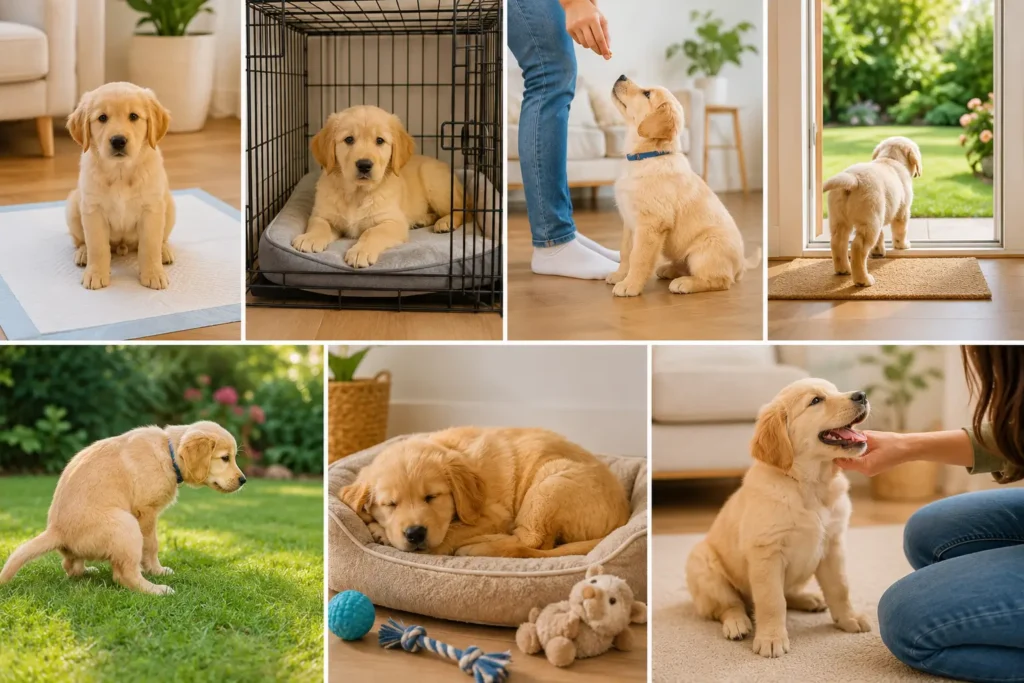
The best 7-day puppy schedule starts with frequent potty trips and slowly adds supervised freedom after outdoor success. Each day builds one skill while protecting the puppy from repeated indoor accidents.
The table below shows the weekly structure. Use it as the article’s main training map.
| Day | Main goal | Owner action | Success sign |
| Day 1 | Find the baseline | Record every pee, poop, meal, nap, and accident | You know the main trigger times |
| Day 2 | Reduce freedom | Use a crate, pen, leash, or direct supervision | Hidden accidents decrease |
| Day 3 | Improve reward timing | Reward outdoors within seconds | Puppy finishes faster outside |
| Day 4 | Strengthen crate routine | Potty before and after crate rest | Crate stays clean |
| Day 5 | Fix accident patterns | Clean, record, and shorten intervals | Repeat spots decrease |
| Day 6 | Add a door signal | Teach bell, sit, or door wait | Puppy shows early request behavior |
| Day 7 | Test small freedom | Add 5 to 10 minutes after outdoor success | Puppy stays clean in one room |
This schedule does not promise zero accidents. It gives you a controlled system for fewer mistakes and stronger learning.

Day 1: How do you find your puppy’s potty pattern?
Day 1 identifies your puppy’s real bathroom rhythm. Take your puppy out after every trigger and record each result.
Start the morning with an immediate potty trip. Carry small puppies outside if the route includes stairs, hallways, carpets, or elevators. Many puppies pee before reaching the door.
Use these trigger trips on day 1:
- Take your puppy out after waking.
- Take your puppy out after meals.
- Take your puppy out after drinking.
- Take your puppy out after play.
- Take your puppy out after crate time.
- Take your puppy out before bedtime.
Stand at the potty spot for 3 to 5 minutes. Reward immediately after elimination. If nothing happens, return indoors with close supervision and try again in 10 to 15 minutes.
Day 2: How do you prevent hidden accidents?
Day 2 prevents hidden accidents by removing unsupervised indoor freedom. Your puppy stays in your sight, on a leash, in a pen, or in a correctly sized crate.
Hidden accidents create 2 problems. The puppy practices the wrong behavior. You also lose the chance to reward the correct behavior outside.
Use a simple indoor rule. Your puppy gets freedom only after a successful outdoor potty trip. If the puppy is not eliminated, use crate rest, pen time, or leash supervision.
Watch for 5 early signals:
- Sniffing one floor area
- Circling near furniture
- Walking away from play
- Pausing near rugs or corners
- Whining near a door or gate
Take your puppy out when you see the first signal. Do not wait for barking. Many young puppies do not know how to ask yet.
Day 3: How do you make rewards clearer?
Day 3 makes rewards clearer by paying for the exact outdoor behavior within seconds. The treat marks the finished pee or poop, not the walk back indoors.
Positive reinforcement training works through timing. If you reward in the kitchen, your puppy may connect the reward with walking inside. If you reward at the potty spot, your puppy connects the reward with outdoor elimination.
Keep treats in a container by the door. Use small pieces. Calm praise is useful, but food gives a clearer marker for many puppies.
Wait after the first pee. Some puppies pee twice before they are fully empty. Give the puppy 60 to 90 extra seconds before returning indoors.
Most dogs defecate 1 to 3 times daily and often shortly after eating. That pattern makes post-meal outdoor trips important for quick house training.
Day 4: How do you use crate training for potty training puppy routines?
Day 4 uses the crate as a rest and management tool, not a punishment tool. The crate helps your puppy stay clean when you cannot supervise every step.
Take your puppy out before crate time. Give calm praise when the puppy enters. Use a safe chew or food toy after the potty trip. Keep early crate periods short.
Crate training can start at any age, and that early training makes crate adjustment easier. Signs of distress, such as persistent vocalizing or escape attempts, require veterinary guidance before continuing.
Do not place your puppy in the crate after an accident as punishment. That makes the crate feel unsafe. A crate supports potty training only when the puppy sees it as a resting place.
Use the crate size rule. The puppy needs enough space to stand, turn, and lie down. Extra space can create a sleep side and a toilet side.
Day 5: How do you fix accidents without punishment?
Day 5 fixes accidents by changing the schedule, not blaming the puppy. Each accident shows where the plan needs tighter timing or better supervision.
Use this 4-step accident review:
- Record the accident time.
- Identify the trigger before the accident.
- Clean the area with an enzymatic cleaner.
- Shorten the next potty interval by 15 to 30 minutes.
Never rub a puppy’s nose in waste. Never yell after finding a mess. The puppy cannot connect delayed punishment with the earlier bathroom choice.
Research supports avoiding aversive methods. A 2020 PLOS ONE study observed 92 companion dogs from reward-based, mixed-method, and aversive-method training schools. Dogs trained with more aversive methods showed more stress-related behavior and poorer welfare indicators than dogs trained with reward-based methods.
That evidence matters for potty training puppy routines. Fear creates hiding. Hiding creates missed rewards. Missed rewards slow learning.
Day 6: How do you teach a puppy to ask to go out?
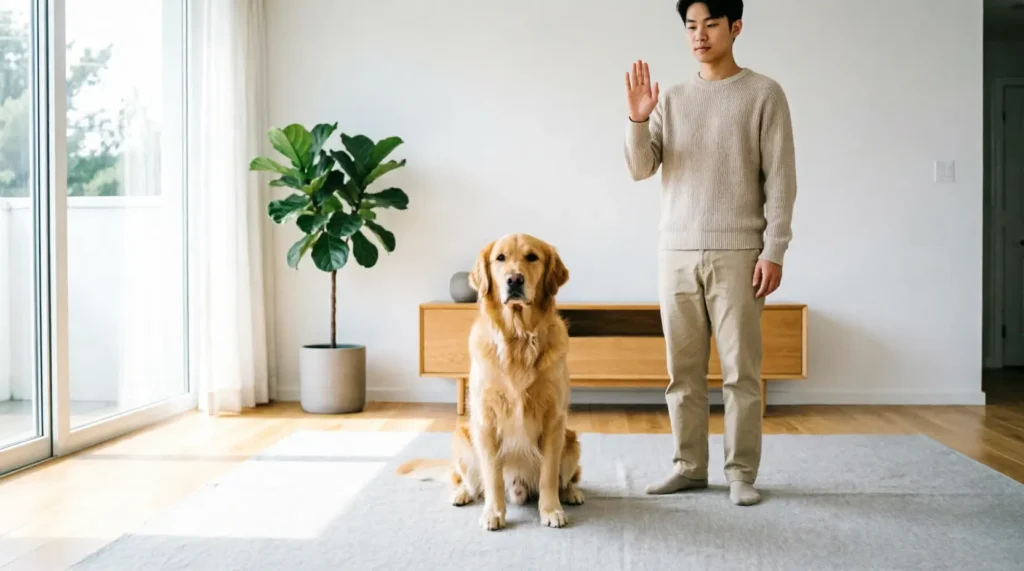
Day 6 adds one door signal after the puppy understands the potty route. The signal can be a bell, a sit, a nose touch, or a quiet wait at the door.
Choose one signal only. Mixed signals confuse young puppies. Use the same signal before every potty trip.
Follow this sequence:
- Walk to the door.
- Ask for the signal.
- Open the door immediately.
- Go to the potty spot.
- Reward outdoor elimination.
Do not treat the signal as proof of full house training. Many puppies ring a bell for fresh air, attention, or sniffing. Continue the 7-day puppy schedule even after your puppy starts asking.
If your puppy signals and does not potty, return indoors calmly. Try again later. The signal gets cleaner through repetition.
Day 7: How do you test progress without causing setbacks?
Day 7 tests progress with small, supervised freedom after successful outdoor elimination. Give access to one clean room for 5 to 10 minutes after a potty success.
Do not open the whole house. Bedrooms, rugs, laundry piles, and quiet corners create accident risk. Expand space only after your puppy shows repeated clean patterns.
Use the “potty first, freedom second” rule. Outdoor success earns short freedom. No potty result means crate, pen, or leash supervision for 10 to 15 minutes. Then try outside again.
This step builds real reliability. The puppy learns that clean behavior creates access to more of the home.
What daily timetable supports quick house training?
A daily timetable supports quick house training by matching potty trips to meals, naps, play, and sleep. The timetable turns owner memory into a visible system.
The table below fits many puppies aged about 10 to 14 weeks. Younger puppies often need shorter intervals.
| Time | Action | Why it helps |
| 6:30 a.m. | Wake and potty | Morning urgency is high |
| 6:45 a.m. | Breakfast | Fixed meals create predictable bowel timing |
| 7:00 a.m. | Potty trip | Food often triggers elimination |
| 7:20 a.m. | Supervised play | One room reduces hidden accidents |
| 7:45 a.m. | Potty trip | Play increases bladder pressure |
| 8:00 a.m. | Crate nap | Rest follows outdoor success |
| 10:00 a.m. | Wake and potty | Naps trigger urination |
| 12:00 p.m. | Lunch and potty | Meal rhythm supports tracking |
| 3:00 p.m. | Potty and play | Afternoon activity needs supervision |
| 5:30 p.m. | Dinner and potty | Evening pattern reduces night accidents |
| 8:30 p.m. | Calm potty trip | Quiet routines protect sleep |
| 10:30 p.m. | Final potty | Last trip lowers overnight risk |
This timetable is a sample, not a medical rule. Adjust it for age, breed size, weather, apartment distance, and your veterinarian’s advice.
How many potty breaks does a puppy need by age?
A puppy’s potty break count changes with age, and younger puppies need more daily elimination chances. Age-based break targets make the schedule more realistic.
| Puppy age | Suggested elimination breaks | Practical planning note |
| 6 to 14 weeks | 8 to 10 breaks daily | Plan a break every 1 to 2 waking hours |
| 14 to 20 weeks | 6 to 8 breaks daily | Keep breaks after meals and naps |
| 20 to 30 weeks | 4 to 6 breaks daily | Expand freedom slowly |
| 30 weeks and older | 3 to 4 breaks daily | Maintain routine during transitions |
This table helps you avoid overestimating your puppy. A 9-week-old puppy on an adult dog routine has too few chances to succeed.
How many accidents are normal in the first week?
Several accidents can happen during the first week, especially in puppies under 16 weeks. The important metric is a downward trend in accidents and fewer repeat spots.
Use this tracking table.
| Day | Target pattern | What progress looks like |
| Day 1 | Baseline count | You learn the puppy’s timing |
| Day 2 | Fewer hidden accidents | Supervision starts working |
| Day 3 | Faster outdoor success | Reward timing becomes clear |
| Day 4 | Cleaner crate periods | Rest routine improves |
| Day 5 | Fewer repeat locations | Cleanup and blocking work |
| Day 6 | First door signal attempts | Communication starts |
| Day 7 | Clean short freedom | Reliability begins in one room |
Do not judge progress by one accident. Judge progress by the full 7-day pattern. Fewer hidden accidents, faster outdoor elimination, and fewer repeat areas show real improvement.
What mistakes delay potty training puppy progress?
The 8 mistakes that delay potty training puppy progress are late rewards, too much freedom, long intervals, poor cleanup, punishment, mixed surfaces, random meals, and weak tracking.
Late rewards
Reward outdoors within seconds. A reward inside the house marks the wrong behavior.
Too much freedom
Give freedom after success. Do not let a puppy wander before elimination.
Long intervals
Young puppies need more breaks than adult dogs. Focus on 8 to 10 daily breaks for puppies aged 6 to 14 weeks.
Poor cleanup
Use an enzymatic cleaner on every accident. Scent residue can pull the puppy back to the same location.
Punishment
Punishment can create hiding and fear. It is recommended to use reward-based methods for dog training and behavior problems.
Mixed surfaces
Grass, pads, turf, and carpet feel different. Use the surface that matches your long-term goal.
Random meals
Scheduled meals make bowel timing more predictable.
No potty log
A log shows timing patterns. Without tracking, you rely on memory during a busy first week.
How do puppy pads affect quick house training?
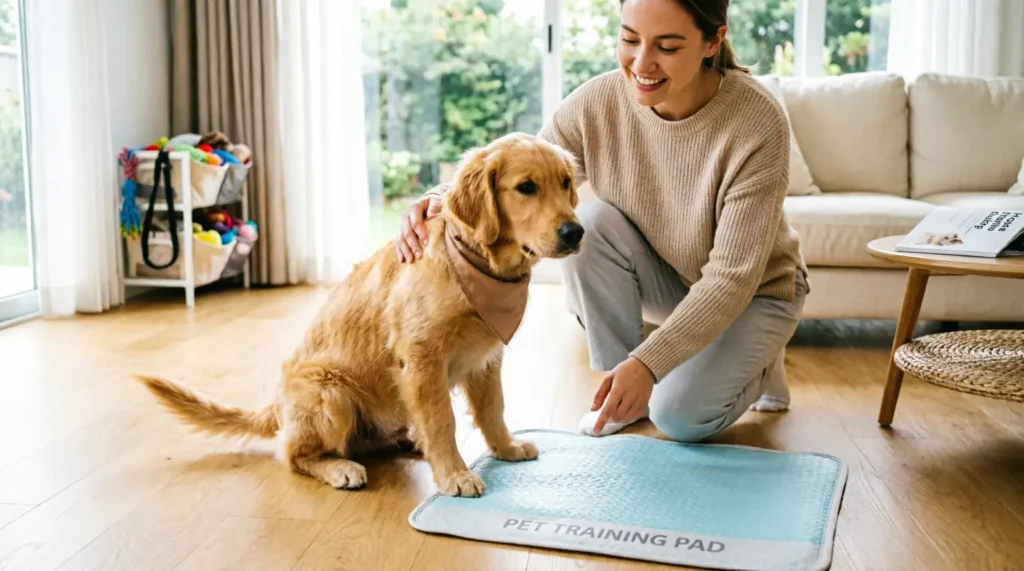
Puppy pads help some homes, but pads can slow outdoor-only training when the final goal is grass. Pads teach an indoor bathroom surface unless you transition them carefully.
Pads make sense when outdoor access is unsafe, vaccination risk is high, apartment distance is long, or severe weather blocks safe trips. Ask your veterinarian about shared outdoor areas and disease risk.
Transition pads with 3 steps:
- Move the pad closer to the exit.
- Move the pad outside or onto the target surface.
- Reward only the final outdoor surface.
Do not punish the pad confusion. The puppy learned one bathroom rule. Now you are teaching a new location and surface.
How do you potty train a puppy in an apartment?
Apartment potty training uses the same schedule, but route control matters more. Carry or leash your puppy to prevent hallway, elevator, and lobby accidents.
Choose one legal potty area. Use the same door and route each time. Reward at the potty location. Keep trips boring until elimination happens.
Some guidance recommends taking young puppies outside frequently and building the potty routine early.
If you use a balcony station, check building rules. Clean the area daily. Odor control protects neighbors and stops scent buildup from confusing your puppy.
When do accidents mean a medical problem?
Accidents may signal a medical problem when they come with pain, blood, diarrhea, vomiting, lethargy, repeated crate soiling, or sudden regression. Training cannot solve urgent physical symptoms.
Call your veterinarian if your puppy strains to urinate, cries while peeing, has watery stool, stops eating, or cannot stay clean in a correctly sized crate.
It is necessary to have a veterinary consultation when crate accidents continue after proper crate sizing. That step separates training problems from possible health causes.
Digestive timing matters too. Most dogs poop 1 to 3 times daily and often poop after meals. Sudden changes in that pattern may justify a health check.
What is the final 7-day checklist for fewer accidents?
The final checklist combines timing, supervision, rewards, cleanup, and data review. Use it daily until your puppy has several weeks of clean patterns.
- Take your puppy out after waking.
- Take your puppy out after meals.
- Take your puppy out after drinking.
- Take your puppy out after play.
- Take your puppy out after naps.
- Take your puppy out after crate time.
- Reward outdoor elimination within seconds.
- Use one potty cue and one potty surface.
- Clean every accident with an enzymatic cleaner.
- Record accidents and shorten risky intervals.
This checklist gives your puppy clear rules. Potty happens in the chosen place. Rewards happen immediately after the correct choice. Freedom follows success.
Last step: Use the 7-day plan as your puppy’s first clean routine
Puppy potty training in 7 days works best when you treat the first week as a routine-building phase. Your puppy is learning the route, the surface, the timing, and the reward pattern. The goal is not perfection. The goal is fewer accidents, faster outdoor success, and better signals each day.
The strongest 7-day puppy schedule is practical because it uses your puppy’s body rhythm. Young puppies need frequent breaks, and accidents can happen during the first months of house training because puppies have small bladders and get distracted easily. The uploaded draft already connects the same training logic to trigger-based trips, reward timing, crate supervision, and accident review.
Quick house training becomes easier when you stop guessing. A potty log shows when your puppy usually pees, poops, misses signals, or needs a shorter interval. That information turns a messy first week into a clear plan.
The lasting habit comes from repetition. One clean day helps. Seven structured days help more. Several consistent weeks turn the first 7-day plan into dependable house training.
Frequently Asked Questions
What is the first sign that a puppy is ready for a potty break?
Sniffing one spot, circling, pausing near a rug, leaving play, or moving toward a corner usually means your puppy needs a potty break.
Can I use the same 7-day puppy schedule for every breed?
You can use the same structure, but small breeds, young puppies, and excitable puppies often need shorter potty intervals.
What matters more in potty training puppy routines: age or schedule?
Age sets the puppy’s physical limit, but the schedule decides how often your puppy gets a chance to succeed.
Why does my puppy pee outside and then pee again indoors?
Your puppy may not fully empty outside, so wait 60 to 90 seconds after the first pee before returning indoors.
Does quick house training work better with meals at fixed times?
Yes, fixed meals make poop timing easier to predict because many dogs defecate after eating.
How long do I stay outside if my puppy does not go potty?
Stay at the potty spot for 3 to 5 quiet minutes, then return indoors with close supervision and try again in 10 to 15 minutes.
What room is safest for supervised freedom after potty success?
A small room with washable flooring is safe because you can watch signals and clean mistakes quickly.
Should I wake a sleeping puppy for a potty break?
Wake a young puppy for planned breaks when the puppy’s age, recent water intake, or previous accidents show the sleep interval is too long.
Why does my puppy have more accidents during play?
Play raises excitement and movement, which can shorten bladder control and hide early potty signals.
When is the 7-day potty plan working?
The plan is working when accidents decrease, repeat spots disappear, outdoor elimination happens faster, and your puppy starts showing clearer pre-potty signals.