

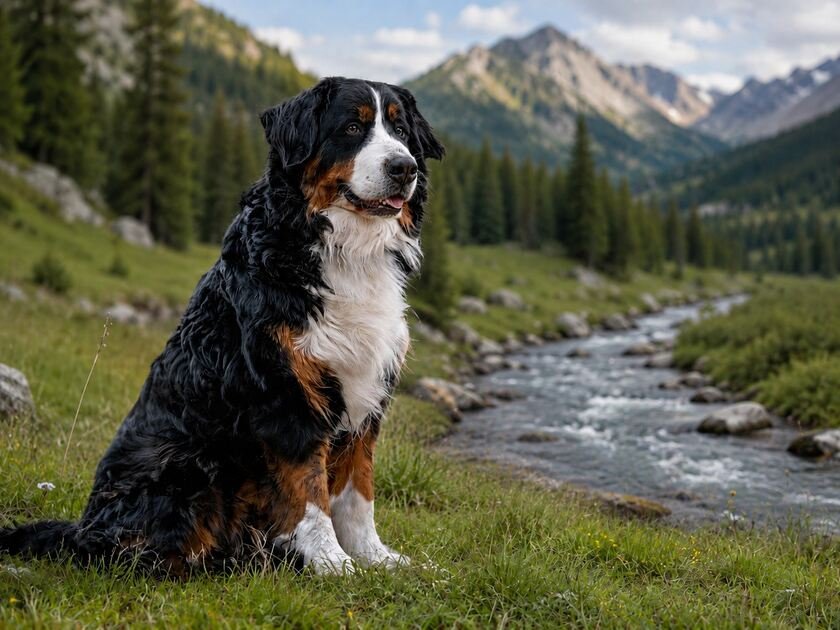
A Bernese Mountain Dog looks calm, affectionate, and easy to love. Living with one takes more planning. Adult Berners can weigh 70 to 115 pounds, shed heavily, and face serious health risks that affect long-term care.
The breed suits many families, but size, training, exercise, grooming, feeding, and veterinary costs can become difficult without preparation. The Bernese personality also brings strong family attachment, which makes long periods alone a poor fit.
This guide explains temperament, family compatibility, daily exercise, coat care, nutrition, lifespan, common health problems, and breeder health testing. It also helps you compare this breed with other large family dogs and gentle giant breeds.
The right decision begins with daily reality, not appearance.
Is a Bernese Mountain Dog right for your family?
A Bernese Mountain Dog suits a family that wants close companionship and can manage a large, strong, heavily coated working dog.
The official standard describes the desired Bernese personality as self-confident, alert, good-natured, and steady. It permits some reserve with strangers. These traits support the breed’s reputation among large family dogs.
Temperament does not settle the decision alone. Your available space, climate, schedule, child supervision, grooming tolerance, and medical budget carry equal weight.
A Berner may fit your household when you can provide the following:
- Indoor access and regular family contact
- About 30 to 60 minutes of moderate daily activity
- Reward-based training from puppyhood
- Brushing several times each week
- Safe management around children and smaller pets
- Verified parental health screening
- Financial preparation for large-breed veterinary care
A garden helps with play and toilet breaks. It does not replace walks, training, or social contact.
What are the key Bernese Mountain Dog facts?
The table below combines official breed standards, veterinary research, and breed-club guidance. It gives you a practical ownership summary.
| Attribute | Fact or figure |
| Adult weight | 70 to 115 pounds |
| Male height | 25 to 27.5 inches |
| Female height | 23 to 26 inches |
| Breed group | Working |
| Original roles | Farm work, cattle droving, guarding, and cart pulling |
| Coat | Thick, moderately long, straight or slightly wavy |
| Daily exercise reference | At least 30 minutes, with up to 60 minutes for many healthy adults |
| Grooming | More than once weekly |
| Swiss median lifespan | 8.4 years |
| 2024 UK median lifespan | 10.1 years |
| Main health priorities | Cancer, joint disease, heart, eyes, and degenerative myelopathy |
| Breeding health checks | Five core tests plus one optional category |
The figures come from the American Kennel Club, Royal Kennel Club, Bernese Mountain Dog Club of America, and two peer-reviewed longevity studies.
Population figures do not predict one dog. Genetics, sex, body condition, veterinary access, and diagnostic quality create individual differences.
What was the Bernese Mountain Dog bred to do?
The Bernese Mountain Dog developed as a Swiss farm companion that guarded property, moved cattle, and pulled loaded carts.
The Bernese Mountain Dog Club of America describes the breed as a watchful farm dog rather than a specialist herder. Swiss farmers kept Berners close to the household and farmyard.
This background explains several modern traits. A Berner watches unfamiliar activity, remains close to family members, and often enjoys tasks involving controlled pulling or obedience.
The breed standard describes a slow natural trot with enough power for draught and droving work. It also requires strength, balance, intelligence, and agility.
That history separates the Bernese Mountain Dog from several other gentle giant breeds. A Berner has working capacity, but most adults do not require the relentless activity associated with high-drive herding dogs.
A daily walk alone still provides an incomplete routine. Add scent games, controlled training, social contact, and purposeful household participation.
How large does a Bernese Mountain Dog become?
An adult Bernese Mountain Dog stands 23 to 27.5 inches tall and commonly weighs 70 to 115 pounds.
The breed standard places males between 25 and 27.5 inches. Females measure 23 to 26 inches at the shoulder.
Body weight varies with sex, frame, muscle, age, and body condition. Weight alone cannot show whether a dog carries healthy tissue or excess fat.
Size changes ordinary household decisions. Bernese Mountain Dogs share transport, housing, flooring, feeding, and veterinary-care challenges with other biggest dog breeds. Consider these practical examples:
- Measure doorways, stair turns, vehicle space, and sleeping areas.
- Place food away from narrow routes where children pass.
- Install traction on polished flooring.
- Use a vehicle ramp when jumping becomes difficult.
- Choose barriers that can contain a 100-pound adult.
A large garden helps, but a garden does not replace exercise or family contact. The Royal Kennel Club associates the breed with a large house and large garden.
Apartment ownership remains possible in some cases. Success depends on lift access, cooling, toilet arrangements, neighbor tolerance, and dependable outdoor exercise.
A mature Berner also occupies more physical space than many people expect. A dog lying across a kitchen walkway can block the entire route.
What is the Bernese personality like?
The Bernese personality is generally affectionate, steady, socially attached, and sensitive to handling.
A well-bred adult often rests calmly indoors and follows family activity. Some Berners remain reserved with unfamiliar people. The breed standard rejects sharpness and excessive shyness.
“Gentle” does not mean trained. A 90-pound adolescent can pull an adult, knock over a child, block a doorway, or jump onto visitors. Early manners carry extra value because every repeated behavior gains physical force.
Use force-free dog training to teach recall, loose-lead walking, handling, settling, and calm greetings. . The American Veterinary Society of Animal Behavior supports reward-based methods for all canine training. Its evidence review links aversive methods with stress behaviors and poorer welfare outcomes.
Prioritise 6 practical skills:
- Teach a fast response to the dog’s name.
- Build recall in low-distraction settings.
- Reward loose-lead walking before pulling becomes established.
- Train a settle cue for meals and visitors.
- Practice calm handling of paws, ears, mouth, and coat.
- Reinforce four feet on the floor during greetings.
Keep sessions brief. Two focused minutes can produce cleaner learning than a long session with a tired puppy.
Are Bernese Mountain Dogs good family dogs?
Bernese Mountain Dogs can make suitable family dogs when adults supervise children, train the dog, and manage its size.
Their reputation among large family dogs comes from their steady temperament and strong interest in household companionship. The breed standard supports good nature, confidence, and controlled behavior.
No breed label guarantees safety. Every interaction depends on the individual dog, the child’s behavior, supervision, and the environment.
Are Bernese Mountain Dogs good with children?
Bernese Mountain Dogs can live successfully with children when adults supervise every close interaction and teach safe behaviour to both.
The breed has a recognized reputation for gentleness with children. Size creates the main practical concern. A friendly adult can knock over a toddler without showing aggression.
The American Veterinary Medical Association advises constant supervision around young children, regardless of breed or previous behavior. Give your Berner a child-free resting area and separate the dog during chaotic play.
Teach children 4 rules:
- Leave the dog alone while eating or sleeping.
- Stroke the shoulders or back instead of grabbing the face.
- Never climb, ride, corner, or hug the dog.
- Call an adult when the dog stiffens, hides, guards an item, or moves away.
A family-friendly label describes a tendency. It does not replace supervision, socialization, or individual assessment.
Can a Berner live with other pets?
A Bernese Mountain Dog can live with dogs and cats when you manage introductions and prevent repeated chasing.
Start at a distance. Reward calm observation, use gates, and provide separate food and resting areas. Repeat short meetings before allowing free access.
The breed’s farm history does not guarantee safe behavior around every animal. Individual prey drive, confidence, age, and past learning still matter.
Can a Berner stay alone all day?
A Bernese Mountain Dog does not suit routine isolation for an entire working day.
The American Kennel Club notes that undesirable behavior can develop when a Berner remains alone for long periods.
Build independence gradually. Short departures, food puzzles, predictable routines, and a trained caregiver can reduce disruption.
Daycare does not suit every Berner. Some dogs prefer a familiar walker or home visitor over a crowded group setting.
How much exercise does a Bernese Mountain Dog require?
A healthy adult generally needs 30 to 60 minutes of moderate daily exercise, adjusted for weather, fitness, and medical status.
The American Kennel Club gives at least 30 minutes as a baseline. The Royal Kennel Club lists up to one hour. These figures support moderate activity rather than prolonged high-impact running.
Split activity into two sessions when useful. Combine walking with nose work training for dogs, recall practice, lead skills, or controlled hill work for a fit adult.
Puppies require a different plan. Avoid forced distance running, repetitive jumping, sharp turns on slippery floors, and repeated vehicle jumps during rapid growth. Free play on safe surfaces lets a puppy regulate effort more naturally.
Warm weather changes the schedule. Exercise during cooler hours, provide shade and water, and stop after heavy panting, slowing, weakness, or poor coordination.
How much space does a Bernese Mountain Dog require?
A Bernese Mountain Dog requires enough indoor space to stand, turn, rest, and move without constant collision.
The Royal Kennel Club associates the breed with a large house and garden. Apartment living can work, but lift access, cooling, toilet breaks, flooring, neighbor tolerance, and emergency transport require planning.
Measure door widths, stair turns, sleeping space, feeding positions, and vehicle capacity. Add non-slip runners to polished floors.
Weak traction creates problems for a dog weighing 70 to 115 pounds.
What does a Bernese Mountain Dog eat?
A Bernese Mountain Dog requires a complete diet matched to life stage, activity, body condition, and medical history.
Large-breed puppies benefit from controlled portions and slow growth. World Small Animal Veterinary Association guidance identifies 4 out of 9 as a suitable puppy body-condition target. It also advises portion control for growing large breeds.
For most adults, the same guidance places ideal body condition at 4 to 5 out of 9. Disease associations rise above 6 out of 9.
Keep treats and table food near or below 10% of daily calories. Food rewards used during training count toward that allowance.
Check body condition every two weeks during growth or a diet change:
- Feel the ribs beneath a light fat layer.
- Look for a waist behind the ribs.
- Check for an abdominal tuck from the side.
- Record weight on the same scale.
- Adjust portions when body condition changes.
Do not add calcium or mineral supplements to a complete large-breed puppy diet without veterinary direction. Extra nutrients can disturb the diet’s intended balance.
How much grooming does a Berner need?
A Bernese Mountain Dog needs brushing more than once weekly, with extra work during heavier shedding periods.
The official standard describes thick, moderately long hair that remains straight or slightly wavy. The Royal Kennel Club confirms that the breed sheds.
Use grooming as a health check. Feel behind the ears, under the collar, around the limbs, beneath the tail, and across the abdomen.
Record new lumps, pain, skin changes, or restricted movement. These findings deserve veterinary assessment when they persist.
A weekly routine includes brushing, nail inspection, ear checks, skin examination, and dental care that reduces the risk of periodontal disease in dogs. Dry the coat fully after bathing or swimming.
How long does a Bernese Mountain Dog live?
Bernese Mountain Dog lifespan estimates commonly fall between 8 and 10 years, although research results vary by population and method.
A Swiss study collected information from 389 of 1,290 eligible Berners, a 30.2% response. By study’s end, 381 dogs had died.
The median lifespan reached 8.4 years. Females reached 8.8 years, while males reached 7.7 years. The middle 50% fell between 6.9 and 9.7 years.
A 2024 United Kingdom analysis covered 584,734 dogs, including 284,734 deceased dogs, across 155 recognized breeds. Its breed data reported a 10.1-year median for Bernese Mountain Dogs.
Dataset design and population differences help explain the 1.7-year gap. The UK study combined 18 sources, including registries, insurers, veterinary groups, and welfare organizations.
Use lifespan as planning data for insurance, screening, senior care, and emotional commitment. It cannot predict one dog’s age at death.
Which Bernese Mountain Dog health problems matter most?
Cancer, joint disease, eye conditions, cardiac disease, degenerative myelopathy, and gastric emergencies deserve attention before purchase.
How serious is cancer in Bernese Mountain Dogs?
Cancer represents the most documented health concern in the Bernese Mountain Dog.
A 2005 breed health study reported cancer in 67% of surveyed dogs that had died. The breed-club report identifies histiocytic sarcoma and mast-cell cancer among inherited concerns.
A separate mortality study linked at least 55.1% of Bernese Mouhistiocytic sarcomantain Dog deaths with malignant tumors. More than one-seventh involved histiocytic sarcoma.
Another veterinary review estimated frequency at about 25% within the breed. Estimates vary because researchers use different populations and diagnostic methods.
Watch for persistent lumps, unexplained weight loss, reduced stamina, pale gums, abdominal enlargement, lameness, coughing, or appetite change. These signs have several possible causes.
Arrange veterinary assessment rather than waiting for several symptoms to appear together. Early evaluation gives the veterinary team more diagnostic information.
How common are hip and elbow problems?
Elbow Hip dysplasia in dogs causes joint instability that can progress to pain, arthritis, lameness, and reduced mobility. The breed club explains that hip dysplasia involves hip instability and later arthritic change. Elbow dysplasia covers several developmental abnormalities within the elbow joint.
Normal movement during a brief puppy visit cannot confirm healthy joints. Qualified evaluators use properly positioned radiographs.
Keep growing puppies lean. Add rugs to slippery floors and prevent repeated jumping from vehicles or furniture.
Can Bernese Mountain Dogs develop bloat?
A Bernese Mountain Dog can develop gastric dilatation-volvulus, although research does not consistently classify the breed among the highest-risk dogs.
Gastric dilatation-volvulus occurs when the stomach expands and twists. Cornell University describes it as a sudden emergency requiring immediate medical and surgical care.
Warning signs include repeated unproductive retching, pacing, salivation, abdominal swelling, weakness, or collapse. Travel to an emergency clinic immediately.
Discuss preventive gastropexy with your veterinarian, particularly during another planned abdominal procedure. Your veterinarian can assess individual conformation, family history, and risk.
Which health tests must a breeder document?
A responsible breeder documents five core health tests plus one test from three optional categories.
The Bernese Mountain Dog Club of America lists hips, elbows, eyes, heart, and degenerative myelopathy as the core areas. The optional category covers von Willebrand disease, thyroid testing, or a histiocytic sarcoma risk test.
The breed club identifies two degenerative myelopathy mutations in Berners. It recommends testing both because some laboratories test only the common variant.
The histiocytic sarcoma pre-test uses nine genes across five chromosomes. An “A” result indicates a four times lower risk, “B” remains neutral, and “C” indicates a four times higher risk.
The test estimates risk. It does not diagnose disease or guarantee an outcome.
Use this buying check:
- Verify both parents in the Orthopedic Foundation for Animals or Berner-Garde databases.
- Read the results rather than accepting a certificate alone.
- Review siblings, previous litters, longevity, and causes of death.
- Request the puppy’s examination, vaccination, and identification records.
- Read the return clause and health terms before paying.
A Canine Health Information Center number confirms public completion of required testing. It does not confirm that every result was normal.
What food does a Bernese Mountain Dog require?
A Bernese Mountain Dog requires a complete diet matched to growth stage, body condition, activity, and health status.
The World Small Animal Veterinary Association recommends checking whether food provides complete nutrition for the intended life stage. Its guidance also examines formulation expertise and quality control.
Choose a food formulated for large-breed growth during puppyhood. Avoid adding calcium, vitamins, or minerals without veterinary direction. Growing Berners require large-breed puppy food with controlled calories and an appropriate calcium-to-phosphorus balance.
Measure meals with a consistent method. Include treats, chews, training food, and table food in the daily calorie total.
The American Animal Hospital Association recommends recording body weight, body condition score, and muscle condition during veterinary examinations. Individual feeding plans use age, activity, disease, and environment.
A healthy body condition matters more than reaching the highest number on a breed weight chart. You can usually feel the ribs under a light fat layer.
Your dog’s waist remains visible behind the ribs when viewed from above. The abdomen rises behind the ribcage when viewed from the side.
Adjust the portion when body condition changes, not when the bowl looks small. Food density varies between products.
What does daily life with a Bernese Mountain Dog involve?
Daily life involves hair removal, outdoor exercise, indoor companionship, training, measured feeding, and close health observation.
A calm adult may rest for much of the day. That calmness does not remove the requirement for movement or mental activity.
Wet weather creates a different problem. A large, long-coated dog brings water, mud, and loose hair into the house.
Travel also requires planning. Check vehicle loading, cooling, restraint space, accommodation rules, and emergency veterinary access.
Veterinary treatment can involve larger medication doses, heavier lifting, diagnostic imaging, and specialist care. Insurance terms deserve review before symptoms appear.
These factors explain why Berners suit some families exceptionally well and overwhelm others. Affection does not cancel logistics.
Is the Bernese Mountain Dog the right gentle giant for you?
Choose a Bernese Mountain Dog when your household can support its size, social dependence, coat care, training, and health risks.
This breed may fit your home when:
- You want a calm, people-oriented working dog.
- You can keep the dog indoors with the family.
- You accept frequent shedding and regular grooming.
- You can provide structured exercise without forced endurance.
- You can fund preventive care and unexpected treatment.
- You can verify health screening before purchase.
- You understand the breed’s shorter average lifespan.
Consider another breed when your home lacks cooling, space, time, or safe handling capacity. A smaller family dog may offer a more practical match.
Among gentle giant breeds, the Bernese Mountain Dog offers a distinct combination of farm dog history, emotional sensitivity, physical strength, and household attachment.
The central question is not whether the breed loves families. The question is whether your family can meet the breed’s full requirements.
Look beyond the gentle giant label
A Bernese Mountain Dog can become a deeply affectionate family companion, but affection alone does not create a suitable match. This dog may weigh 115 pounds, requires regular coat care, and carries documented risks involving cancer, joints, and inherited disease. Published median lifespan estimates range between 8.4 and 10.1 years across major datasets.
Before paying a deposit, verify both parents’ health results and examine the wider family pedigree. A Canine Health Information Center number confirms that required tests were completed and published. It does not mean every result was normal.
Choose a Bernese Mountain Dog when your household can manage the breed’s size, social attachment, grooming, training, and medical planning. The Bernese personality feels gentle because the dog stays close. That same closeness asks for time, structure, and a home prepared for the adult dog behind the puppy photograph.
Frequently asked question
When does house training become easier for a Bernese puppy?
Bladder control usually improves by about six months, although each puppy still requires a consistent toilet schedule and patient training.
Can a Bernese Mountain Dog puppy pull a cart?
Avoid cart pulling until growth plates close at about two years, although gentle harness familiarisation can begin near six months.
Does a CHIC number mean the parent passed every health test?
No, a CHIC number confirms that required results are publicly available, but some recorded results may show health concerns.
Which documents should come with a responsibly bred puppy?
The breeder should provide registration details, veterinary history, parental health evidence, a four-generation pedigree, and written care recommendations.
Can a large garden replace daily walks for a Bernese Mountain Dog?
No, a garden supports play and toilet breaks, but a Berner still requires structured exercise, training, and regular social contact.