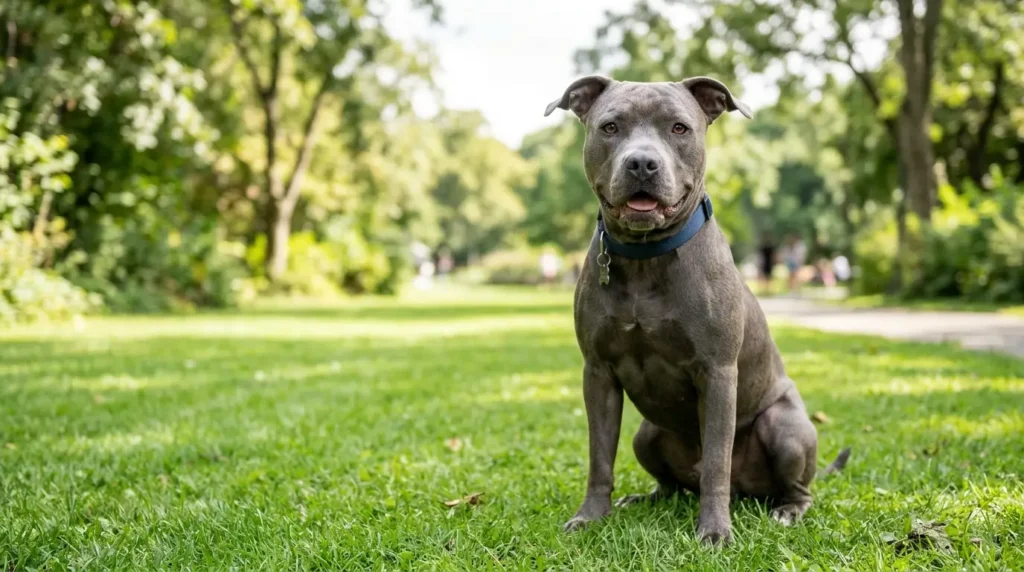
A Blue Nose Pitbull is not a separate dog breed. The name usually describes an American Pit Bull Terrier or another pit bull-type dog with dilute gray-blue pigmentation affecting the coat, nose, lips, eye rims, and sometimes paw pads.
The blue-gray appearance comes from inherited coat-color genetics rather than from a special temperament or separate “blue nose” bloodline. A blue-colored American Pit Bull Terrier should otherwise have the same general physical and behavioral characteristics as other dogs of its breed.
For a registered American Pit Bull Terrier, the United Kennel Club describes a medium-sized, muscular, athletic dog rather than an excessively heavy or bulky one. Adult males are generally around 35–60 pounds and 18–21 inches tall, while females are around 30–50 pounds and 17–20 inches tall.
Before buying a Blue Nose Pitbull puppy, focus on health, temperament, structure, ancestry, and responsible breeding rather than paying a premium simply because the puppy is blue.
Blue Nose Pitbull at a Glance
| Trait | Typical Blue Nose Pitbull / APBT |
| Breed status | Blue nose is a color description, not a separate breed |
| Common underlying breed | American Pit Bull Terrier |
| Male weight | About 35–60 lb |
| Female weight | About 30–50 lb |
| Male height | About 18–21 in |
| Female height | About 17–20 in |
| Coat | Short, smooth, close |
| Typical color | Gray-blue, sometimes with white markings |
| Nose | Slate, gray, or blue-gray |
| Build | Muscular and athletic |
| Energy | Moderate to high |
| Trainability | Generally high |
| Grooming | Low |
| Shedding | Light to moderate |
| Typical lifespan | Often around 10–14 years, depending on ancestry and health |
| UKC recognition | American Pit Bull Terrier recognized |
| AKC recognition | American Pit Bull Terrier itself is not an AKC-recognized breed |
| Best suited to | Active owners prepared for training and socialization |
What Is a Blue Nose Pitbull?
A Blue Nose Pitbull is a pit bull-type dog in which normally dark pigment has been diluted to a gray or blue-gray shade.
The word blue in dog coat terminology does not mean bright blue.
Instead, the color may appear:
- Slate gray
- Charcoal
- Steel gray
- Silver-gray
- Dark blue-gray
The same dilution can affect pigment in the:
- Nose
- Lips
- Eye rims
- Paw pads
This gray nose leather is where the term blue nose pit comes from.
However, nose color cannot establish a dog’s breed.
Dogs described as Blue Nose Pitbulls may actually be:
- American Pit Bull Terriers
- American Staffordshire Terriers
- American Bullies
- Mixed pit bull-type dogs
Pedigree and registration records are more useful than color when breed identity matters.
Is a Blue Nose Pitbull a Separate Breed?
No. Blue Nose Pitbull is a color description, not an officially recognized breed.
The UKC American Pit Bull Terrier standard accepts essentially all colors and patterns except merle and allows the nose to be any color. It does not divide American Pit Bull Terriers into separate blue-nose and red-nose breeds.
This distinction is important because breeders sometimes advertise phrases such as:
- Rare Blue Nose Pitbull
- Blue Nose bloodline
- Exotic blue Pitbull
- Special blue Pit
Those terms can make the dog sound genetically separate when the main difference may simply be pigmentation.
Why Is a Blue Nose Pitbull Blue?
Blue coloration results from genetic variants that dilute eumelanin, the pigment that normally produces black coloration.
The UC Davis Veterinary Genetics Laboratory identifies several variants in the MLPH gene at the D locus that can create dilute coat colors.
In a black-based dog, dilution can change black pigment into gray-blue.
The trait is autosomal recessive, which means a dog generally needs two dilution variants to show the dilute phenotype.
A simplified version looks like this:
| Genotype | Expected Effect |
| D/D | Non-dilute |
| D/d | Usually non-dilute carrier |
| Two dilution variants | Dilute coat expressed |
This genetic mechanism occurs in many dog breeds and is not unique to Pitbulls.
For readers interested in the genetics itself, the UC Davis Veterinary Genetics Laboratory’s dilute-color explanation details the known MLPH variants and their inheritance.
Are Blue Nose Pitbulls Rare?
Blue coloration is recessive and may be less common than some traditional colors, but “rare Blue Nose Pitbull” is often more of a marketing phrase than a meaningful breed category.
A recessive color can become fairly common within breeding programs that deliberately select for it.
Therefore, blue coloration alone does not indicate:
- Superior pedigree
- Better health
- Better temperament
- Greater intelligence
- Greater strength
A responsible breeder should have much more to discuss than the puppy’s color.
What Does a Blue Nose Pitbull Look Like?
A Blue Nose American Pit Bull Terrier should have an athletic, muscular body rather than an excessively bulky appearance.
Common physical characteristics include:
- Broad but proportional head
- Wide, deep muzzle
- Strong neck
- Muscular shoulders
- Deep chest
- Defined waist
- Strong hindquarters
- Short smooth coat
- Low-set tapering tail
- Slate-gray nose
White markings may occur on the:
- Chest
- Face
- Feet
- Neck
The UKC specifically describes the American Pit Bull Terrier as powerful and muscular while still emphasizing agility and balance. It states that the breed should not appear excessively bulky or muscle-bound.
How Big Does a Blue Nose Pitbull Get?
A Blue Nose American Pit Bull Terrier generally grows to the same size as an APBT of any other color.
The UKC gives these desirable ranges:
| Sex | Adult Weight | Adult Height |
| Male | 35–60 lb | 18–21 in |
| Female | 30–50 lb | 17–20 in |
Individual dogs can fall outside these numbers.
However, a dog advertised as a Blue Nose Pitbull that matures to:
- 80 pounds
- 90 pounds
- 100+ pounds
may have American Bully, American Bulldog, mastiff, or other ancestry rather than fitting traditional APBT proportions.
When Is a Blue Nose Pitbull Full Grown?
Most medium-sized pit bull-type dogs approach their adult height during the first year but may continue developing muscle and chest width until around 18–24 months.
A general growth pattern looks like this:
| Age | Typical Development |
| 8–12 weeks | Rapid growth and early social development |
| 3–6 months | Fast skeletal growth |
| 6–9 months | Major increase in height and weight |
| 9–12 months | Height growth begins slowing |
| 12–18 months | Chest and muscle continue developing |
| 18–24 months | Mature proportions become clearer |
Trying to make a puppy “bulk up” through excessive calories is unnecessary.
Healthy skeletal development and appropriate body condition matter far more than producing a heavily built adolescent dog.
What Is a Blue Nose Pitbull Puppy Like?
A Blue Nose Pitbull puppy is usually active, playful, curious, and highly engaged with its environment, but coat color does not predict personality.
Puppies may differ substantially in:
- Confidence
- Sociability
- Playfulness
- Independence
- Energy
- Sensitivity
- Trainability
Important influences include:
- Parent temperament
- Genetics unrelated to color
- Early handling
- Socialization
- Environment
- Training
When choosing a puppy, observing behavior and asking about the parents is more useful than selecting whichever puppy has the darkest blue coat.
Blue Nose Pitbull vs. Red Nose Pitbull: What’s the Difference?
The main difference is pigmentation, not a separate breed or guaranteed difference in temperament.
| Feature | Blue Nose Pitbull | Red Nose Pitbull |
| Nose pigment | Slate/gray | Brown/copper/red |
| Typical coat tones | Gray/blue | Red/fawn/copper |
| Separate breed? | No | No |
| Temperament determined by color? | No | No |
| Special size category? | No | No |
| Health guaranteed by color? | No | No |
A red nose usually reflects brown or reddish pigmentation, while the blue nose reflects dilution of darker eumelanin.
Color is visually obvious, but it tells you very little about whether a dog will make a suitable pet.
Is a Red Nose Pitbull Rarer Than a Blue Nose Pitbull?
There is no useful universal ranking of rarity based solely on nose color.
Availability depends on:
- Breeding population
- Bloodline
- Geography
- Registry
- Breeder preferences
The term Old Family Red Nose has historical bloodline associations within some APBT circles, but not every red-coated Pitbull belongs to that lineage.
Likewise, an ordinary blue dog should not automatically be described as coming from a special “Blue Nose bloodline.”
Blue Nose Pitbull vs. American Bully: Are They the Same?
No. An American Pit Bull Terrier and an American Bully are different breed types, even though both can have blue coats.
This distinction is particularly important when people search for a bully blue nose.
| Feature | American Pit Bull Terrier | American Bully |
| General build | Athletic | Usually heavier and broader |
| Bone | Moderate | Often heavier |
| Head | Broad but proportional | Frequently larger and broader |
| Movement | Agile and functional | Depends on class and breeding |
| Traditional type | Athletic bull-and-terrier | Companion bully breed |
| Blue coloration possible | Yes | Yes |
A traditional APBT should not look like an extremely heavy or exaggerated bully.
If a puppy is advertised as both an American Bully and a Blue Nose Pitbull, ask exactly what breed appears on its registration documents.
What Does “Bully Blue Nose” Mean?
The phrase usually describes a blue-colored American Bully or another bully-type dog rather than a separate recognized Blue Nose Bully breed.
Before buying one, ask:
- What breed are both parents?
- Which registry are they registered with?
- Can you see the pedigree?
- What are the parents’ adult weights?
- What health testing has been completed?
Those answers reveal far more than the words “bully blue nose.”
What Is a Blue Nose Pitbull’s Temperament?
A Blue Nose Pitbull’s temperament should reflect its underlying breed and individual genetics, not the color of its nose.
Commonly reported APBT traits include:
- Confidence
- Enthusiasm
- Affection toward people
- Playfulness
- Persistence
- Athleticism
- Strong engagement with owners
The UKC characterizes the American Pit Bull Terrier as confident, enthusiastic, and eager to please while describing human-directed aggression as uncharacteristic.
At the same time, some APBTs may show dog-directed aggression or increasing dog selectivity as they mature.
That distinction matters.
Being friendly toward people does not automatically mean every dog will enjoy unrestricted interaction with unfamiliar dogs.
Are Blue Nose Pitbulls Aggressive?
There is no evidence that blue coat color itself causes aggression.
Behavior is influenced by a far broader set of factors, including:
- Genetics
- Parent temperament
- Early socialization
- Learning history
- Environment
- Fear
- Arousal
- Training
- Management
The color gene primarily affects pigmentation.
A gray nose is not a temperament test.
Are Blue Nose Pitbulls Good Family Dogs?
A stable, well-socialized Blue Nose Pitbull can be an affectionate family companion when its strength, exercise needs, and behavior fit the household.
Many enjoy:
- Being close to family
- Interactive play
- Training
- Walking
- Relaxing beside their owners
- Participating in household routines
Like other potential family dogs, suitability should be judged by temperament, energy, supervision needs, and lifestyle rather than appearance alone.
Young children and powerful dogs should always be supervised together.
Are Blue Nose Pitbulls Good With Children?
Many individual dogs are affectionate with children, but no breed or color should be considered automatically safe around kids.
Children should learn not to:
- Climb on the dog
- Pull ears
- Grab the tail
- Disturb a sleeping dog
- Take food
- Corner the dog
- Remove high-value toys
Dogs should learn:
- Leave it
- Drop it
- Settle
- Recall
- Calm greetings
Avoid relying on the historically popular “nanny dog” nickname as evidence that supervision is unnecessary.
Are Blue Nose Pitbulls Good With Other Dogs?
Some are highly social with other dogs, while others become selective as they mature.
The UKC breed standard acknowledges that some degree of dog-directed aggression can occur within the APBT.
Responsible management includes:
- Controlled introductions
- Early socialization
- Avoiding forced greetings
- Supervising play
- Managing food and high-value resources
- Recognizing signs of tension
A puppy that enjoys every dog at four months old may behave differently after social maturity.
Can Blue Nose Pitbulls Live With Cats?
Some can live successfully with cats, particularly when raised with them, but prey drive varies among individuals.
Introductions should be:
- Gradual
- Controlled
- Supervised
- Reward-based
Cats should have:
- High resting areas
- Escape routes
- Dog-free spaces
A dog living peacefully with a familiar household cat may still chase unfamiliar outdoor animals.
Are Blue Nose Pitbulls Easy to Train?
Many pit bull-type dogs are intelligent, motivated, and responsive to consistent training.
Because they grow into physically powerful dogs, training should begin early.
Prioritize:
- Name response
- Recall
- Sit
- Stay
- Leave it
- Drop it
- Loose-leash walking
- Place
- Calm greetings
- Cooperative handling
Consistent force-free dog training can build these skills using food, play, praise, and access to desired activities rather than harsh corrections.
How Should You Socialize a Blue Nose Pitbull Puppy?
Good socialization teaches a puppy to remain calm and confident around normal experiences; it does not mean forcing the puppy to greet everyone.
Positive exposure can include:
- Adults
- Children
- Calm healthy dogs
- Cars
- Household noises
- Different surfaces
- Grooming
- Veterinary handling
- Harnesses and collars
- Brief periods alone
Experiences should remain controlled and positive.
A chaotic dog park is not necessary for successful socialization.
How Much Exercise Does a Blue Nose Pitbull Need?
Healthy adult APBT-type dogs generally need meaningful daily activity combined with mental stimulation.
There is no scientifically fixed rule saying every Blue Nose Pitbull needs exactly 90 minutes or two hours each day.
Useful activities include:
- Brisk walking
- Hiking
- Fetch
- Structured tug
- Scent games
- Obedience
- Swimming
- Agility-style activities
Mental enrichment matters too. Short training sessions and nose work for dogs can give an intelligent, active dog productive outlets without relying only on high-impact exercise.
Activity should be adjusted for:
- Age
- Fitness
- Health
- Weather
- Individual energy
Growing puppies should not be subjected to excessive repetitive jumping or long forced runs.
Can Blue Nose Pitbulls Live in Apartments?
Yes, provided their exercise, training, and mental-stimulation needs are met and local housing rules permit them.
A yard is helpful but not essential.
A bored dog with a large yard can still develop behavior problems, while a well-exercised dog may settle comfortably in an apartment.
Before acquiring one, check:
- Lease restrictions
- Building policies
- Insurance requirements
- Local dog regulations
Rules affecting pit bull-type dogs vary significantly by location.
Do Blue Nose Pitbulls Bark a Lot?
Many pit bull-type dogs are not especially persistent barkers, but individual behavior varies.
Barking can occur because of:
- Visitors
- Excitement
- Frustration
- Boredom
- Separation distress
- Environmental noises
Instead of assuming barking is a breed trait, identify the trigger and address the underlying cause.
Can Blue Nose Pitbulls Be Left Alone?
Adult dogs can learn to tolerate reasonable periods alone, but highly people-oriented individuals may struggle with long daily absences.
Signs of separation-related distress can include:
- Barking
- Whining
- Pacing
- Destructive chewing
- Scratching exits
- Indoor toileting
Teach independence gradually during puppyhood rather than suddenly expecting a dog accustomed to constant company to spend an entire workday alone.
How Much Grooming Does a Blue Nose Pitbull Need?
Grooming needs are relatively low because the coat is short and close to the body.
A practical routine includes:
| Task | Typical Frequency |
| Brushing | About weekly |
| Bathing | As needed |
| Ear check | Weekly |
| Nail trim | As needed, often every few weeks |
| Teeth brushing | Ideally daily or as frequently as practical |
| Skin check | During grooming |
A rubber curry brush or grooming mitt works well for short hair.
Do Blue Nose Pitbulls Shed?
Yes. Their short coat sheds even though grooming demands are relatively low.
Short hairs can stick to:
- Sofas
- Clothes
- Car seats
- Bedding
Regular brushing helps remove loose coat before it spreads around the home.
Are Blue Nose Pitbulls Hypoallergenic?
No. A short coat does not make the Blue Nose Pitbull hypoallergenic.
Dog allergens come from proteins associated with:
- Dander
- Saliva
- Urine
People with significant dog allergies should spend time around the individual dog before adoption or purchase.
What Health Problems Can Blue Nose Pitbulls Have?
Health risks depend primarily on actual breed ancestry and family genetics rather than nose color.
Conditions worth discussing with a veterinarian or breeder can include:
- Hip dysplasia
- Skin allergies
- Joint injuries
- Cardiac disease
- Thyroid problems
- Obesity
Dilute-colored dogs also warrant discussion of color dilution alopecia, although not every blue dog develops it.
What Is Color Dilution Alopecia?
Color dilution alopecia is an inherited hair-follicle disorder associated with dilute pigmentation in susceptible dogs.
Merck Veterinary Manual explains that affected dogs may be born with apparently normal hair and later develop:
- Progressive hair thinning
- Folliculitis
- Scaling
- Dry skin
- Secondary superficial skin infections
Hair loss tends to affect the dilute-colored portions of the coat.
Importantly, being blue does not mean a dog will inevitably develop color dilution alopecia.
The condition is especially well documented in several other dilute-color breeds.
For a veterinary explanation, see the Merck Veterinary Manual overview of inherited alopecia.
Does the Blue Gene Cause a Weak Immune System?
The broad claim that every Blue Nose Pitbull has a genetically weak immune system because of its color is not supported by the stronger veterinary sources.
UC Davis describes MLPH variants as pigmentation-dilution variants, while Merck documents a specific association with hair-follicle abnormalities in susceptible dilute dogs.
That is very different from saying that all blue dogs have poor immunity.
Persistent:
- Hair loss
- Scaling
- Itching
- Recurrent infection
should be evaluated by a veterinarian instead of automatically blamed on coat color.
Can Blue Nose Pitbulls Get Hip Dysplasia?
Yes. Hip dysplasia can occur in pit bull-type dogs and can cause pain or reduced mobility.
Signs may include:
- Stiffness
- Limping
- Difficulty rising
- Reluctance to jump
- Reduced exercise tolerance
These signs overlap with common symptoms of hip dysplasia in dogs and deserve veterinary assessment rather than being dismissed as normal soreness after exercise.
Do Blue Nose Pitbulls Have Skin Allergies?
Some pit bull-type dogs develop allergic skin disease, but skin irritation should not automatically be attributed to blue coloration.
Possible symptoms include:
- Paw licking
- Red belly
- Ear irritation
- Scratching
- Hair thinning
- Hot spots
- Recurrent skin infections
Potential causes include:
- Environmental allergies
- Fleas
- Food reactions
- Contact irritation
- Infection
- Hormonal disease
Color dilution alopecia is only one possible explanation for hair loss.
Can Blue Nose Pitbulls Become Overweight?
Yes. A muscular dog can still carry excessive body fat.
A healthy adult should generally have:
- Ribs that can be felt without heavy pressure
- A visible waist from above
- An abdominal tuck from the side
Because extra weight increases stress on joints, owners should watch for the same body-condition changes associated with obesity in dogs rather than assuming a heavier dog is simply more muscular.
What Should a Blue Nose Pitbull Puppy Eat?
A Blue Nose Pitbull puppy should eat a complete and balanced diet formulated for growth and appropriate for its expected adult size.
Food needs change according to:
- Age
- Current weight
- Growth rate
- Activity
- Calorie density
- Body condition
There is no universal number of cups appropriate for every puppy.
Knowing how much to feed a puppy is more useful than copying one breeder’s fixed feeding amount because different foods can provide very different calories per cup.
Avoid deliberate overfeeding to create a “bigger” or more muscular puppy.
When Should a Blue Nose Pitbull Switch to Adult Food?
The transition should occur as growth approaches completion rather than solely because the dog reaches one particular birthday.
The right time for switching from puppy to adult dog food depends on:
- Expected adult size
- Growth rate
- Body condition
- The specific food’s life-stage formulation
- Veterinary guidance
Gradual transition also reduces the likelihood of digestive upset.
How Long Do Blue Nose Pitbulls Live?
A Blue Nose Pitbull’s lifespan depends more on actual breed ancestry, genetics, body condition, and healthcare than coat color.
Published breed guides commonly give ranges somewhere around 10–15 years for dogs described as Blue Nose Pitbulls.
A reasonable expectation for many healthy APBT-type dogs is therefore the low-to-mid teens, while individual dogs may live shorter or longer lives.
Factors affecting lifespan include:
- Genetics
- Healthy body weight
- Nutrition
- Exercise
- Dental care
- Preventive veterinary care
- Injury prevention
- Inherited disease
Color alone cannot predict longevity.
How Much Does a Blue Nose Pitbull Puppy Cost?
There is no reliable universal Blue Nose Pitbull price, and a blue coat should not automatically justify a large premium.
Price can vary according to:
- Country
- Region
- Pedigree
- Registry
- Breeder reputation
- Health testing
- Demand
Be cautious when most of the price is justified by phrases such as:
- Rare blue
- Exotic blue
- Special blue bloodline
- XXL blue
- One-of-a-kind color
Health testing, temperament, and responsible puppy raising are more valuable than pigmentation.
Why Can Blue Nose Pitbull Puppies Cost More?
Demand for the gray-blue appearance can increase prices even when the color itself provides no health or behavioral advantage.
Legitimate breeding costs can include:
- Parent health screening
- Veterinary care
- Registration
- Pregnancy care
- Puppy examinations
- Vaccination
- Microchipping
- Early socialization
Those expenses are meaningful.
A color premium by itself is not evidence of quality.
How Do You Find a Responsible Blue Nose Pitbull Breeder?
Look for a breeder selecting for health, temperament, structure, and genetic diversity rather than simply producing as many blue puppies as possible.
Ask about:
- Exact breed of both parents
- Registry and pedigree
- Parent temperament
- Adult size
- Hip screening
- Cardiac screening where appropriate
- Skin problems in previous generations
- Genetic testing
- Veterinary records
- Previous litters
- Puppy socialization
- Return policy
A breeder should be comfortable discussing weaknesses in the line as well as strengths.
What Are Red Flags When Buying a Blue Nose Pitbull Puppy?
Heavy color marketing combined with little health information is one of the clearest warning signs.
Be cautious if a seller:
- Calls every blue puppy exceptionally rare
- Charges dramatically more solely for color
- Cannot identify the parents clearly
- Has no health documentation
- Guarantees an exact giant adult weight
- Produces excessively bulky dogs with poor movement
- Claims blue dogs are genetically superior
- Pressures you to pay immediately
- Always has puppies available
- Refuses to discuss inherited disease
The goal of responsible breeding should never be simply “make more blue puppies.”
Can You Adopt a Blue Nose Pitbull?
Yes. Gray and blue pit bull-type dogs can be found through shelters and rescue organizations.
Adopting an adult has several practical advantages because you can often observe:
- Final body size
- Coat
- Energy level
- Social behavior
- Handling tolerance
- Dog compatibility
A rescue may also have more behavioral information about an adult dog than is possible with an eight-week-old puppy.
Do Two Blue Parents Produce Blue Puppies?
If both parents genetically express compatible D-locus dilution variants, they will pass a dilution variant to their offspring, making dilute puppies expected from the pairing.
UC Davis notes that dogs carrying two known dilution variants express the dilute phenotype and transmit a dilution variant to all offspring.
Other coat-color genes can still affect the puppy’s final appearance, so dog-color genetics is more complex than nose color alone.
Do Blue Nose Pitbulls Have Stronger Jaws?
Blue pigmentation does not create stronger jaws.
There is also no unique anatomical “locking jaw” mechanism found only in Pitbulls.
A powerful dog can cause significant injury if poorly managed, but the responsible response is:
- Training
- Supervision
- Safe handling
- Appropriate socialization
rather than repeating exaggerated bite-force myths.
Are Blue Nose Pitbulls Smarter Than Other Pitbulls?
There is no evidence that blue coloring increases intelligence.
Learning ability depends on:
- Individual genetics
- Motivation
- Training history
- Reinforcement
- Environment
The dilution gene changes pigmentation, not cognitive ability.
Are Blue Nose Pitbulls More Aggressive Than Red Nose Pitbulls?
No evidence supports nose color as a meaningful predictor of aggression.
Red and blue pigmentation are cosmetic traits.
Temperament is much more strongly affected by:
- Broader genetic background
- Parent temperament
- Development
- Socialization
- Training
- Environment
Choose dogs based on behavior rather than nose color.
Do Blue Nose Pitbulls Make Good Guard Dogs?
Their muscular appearance can be intimidating, but an American Pit Bull Terrier should not automatically be expected to behave like a traditional guarding breed.
The UKC emphasizes confidence and enthusiasm toward people and identifies human aggression as uncharacteristic.
An individual dog may alert to unusual activity, but appearance alone does not make it a reliable protection dog.
Should You Crop a Blue Nose Pitbull’s Ears?
Ear cropping is not required for breed identity.
The UKC accepts American Pit Bull Terriers with either:
- Natural ears
- Cropped ears
and states no preference between the two.
Cosmetic cropping is also restricted or prohibited in some jurisdictions.
A natural-eared dog is no less genuine because its ears were not surgically altered.
Blue Nose Pitbull Pros and Cons
| Pros | Potential Challenges |
| Affectionate in many lines | Needs regular activity |
| Intelligent | Strong adult body requires training |
| Athletic | Dog selectivity can occur |
| Short, easy-care coat | Still sheds |
| Usually responsive to training | Separation distress can occur |
| Medium-sized | Housing restrictions may apply |
| Striking appearance | Color attracts irresponsible breeding |
| Low coat-maintenance workload | Dilute dogs can develop CDA in susceptible lines |
Is a Blue Nose Pitbull Right for You?
A Blue Nose Pitbull may suit an active owner who wants an affectionate, muscular, highly interactive dog and is prepared to train and manage it responsibly.
A good match may be someone who:
- Enjoys regular exercise
- Likes training dogs
- Can manage a strong adult dog
- Provides early socialization
- Has secure housing
- Understands dog body language
- Can accommodate local breed rules
It may be a poorer fit if you:
- Want a very low-energy dog
- Have little time for training
- Expect every dog to enjoy dog parks
- Cannot manage a strong dog on leash
- Have housing restrictions
- Are choosing mainly because blue looks rare
- Want an excessively massive dog rather than an athletic one
Frequently Asked Questions
What is a Blue Nose Pitbull?
A Blue Nose Pitbull is usually a pit bull-type dog with genetically diluted gray-blue pigmentation. It is not a separate breed.
What makes a Blue Nose Pitbull blue?
MLPH-related D-locus dilution variants can lighten black eumelanin into gray-blue pigment.
How big does a Blue Nose Pitbull get?
A UKC-standard American Pit Bull Terrier generally falls around 35–60 pounds for males and 30–50 pounds for females.
Is a Blue Nose Pitbull rare?
The recessive coloration may be less common in some populations, but “rare blue nose” is often used as a marketing phrase.
How much does a Blue Nose Pitbull puppy cost?
Prices vary widely by breeder, region, pedigree, and health testing. A higher price based mainly on blue color does not prove higher quality.
Final Verdict: What Makes a Blue Nose Pitbull Different?
The gray-blue pigmentation is what makes a Blue Nose Pitbull visually different; it does not create a separate breed or a special temperament.
For a genuine American Pit Bull Terrier, the UKC favors a medium-sized, powerful but athletic dog rather than an exaggeratedly massive body.
The characteristic color occurs because MLPH-related dilution variants lighten dark eumelanin into gray-blue pigment.
That can produce the familiar:
- Blue-gray coat
- Slate nose
- Gray lips
- Dark gray paw pads
But those cosmetic traits should come after:
- Stable temperament
- Healthy structure
- Responsible breeding
- Appropriate health screening
- Early socialization
- Consistent training
- Compatibility with your household
Bottom line: choose a Blue Nose Pitbull because its health, temperament, activity level, and personality fit your household—not simply because its nose is blue.