

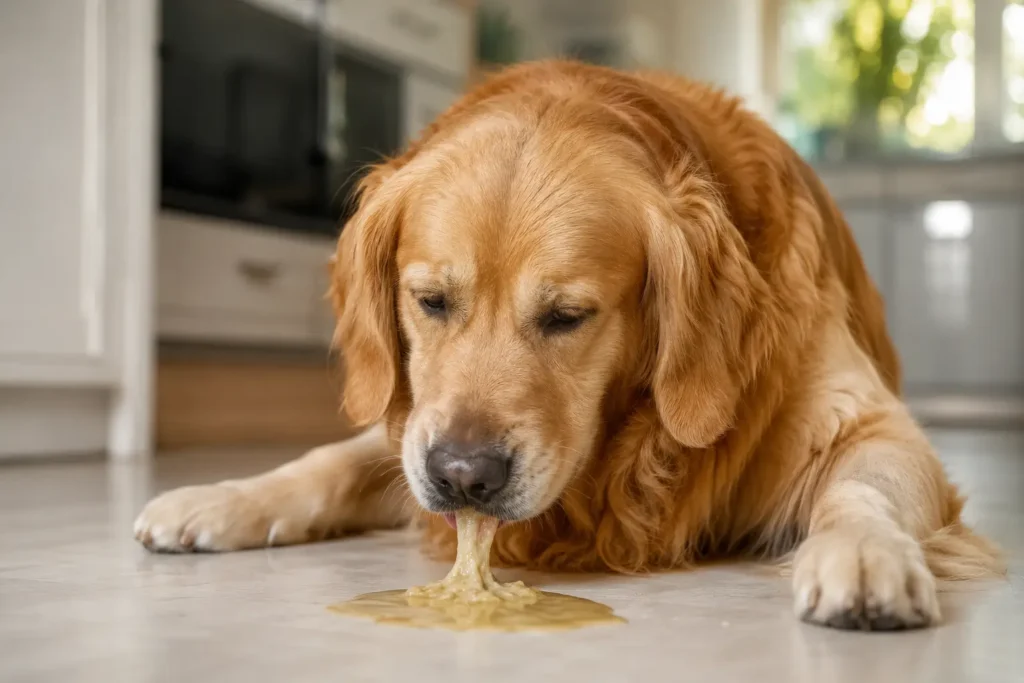
Dog vomiting causes stomach irritation, intestinal blockage, infection, inflammation of pancreas or some sort of poisoning, and also may have any other comorbidities.Color describes what came up. It rarely explains why.
Let’s start with the dog.
Is your dog walking around normally? Did the vomiting happen once? Can water stay down? A bright adult dog after one episode gives you time to observe.
The situation changes when the dog becomes weak, painful, or unusually still. Repeated vomiting changes it again.
This is a complete guide to vomiting causes in dogs, what the color indicates, symptoms and emergency signs.
What should you check during the first 10 minutes?
Check the episode, your dog’s situation, and the area around your dog.
A useful first check covers five facts:
- What came up?
- How did it come up?
- How many episodes occurred?
- What happened earlier that day?
- How does your dog look now?
Take a photograph before cleaning the area. Record the time. Search for missing food, which could be anything like medicine, wrappers etc.
Then watch your dog walk. Observe the posture, weak legs and breathing patterns and pain may appear as a tense abdomen.
In a study of 99 vomiting dogs, certain features are observed in dogs having complicated concerns including:
- Poor alertness
- Greater abdominal tension
- Pain
- Dehydration
- Abnormal temperature
Only color does not explain the situation, but the behaviour explains more.
Did your dog vomit, regurgitate, or cough?
Vomiting involves active abdominal contractions. Regurgitation is passive food or fluid slides back from the esophagus with no retching, sometimes no warning at all.
Get this distinction right before anything else. Vomiting investigation focuses on the stomach, intestines, and systemic disease. Regurgitation diagnosis concerns with the esophagus and swallowing mechanism.
A coughing dog moves the chest and throat first. White foam may appear after several coughs.
Merck describes vomiting as a forceful ejection from the stomach or upper small intestine. Regurgitation is passive and does not require abdominal contraction. Below given table can help you to differentiate among these three conditions.
| What you see | Vomiting | Regurgitation | Coughing |
| Effort | Retching with abdominal movement | Little visible effort | Chest or throat movement |
| Warning | Nausea, drooling, lip licking | Often none | Repeated cough |
| Material | Food, bile, fluid, foam, blood | Undigested food or water | Mucus or foam |
| Likely source | Stomach or upper intestine | Esophagus | Airways or lungs |
| Useful clue | Dog looks nauseated first | Food may appear tube-shaped | Cough comes before material |
A short video content helps the veterinarian in the quick and proper diagnosis.Thats why film that moment.
What happened before the vomiting started?
The hours before vomiting often narrow the cause faster than the color.
There are various causes of vomiting in dogs, some of them are elaborated below, which basically occurred before this condition.
Was food or garbage involved?
Some irritants responsible for the stomach irritation which included:
- Spoiled food
- Rich scraps
- Overeating
- Sudden diet changes
Suppose an adult dog steals cooked meat from an open bin. The dog vomits once overnight, drinks normally, and remains interested in breakfast.
That pattern fits a short food related upset.
Now add repeated vomiting and belly pain. A simple stomach upset no longer covers the whole event. Pancreatitis, poisoning, or obstruction moves higher on the list.
Check the last 24 hours rather than the last meal alone:
- New dog food
- Fatty table scraps
- Open rubbish
- Missing bones or chews
- Damaged toys or clothing
Food allergy gets blamed too quickly. Vomiting alone cannot confirm it.
Is something missing from the house?
A missing object plus repeated vomiting raises concern for a gastrointestinal obstruction.
Like socks, clothing, toys, bones, corn cobs, and food wrappers can cause blockage inside the stomach or intestine, which in turn prevent food and waste removal normally.
Vomiting may start at once or several hours later. Appetite often drops. The dog may become quiet or painful.
Some blocked dogs still pass stool. A partial obstruction can leave material already inside the colon, so one bowel movement does not rule it out.
String and ribbon create a different injury. The intestine can gather along the material while the string cuts into its wall.
Perforation allows bowel contents to enter the abdomen. Peritonitis and sepsis can follow.
Imaging does not answer every case. Cornell notes that surgery may still be required when history and symptoms strongly suggest obstruction despite unclear images.
Tell the clinic what disappeared and when you last saw it.
Did the symptoms begin during travel?
Motion sickness often follows a clear timetable.
A dog may look uneasy, or vomit while travelling. Signs often stop when the vehicle stops moving.
Fear can become part of the pattern. A dog that associates a car with nausea may drool before the journey begins.
Vomiting that continues for hours after arriving home needs a wider assessment. The car may not explain the full illness.
Is the dog taking medicine?
Medicine use changes the risk assessment.
Human painkillers can damage a dog’s stomach. Veterinary anti-inflammatory medicine can also cause digestive bleeding in some patients.
Bring the medicine packet to the clinic, which helps in early assessment.
Do not treat vomiting with leftover medicine from an earlier illness. The same symptom can come from different causes.
Why does puppy vomiting require earlier action?
Puppies lose fluid quickly and often swallow objects that adult dogs ignore.
An unvaccinated puppy with vomiting and diarrhea requires prompt parvovirus testing. Cornell reports that canine parvovirus commonly affects puppies aged 6 weeks to 6 months.
The illness may begin with tiredness and reduced appetite. Vomiting follows. Diarrhea can become bloody or contain mucus.
Parvovirus attacks the intestinal lining. Bacteria can then cross into the bloodstream and reduce the immune system of dogs, which lead to the growth and chances of infection more by many parasites like Roundworms, hookworms, whipworms, Giardia, and coccidia.
A fecal examination helps separate these infections from parvovirus and food irritation.
A puppy can carry parasites and parvovirus at the same time. The clinic may test for both.
What does belly pain add to the picture?
Dog vomiting with abdominal pain raises concern for pancreatitis, obstruction, or another painful abdominal disorder.
Pancreatitis is inflammation of the pancreas. Severe cases often include vomiting, appetite loss, weakness, dehydration, diarrhea, and abdominal pain.
A painful dog may lower the chest while keeping the hindquarters raised. This is often called the prayer position.
The posture shows discomfort. It does not prove pancreatitis.
Merck also links the prayer position with inflammation and pain near the front of the abdomen.
Diagnosis draws on several findings:
- Recent diet and medical history
- Physical examination
- Blood chemistry
- Pancreatic lipase testing
- Abdominal ultrasound
Mild pancreatitis can be harder to spot. The dog may simply eat less or seem tired.
Which toxins can begin with vomiting?
Poisoning may look like a stomach problem at first.
The dangerous effects can continue after the vomiting stops.
Xylitol
Xylitol appears in some sugar free gum, sweets and other supplemental products .Labels may call it birch sugar or wood sugar.
The U.S. Food and Drug Administration states that xylitol poisoning can begin within 20 minutes.
Vomiting may come first with lagging conditions such as weakness, trouble walking and shaking. Do not wait for another symptom after known exposure.
Grapes and raisins
Grapes and raisins can damage canine kidneys.
The response varies between dogs. The absence of early symptoms does not prove safety.
Contact a veterinarian after known exposure. Keep the packaging or remaining fruit available.
Household chemicals and unknown products
Cleaners, pesticides, and garden products can trigger vomiting.
Do not force vomiting unless a veterinary professional gives specific directions. Some products can burn the esophagus or enter the lungs during vomiting.
Products such as salt, mustard, and syrup of ipecac can add another injury.
Record the maximum data regarding product name, ingredients etc.
What if there was no obvious trigger?
Recurring vomiting can begin outside the stomach and intestines.
Other diseased state may also contribute to vomiting in dogs like:
- Kidney disease
- Liver disease
- Addison disease
- Uterine infection
- Some cancers can all cause nausea
Look for changes that seem unrelated to digestion.
A dog with kidney disease may drink more and urinate more. Liver disease can cause yellow gums or yellow eye whites.
Weight loss and reduced appetite can develop slowly. The vomiting may come and go.
Addison disease creates this uneven pattern in some dogs. Merck reports that vomiting, diarrhea, and increased drinking can appear for days or months before diagnosis.
Stress can make the signs worse. An Addisonian crisis can cause shock, low blood glucose, severe vomiting, or bloody diarrhea.
Vomiting once each week still counts as recurring vomiting. Cornell advises veterinary assessment for that pattern.
What do dog vomit colors mean?
Dog vomit colors identify possible contents. They do not identify one disease.
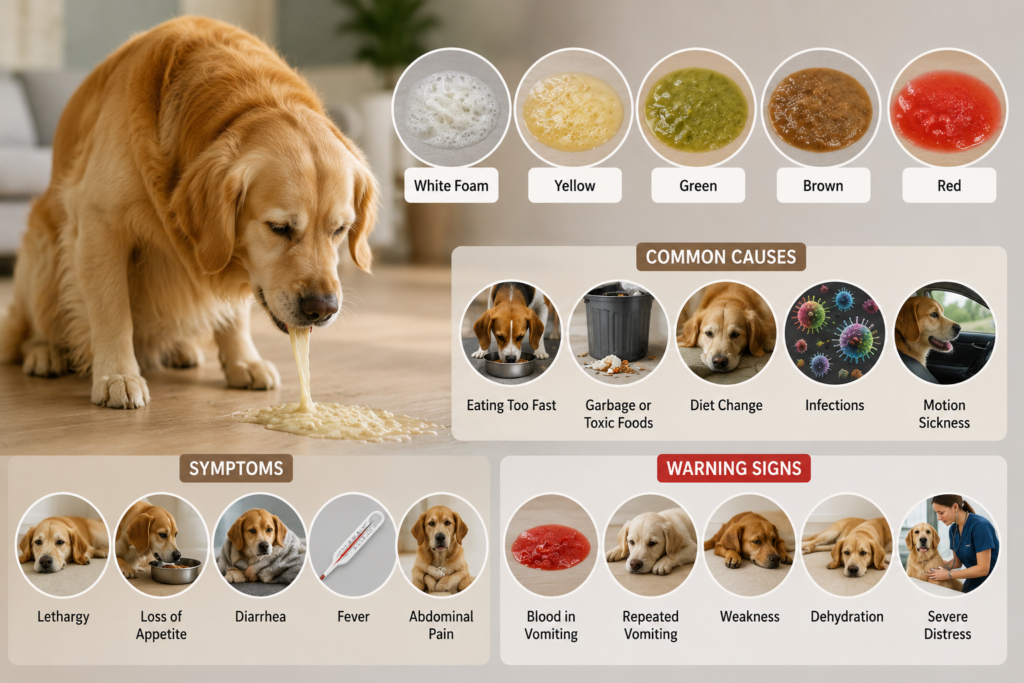
Bile can look yellow or green. Fresh blood may look red. Partly digested blood can resemble coffee grounds.
Food dye, soil, grass, and swallowed material can alter the appearance again.
The table connects color with context. Read both columns before deciding what to do.
| Appearance | Possible contents | What raises concern |
| Yellow or yellow-green | Bile | Repeated episodes, weakness, pain |
| White foam | Saliva, air, stomach fluid | Dry heaving, swollen abdomen |
| Clear liquid | Water or gastric secretions | Vomiting after every drink |
| Green material | Grass, bile, dye, chemical | Access to bait or pesticide |
| Bright red blood | Fresh bleeding | Pale gums, weakness, black stool |
| Coffee-ground material | Partly digested blood | Pain, repeated vomiting |
| Brown or black material | Food, soil, blood, intestinal material | Foul smell, missing object |
| Undigested food | Recent meal or regurgitation | Weight loss, coughing, repeat events |
Yellow dog vomit
Yellow dog vomit usually contains bile.
An empty stomach may produce a small yellow puddle early in the morning. Repeated vomiting can also empty the stomach until only bile remains.
Stomach inflammation, pancreatitis, obstruction, and disease elsewhere in the body can produce the same color.
The timing and the dog’s condition decide what the color means.
White foamy dog vomit
White foam often contains saliva, swallowed air, and stomach fluid.
One episode can follow minor irritation. Repeated foam beside dry heaving and abdominal swelling is an emergency pattern.
Coughing can also produce white foam. Watch whether chest movement or abdominal tightening occurred first.
Clear dog vomit
Clear vomit may contain water, saliva, or gastric secretions.
A dog can vomit once after drinking quickly. Repeated vomiting after every drink means the dog cannot replace lost fluid.
Do not remove water for a long period without veterinary guidance. Fluid restriction can worsen dehydration.
Blood or coffee ground material
Bright red blood suggests recent bleeding.
Coffee ground material suggests blood that remained in the stomach long enough for partial digestion.
Cornell advises veterinary contact when vomit contains blood or coffee ground material. A painful abdomen, fever, or vomiting beyond 24 hours also warrants assessment.
A few red streaks can appear after repeated retching. The appearance still cannot identify the source.
Brown, black, or foul smelling vomit
Brown vomit may contain kibble, soil, blood, or intestinal material.
Recently eaten brown food gives one possible answer. Dark, grainy material may indicate digested blood.
A foul, stool like smell beside pain or repeated vomiting raises concern for a blockage.
Take a clear photograph. Color descriptions vary too much to rely on memory.
How do you assess whether dog vomiting is serious?
Assess using 5 checks. Not color. Not one symptom in isolation.
Check 1 — Vomit content. Photograph before cleaning. Look for blood, bile, foam, food, foreign material, coffee ground texture.
Check 2 — Timing. Link episodes to meals, drinking, exercise, medication, diet changes, outdoor access. Each relationship narrows the field.
Check 3 — Episode count. Count retching attempts and dry heaving separately from productive vomiting. Eight unproductive retches and one productive vomit are not the same clinical picture as two clean productive episodes.
Check 4 — Dog’s current state. Gum color, alertness, willingness to drink, abdominal sensitivity, stool consistency, urination pattern. This is more diagnostic than the vomit itself in many cases.
Check 5 — Patient risk. A 10-week-old unvaccinated puppy, a 12-year-old with kidney disease, and a healthy 3-year-old adult carry completely different risk levels from identical symptoms.
When does waiting become unsafe?
Waiting becomes unsafe when vomiting occurs with shock, severe pain,or blood loss.
One emergency deserves separate attention.
Gastric dilatation volvulus (GDV) occurs when the stomach expands and rotates. Dogs often retch repeatedly while producing little material.
Large and giant breeds face higher risk. Merck reports a 20% mortality rate in treated animals, with some clinical estimates reaching 45%.
Seek emergency care for:
- Repeated dry heaving
- A swollen or firm abdomen
- Collapse or inability to stand
- Difficult breathing
- Seizures or poor coordination
- Large amounts of blood
- Known poison exposure
- Suspected foreign-object ingestion
- Puppy vomiting with bloody diarrhea
- Water returning after every drink
What information does the veterinarian need?
“My dog vomited” gives the clinic a starting point. A timeline gives the clinic something useful.
Record:
- Exact episode times
- Number of productive episodes
- Number of dry-heaving attempts
- Color and texture
- Visible blood or foreign material
- Recent food and treats
- Medicine and supplements
- Stool and urination changes
- Vaccination status
- Missing household objects
- Possible poison exposure
- Behaviour between episodes
Bring product packaging after suspected poisoning.
Testing depends on the history and examination. Blood work, urine testing, fecal tests, radiographs, ultrasound, and pancreatic testing serve different questions.
The study of 99 vomiting dogs found no single testing plan suitable for every patient. Reduced appetite and longer illness made ultrasound more useful.
Poor alertness increased the usefulness of blood tests and radiographs.
Frequently asked questions
Why is my dog vomiting yellow bile?
Yellow dog vomit contains bile, but repeated bile vomiting can occur with stomach irritation, some inflammatory condition, any blockage or may have any other comorbidity.
Why is my dog vomiting white foam?
White foam often contains saliva and stomach fluid, while repeated foamy retching with abdominal swelling can indicate GDV.
Why is my dog vomiting undigested food?
Undigested food can follow vomiting soon after eating or passive regurgitation from the esophagus.
Why is my dog vomiting and having diarrhea?
Dog vomiting and diarrhea can follow food irritation, infection, parasites, poisoning, or intestinal inflammation.
Is one vomiting episode dangerous?
One episode can remain mild in an alert adult dog. But other symptoms like blood, pain, weakness, another episode, or known exposure changes the risk.
How long is too long for dog vomiting?
Contact a veterinarian when vomiting lasts beyond 24 hours, prevents drinking, or occurs with other signs including pain, or appetite loss.
Which dog vomit color is most concerning?
Bright blood, coffee ground material, or dark foul smelling vomit requires veterinary assessment, especially when the dog appears weak or painful.
Does grass cause dog vomiting?
Grass can appear in vomit, but its presence does not prove that grass caused the episode. Nausea may have started before grazing.
Conclusion: What Dog Vomiting Really Tells You
Vomiting once may mean very little. What happens afterward matters more. Is your dog alert? Can it drink? Does it seem comfortable?Keep watching if your dog quickly returns to normal. Call a vet when the vomiting repeats or your dog becomes weak, painful, bloated, or unable to keep water down. A quick photo and a note of the time can also give the vet useful clues.