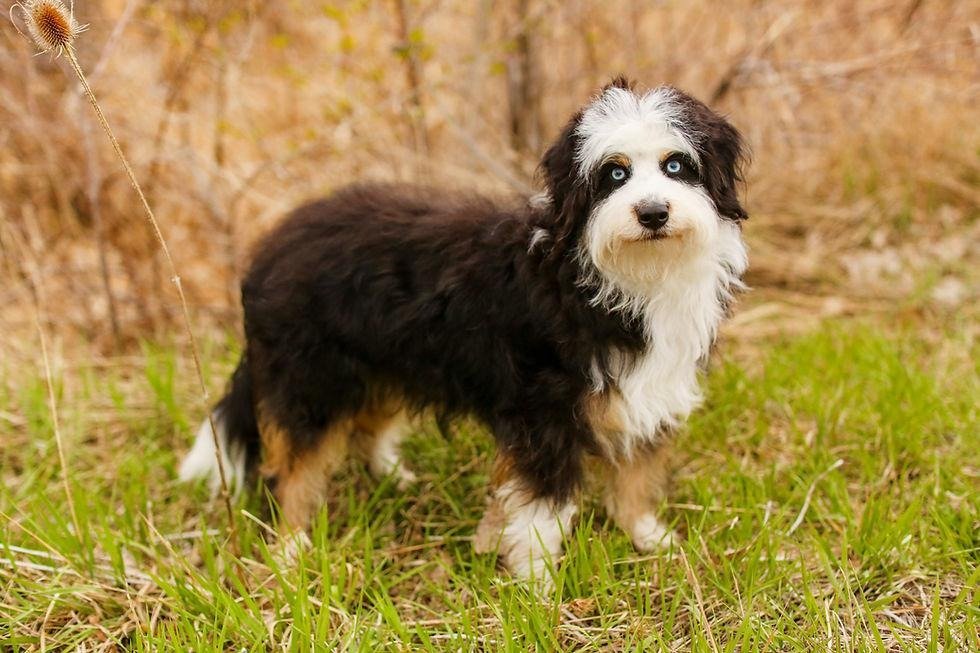
A Mini Aussiedoodle combines the intelligence of an Australian Shepherd with the smaller build and distinctive coat of a Miniature Poodle. Most adults weigh 15 to 35 pounds, but their compact appearance can be misleading. These dogs often require substantial exercise, consistent training, and more coat maintenance than their size suggests.
Choosing a Mini Aussiedoodle involves understanding more than its fluffy appearance. Adult weight, inherited temperament, shedding, grooming expenses, and potential genetic health conditions can vary considerably between puppies. This guide explains what determines a Mini Aussiedoodle’s full-grown size, how its needs change with age, and what families should consider before bringing one home.
What Is a Mini Aussiedoodle?
A Mini Aussiedoodle is a crossbreed produced by combining an Australian Shepherd-type dog with a Miniature Poodle. Some breeders use Miniature American Shepherds, while others use Australian Shepherds of different sizes.
The smaller Poodle parent generally produces a more compact dog than the Standard Aussiedoodle. However, Mini Aussiedoodles remain athletic, intelligent, and often highly energetic.
The cross is sometimes called a Mini Aussiepoo or Mini Aussiepoodle. It is not recognized as a separate purebred dog by the American Kennel Club.
What Are the Main Characteristics of a Mini Aussiedoodle?
| Characteristic | Typical description |
| Breed type | Australian Shepherd-type dog × Miniature Poodle |
| Adult weight | Approximately 15 to 35 pounds |
| Height | Approximately 12 to 18 inches |
| Lifespan | Commonly estimated at 12 to 15 years |
| Temperament | Intelligent, affectionate, energetic, playful |
| Coat | Straight, wavy, or curly |
| Coat colors | Blue merle, red merle, black, cream, chocolate, tricolor |
| Shedding | Low to moderate or higher, depending on coat |
| Exercise | Often around 60 minutes daily for healthy adults |
| Grooming | Regular brushing and periodic professional grooming |
These characteristics are estimates rather than guaranteed breed standards. Two puppies from the same litter may grow into noticeably different adults.
How Big Does a Mini Aussiedoodle Get?
A full-grown Mini Aussiedoodle typically weighs 15 to 35 pounds and stands 12 to 18 inches tall at the shoulder. Adult size depends primarily on inherited growth characteristics and the sizes of the parents.
Some smaller Mini Aussiedoodles remain under 20 pounds, while others may exceed 35 pounds.
Because the Aussiedoodle has no universal breed standard, breeders may use different weight ranges when describing Mini, Medium, or Toy variations.
Mini Aussiedoodle Full-Grown Size Chart
| Size description | Adult weight | Height at shoulder |
| Small Mini | 15 to 22 lb | 12 to 14 in |
| Medium Mini | 22 to 30 lb | 14 to 16 in |
| Large Mini | 30 to 35 lb | 16 to 18 in |
These are approximate descriptive categories, not official breed classifications.
A puppy’s parentage provides more reliable information than a marketing label. An Australian Shepherd parent weighing 45 pounds may produce larger offspring than a smaller Miniature American Shepherd.
When Does a Mini Aussiedoodle Stop Growing?
Many Mini Aussiedoodles approach adult height between 10 and 14 months, although some continue developing muscle and body condition afterward.
Smaller individuals may mature earlier than larger dogs.
Growth depends on genetics, nutrition, health, and individual development. Puppy weights at specific ages cannot reliably predict exact adult size without considering parent measurements and growth history.
A veterinarian can help assess whether a puppy’s development is consistent with its expected adult size.
What Is the Difference Between a Mini Aussiedoodle and a Standard Aussiedoodle?
The main difference is adult body size. Both variations can inherit similar intelligence, energy levels, and coat characteristics.
| Feature | Mini Aussiedoodle | Standard Aussiedoodle |
| Weight | 15 to 35 lb | 40 to 70 lb |
| Height | 12 to 18 in | Approximately 15 to 23 in |
| Physical build | Small to medium | Medium to large |
| Energy | Often high | Often high |
| Training requirements | Consistent training | Consistent training |
| Grooming requirements | Coat-dependent | Coat-dependent |
Smaller size does not guarantee a calmer dog. A Mini Aussiedoodle can display the same strong herding tendencies and interest in activity as a larger Aussiedoodle.
What Does a Full-Grown Mini Aussiedoodle Look Like?
A full-grown Mini Aussiedoodle usually has an athletic body, floppy ears, expressive eyes, and a coat that ranges from loose waves to tight curls.
Some resemble a smaller Australian Shepherd with facial furnishings inherited from the Poodle. Others have rounded features and a dense, curly coat.
The combination of parental genes produces considerable variation in appearance.
What Colors Do Mini Aussiedoodles Come In?
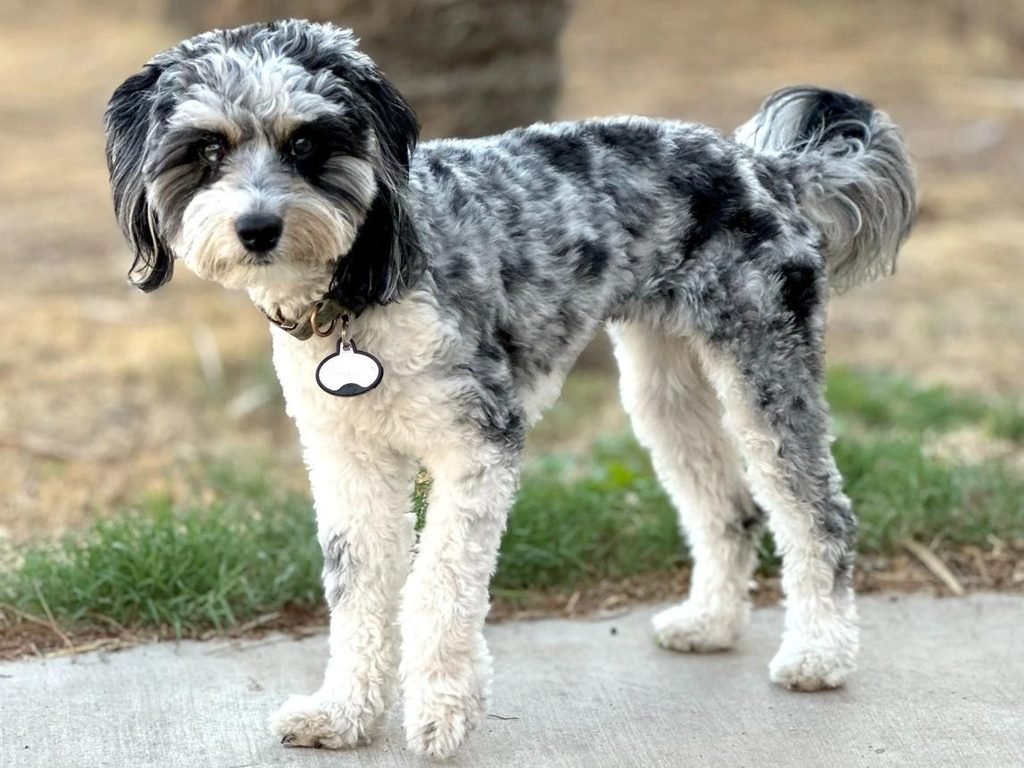
Blue merle
Gray, black, and lighter mottled markings.
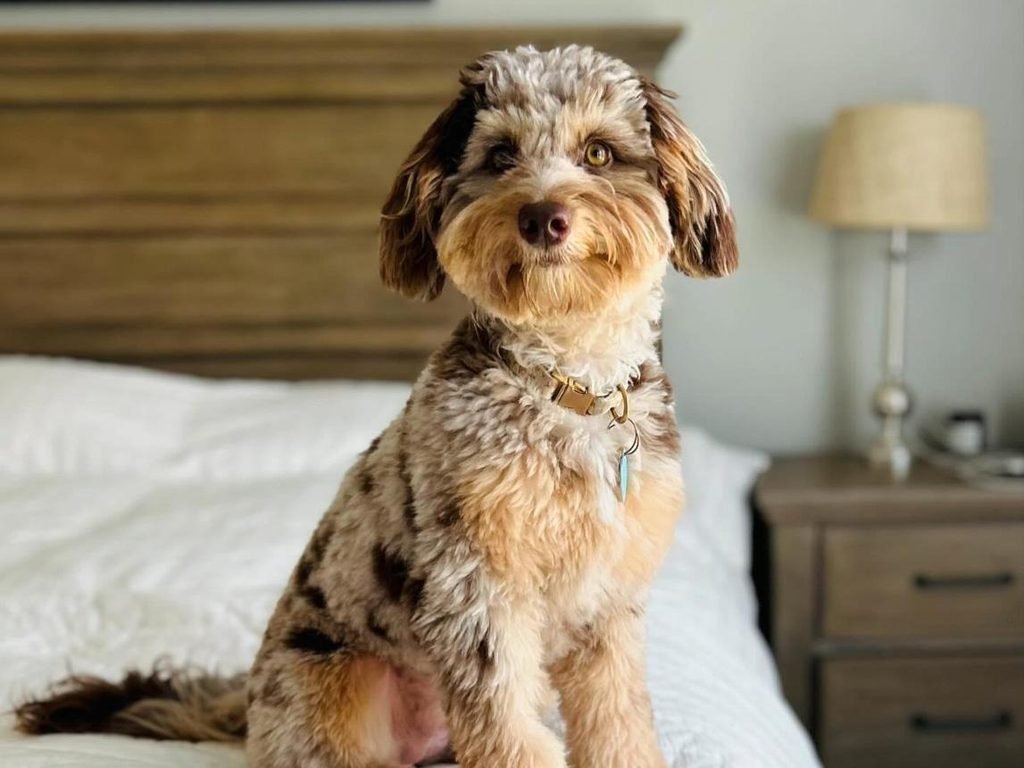
Red merle
Reddish-brown and lighter marbled markings.
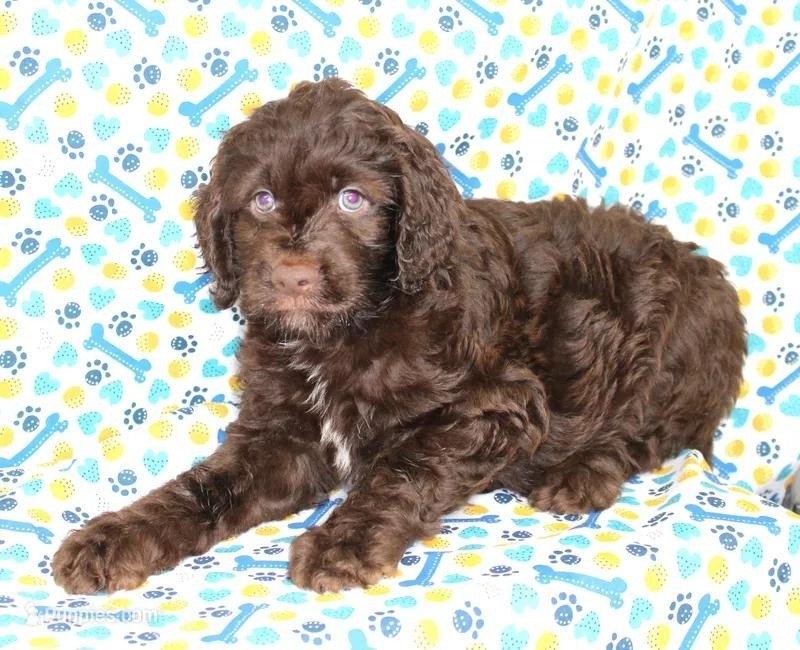
Solid or patterned brown shades.
Other colors include cream, apricot, red, sable, and combinations of these shades.
Coat color does not determine intelligence or temperament. However, merle genetics require responsible breeding practices because certain genetic combinations increase the risk of eye and hearing abnormalities.
Do Mini Aussiedoodles Shed?
Mini Aussiedoodles can shed less than Australian Shepherds, but their shedding level is not predictable from the breed name alone.
Coat texture and genetic inheritance affect how much loose hair enters the environment.
Dogs with curly coats may retain shed hair within the curls, increasing the risk of matting. Dogs with straighter coats may shed more visibly.
Are Mini Aussiedoodles Hypoallergenic?
No Mini Aussiedoodle is guaranteed to be hypoallergenic. All dogs can produce allergens through their saliva, dander, and other biological materials.
Poodle ancestry may contribute a lower-shedding coat, but it does not eliminate allergen exposure.
PetMD also explains that Aussiedoodles cannot be guaranteed to have non-shedding coats or be suitable for everyone with dog allergies.
The amount of shedding varies among individual dogs, just as it does among other low-shedding dog breeds.
People with significant dog allergies should consult an allergy specialist and assess their response to the individual animal before adoption.
What Do F1 and F1B Mini Aussiedoodles Mean?
F1 and F1B describe breeding generations.
| Generation | Parent combination |
| F1 | Australian Shepherd-type dog × Miniature Poodle |
| F1B | F1 Aussiedoodle × Poodle |
| F2 | F1 Aussiedoodle × F1 Aussiedoodle |
| Multigenerational | Later-generation Aussiedoodle crosses |
An F1B Mini Aussiedoodle produced by crossing an F1 Aussiedoodle with a purebred Poodle has an expected ancestry of approximately 75% Poodle.
However, generation labels do not guarantee shedding levels, adult size, or allergy compatibility.
What Is the Temperament of a Mini Aussiedoodle?
Mini Aussiedoodles are generally intelligent, affectionate, energetic, and people-oriented dogs. They often enjoy close relationships with their families and respond well to structured training.
Australian Shepherd ancestry can contribute herding instincts and alertness. Poodle ancestry can contribute retrieving behavior and enthusiasm for learning.
Individual temperament varies according to genetics, social experiences, training, and health.
Are Mini Aussiedoodles Good Family Dogs?
Mini Aussiedoodles can be suitable family dogs when households provide sufficient exercise, companionship, and consistent behavioral guidance.
Their playful nature often suits active families with older children.
However, young children may trigger chasing or herding behavior. Some dogs attempt to nip at moving heels or circle running children.
Supervision and early training help prevent these behaviors from becoming disruptive.
Are Mini Aussiedoodles Easy to Train?
Mini Aussiedoodles are often highly trainable because both parent breeds have strong learning abilities and histories of working with people.
They may quickly recognize familiar commands and routines, but successful training still depends on consistency.
Rewarding appropriate behavior encourages reliable responses without unnecessary stress.
The American Veterinary Society of Animal Behavior recommends reward-based training rather than methods relying on fear or pain. These principles are also central to force-free dog training.
Do Mini Aussiedoodles Bark a Lot?
Mini Aussiedoodles may bark at strangers, unfamiliar noises, moving animals, or changes in their surroundings.
Some develop frequent barking when under-stimulated or distressed during separation.
Alert barking is not necessarily aggression. Identifying triggers and rewarding calm responses helps manage unwanted vocalization.
How Much Exercise Does a Mini Aussiedoodle Need?
Many healthy adult Mini Aussiedoodles benefit from approximately one hour of daily physical activity, along with mental enrichment.
The exact amount varies with age, health, and inherited energy levels.
Young puppies require shorter, age-appropriate activities and sufficient rest. Adults may enjoy longer walks, retrieving games, swimming, or suitable canine sports.
What Activities Are Best for Mini Aussiedoodles?
- Walking: Supports physical activity and environmental exploration.
- Fetch: Encourages movement, recall, and retrieving.
- Scent games: Develop concentration through nose work training.
- Agility: Builds coordination and cooperation when age-appropriate.
- Puzzle toys: Provide mental enrichment during indoor periods.
Daily activity should include opportunities for rest. More intense exercise does not automatically improve behavior when a dog is already overstimulated or tired.
Can Mini Aussiedoodles Live in Apartments?
Mini Aussiedoodles can live in apartments when their exercise, enrichment, and behavioral requirements are met.
A smaller body makes them easier to accommodate in limited spaces, but high energy and frequent barking may create challenges.
Outdoor activity, a quiet resting area, and predictable routines help support apartment living.
How Often Should a Mini Aussiedoodle Be Groomed?
Mini Aussiedoodles generally need brushing several times a week, with some curly coats requiring daily attention. Professional grooming is commonly scheduled around every six to eight weeks.
Grooming requirements depend on coat density, curl pattern, length, and individual skin condition.
Mats frequently develop behind the ears, near the collar, around the armpits, and beneath the legs.
How Should Owners Brush a Mini Aussiedoodle?
Brushing must reach through the coat rather than simply smoothing its outer surface.
A suitable grooming routine includes checking for tangles, dividing the coat into sections, and using an appropriate brush and comb.
Tight mats should not be removed using scissors close to the skin because of injury risk.
Professional grooming may be necessary when matting is extensive or painful.
Why Does a Mini Aussiedoodle Smell Bad?
A persistent odor may result from damp fur, dirty skin, dental problems, or ear infections.
A strong smell originating from the ears may indicate inflammation or infection, particularly when accompanied by redness, discharge, or head shaking.
Repeated bathing without identifying the source of an odor may worsen skin irritation.
Veterinary assessment is appropriate when an unusual smell persists.
What Health Problems Can Mini Aussiedoodles Develop?
Mini Aussiedoodles can inherit genetic health conditions associated with Australian Shepherd-type dogs and Miniature Poodles.
Potential concerns include joint disorders, inherited eye diseases, thyroid problems, and medication sensitivities.
| Health concern | Possible effect |
| Hip dysplasia | Joint pain and reduced mobility |
| Patellar luxation | Kneecap instability |
| Progressive retinal atrophy | Gradual vision loss |
| Cataracts | Clouding of the eye lens |
| Autoimmune thyroiditis | Reduced thyroid function |
| MDR1 drug sensitivity | Adverse reactions to certain medications |
Can Mini Aussiedoodles Develop Hip Dysplasia?
Hip dysplasia occurs when the hip joint develops abnormally and may eventually cause pain or arthritis.
Affected dogs may show stiffness, reluctance to exercise, or changes in movement.
Early signs and treatment options depend on the severity of the condition. Veterinary evaluation is important when symptoms appear.
What Is MDR1 Drug Sensitivity?
MDR1 drug sensitivity involves genetic changes affecting how certain medications are transported within the body.
This condition is relevant to dogs with Australian Shepherd ancestry.
Washington State University’s MDR1 drug sensitivity resource describes the condition and the importance of genetic testing.
Dogs with the relevant genetic variant may react abnormally to specific drugs or doses. Medication decisions require veterinary guidance.
How Long Do Mini Aussiedoodles Live?
Mini Aussiedoodles are commonly estimated to live 12 to 15 years, although individual lifespans vary.
Inherited health, nutrition, exercise, body condition, preventive care, and environmental factors influence longevity.
Routine veterinary examinations support early identification and management of health concerns.
What Should a Mini Aussiedoodle Eat?
Mini Aussiedoodles require a complete, balanced diet appropriate for their age, body condition, and activity level.
Puppies need diets formulated for growth, while healthy adults generally need adult-maintenance food.
Daily portions depend on the food’s energy content and the dog’s individual requirements.
How Much Should a Mini Aussiedoodle Eat?
There is no universal serving quantity for every Mini Aussiedoodle.
Owners can estimate energy requirements using a dog feeding calculator, then adjust portions based on veterinary advice and changes in body condition.
Excessive calorie intake can contribute to obesity, which increases stress on joints and may worsen existing orthopedic problems.
How Much Does a Mini Aussiedoodle Cost?
Mini Aussiedoodle puppies are often advertised for approximately $1,500 to $4,500 in the United States, although prices vary widely by breeder, location, and the services included.
This range represents published asking prices rather than a verified national average.
Higher prices do not automatically indicate better health or ethical breeding.
What Affects Mini Aussiedoodle Puppy Prices?
Common pricing factors include genetic screening, parent lineage, veterinary care, breeder location, and demand for particular sizes or coat patterns.
Breeders who perform appropriate health testing may incur additional costs, but buyers should request documentation rather than assume that a higher purchase price reflects responsible practices.
What Are the Long-Term Ownership Costs?
Ongoing expenses include food, veterinary examinations, parasite prevention, grooming, training, and emergency care.
Professional coat maintenance may represent a substantial recurring cost, especially for dense, curly coats.
Unexpected health conditions can also increase lifetime expenses.
How Can Families Choose a Healthy Mini Aussiedoodle Puppy?
Choosing a Mini Aussiedoodle puppy involves reviewing parental health records, evaluating early socialization, and assessing breeding conditions.
A responsible breeder should explain inherited health risks and provide realistic expectations about adult size and temperament.
Useful checks include:
- Confirm the breeds and adult weights of both parents.
- Request relevant genetic screening records.
- Review orthopedic and eye examination results.
- Ask about MDR1 and merle genetic status where relevant.
- Examine the puppy’s living and socialization environment.
- Confirm vaccination and veterinary examination records.
- Review written purchase and return policies.
Families may also consider rescue organizations, where adult dogs sometimes provide clearer information about final size and established behavior.
Frequently Asked Questions About Mini Aussiedoodles
Is a Mini Aussiedoodle a Good Dog for First-Time Owners?
Mini Aussiedoodles can suit first-time owners who are prepared to provide daily exercise, training, grooming, and companionship.
Do Mini Aussiedoodles Stay Small?
Most remain smaller than Standard Aussiedoodles, although some mature beyond expected Mini weight ranges.
Are Mini Aussiedoodles Hypoallergenic?
No. They may shed relatively little, but no Mini Aussiedoodle is guaranteed to be safe for people with dog allergies.
At What Age Is a Mini Aussiedoodle Fully Grown?
Many approach adult height between 10 and 14 months, with further physical development possible afterward.
Are Mini Aussiedoodles High Maintenance?
Many require substantial exercise, mental stimulation, regular brushing, and professional grooming.
Can Mini Aussiedoodles Be Left Alone?
Some adults tolerate periods alone after gradual independence training. Prolonged isolation may be difficult for dogs prone to separation-related distress.
Do Mini Aussiedoodles Get Along With Cats?
Some coexist peacefully with cats after suitable introductions, although chasing tendencies can complicate interactions.
Conclusion: Is a Mini Aussiedoodle the Right Dog?
A Mini Aussiedoodle offers an appealing combination of intelligence, affection, and athletic ability in a relatively compact body. However, the smaller size does not eliminate demanding exercise, grooming, and training requirements. Adult weight, coat texture, and temperament can differ considerably between individuals, making parental information and health screening important.
Families considering a Mini Aussiedoodle benefit from evaluating more than appearance. Reliable breeding records, realistic financial planning, and a daily routine that accommodates activity and companionship help establish a suitable home.
For households prepared for these responsibilities, a Mini Aussiedoodle can be a rewarding long-term companion.