
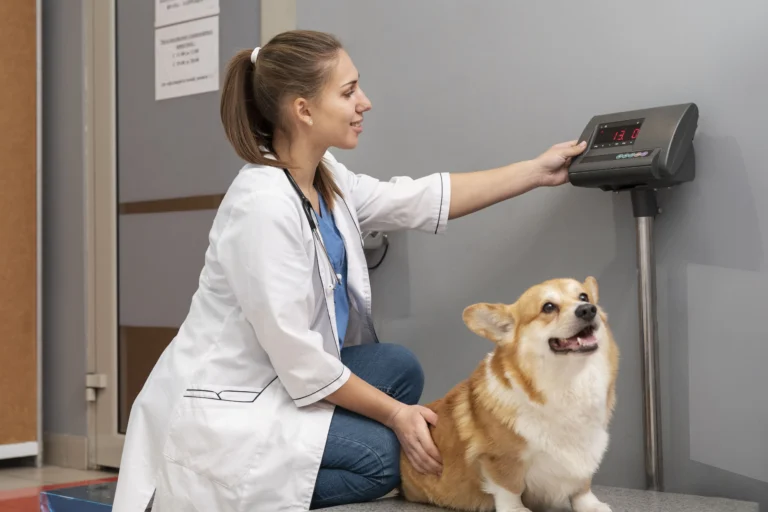
Feeding your dog the correct quantity of food is equally critical to selecting a high-quality diet. Many pet owners only depend on bag guidelines or questionable online calculators, which can result in over-feeding, under-feeding, and long-term health issues. In this blog post, we will introduce you to a more effective, veterinary nutrition-based feeding calculator method and demonstrate the advantages compared to the feeding calculators from websites such as Dog Food Advisor and Purina.
Why Current Calculators Are Not Enough
Two commonly recognized calculators:
The Dog Food Advisor calculator employs a metabolic-weight formula that was established from older articles from Waltham Centre for Pet Nutrition (Waltham) (e.g., “110 x (body weight kg)0.75 to maintain adult dog”) (Sagman, 2009).
The Purina feeding guide tool estimates RER (resting energy requirement) x life-stage multipliers (e.g. neutered adult x 1.6) as its starting point (www.petmd.com 2025).
These calculators view dogs very uniformly and depending on weight, age-stage and activity level, but often do not consider the body condition score, whether or not they are neutered, possible disease states, breed differences or metabolic variability. Recent work shows these elements are likely to be important.
Many calculators simply assume what they listed as “cups per day” will work for all dogs; however, it is easy to make estimating errors given ingredient style (e.g., cups vs. grams) and routinely it results in 50-150% over/under-feeding (Bonza.dog, 2025).
Nutritional recommendations published by authorities like FEDIAF, emphasise that energy requirement equations are simply estimates and must be adjusted for any individual dog – e.g., the older the dog is the lower the estimate should be; a more playfully active dog should consume more; a lean dog will require more than an overweight dog; all this to say, the calculators are starting points, and will need to be modified for effectiveness for optimal feeding for all dogs.
An improved feeding calculator, with clearer steps
There is now a better way to calculate how much food to provide your dog backed by science.

1. Measure or confirm your dog’s current weight (kg) and ideal weight (kg)
You will need to measure (or find out) your dog’s current (actual) weight (kg) and your dog’s ideal weight (kg)
This can easily be accomplished by weighing your dog yourself or at the vet. If your dog is over or under weight, please use your dog’s ideal weight to help you calculate their calorie amount.
2. Compute the Resting Energy Requirement (RER)
Formula:
RER (kcal/day)=70×(body weight in kg)0.75\text{RER (kcal/day)} = 70 \times (\text{body weight in kg})^{0.75}RER (kcal/day)=70×(body weight in kg)0.75 (www.petmd.com 2025)
Example: A 20 kg adult dog →
RER ≈ 70 × (20^0.75) ≈ 70 × 10.6 ≈ 742 kcal/day
3. The Maintenance Energy Requirement (MER) is obtained by multiplying RER by a factor
Determined by life-stage, exercise, neuter status etc.
· Neutered adult pet dog: ≈ 1.6 × RER
· Intact adult pet dog: ≈ 1.8 × RER (MSD Veterinary Manual, 2025)
· Senior, low activity, or obesity prone: ~1.4 × RER or even lower. (Sanderson, S.L, 2023)
· Puppies: <4 months = 3 × RER; >4 months = 2 × RER ((MSD Veterinary Manual, 2025).
Example: For the 20 kg dog above, neutered adult:
MER ≈ 742 × 1.6 ≈ 1,187 kcal/day
4. Divide by your food’s calorie density (kcal per cup or per gram)
You’ll find this number printed on the food label (e.g., “ME = 350 kcal/cup”).
If food is 350 kcal/cup → 1,187 ÷ 350 ≈ 3.4 cups/day
5. Adjust for meals, treats and real life
For adult dogs, split their food into two meals per day; puppies may require three to four appropriate meals.
You should subtract calories from any dog treats and the best practice is to keep the amount of treat calories less than 10% of the dog’s total calories per day.
Weigh the dog each week? Check for body condition where (for good body condition) you should be able to feel the ribs and have a waist line. If the dog is gaining or losing weight, adjust feeding based on the estimated metabolic rate (MER) ±5–10%.
If the dog has a disease or is a very active/working dog, and if it is a large/giant breed, consult a veterinary nutritionist.
6. Reassess often
Energy needs decline with age, decrease if the dog is neutered, or if the dog decreases its activity level. Research suggests neutered dogs have significantly lower MER (Pedrinelli et al., 2021).
Why is this method better
It is evidence-based, as it utilises veterinary literature that documents RER and MER formulas.
It is custom that not all dogs are the same; therefore, calculations include the dog’s weight, neuter status, life stage, and activity.
It focuses on monitoring and adjustment instead of relying on a bag chart.
It mitigates common pitfalls (scoops are often inaccurate; simply rely on the caloric density being a small variation and treating calories will often be ignored; and any evidence of previous caloric needs may not be accounted for if life changes).
Practical examples
Example A: Adult medium dog
Dog: 10 kg neutered adult, moderate activity.
RER ≈ 70 × (10^0.75) ≈ 70 × 5.6 ≈ 392 kcal/day.
MER ≈ 392 × 1.6 ≈ 627 kcal/day.
Food: 400 kcal/cup → 627 ÷ 400 ≈ 1.6 cups/day → ~0.8 cups per meal (if 2 meals).
Example B: Large breed puppy
Dog: Expected adult weight ~30 kg, current age 6 months (puppy life stage).
Ideal weight still growing, but estimate using current weight or target (consult vet). Suppose 20 kg.
RER ≈ 70 × (20^0.75) ≈ 742 kcal/day.
Puppy >4 mo → factor 2.0 → MER ≈ 1,484 kcal/day.
Food: 360 kcal/cup → 1,484 ÷ 360 ≈ 4.1 cups/day → divide into 3–4 meals.
Common mistakes & how to avoid them
Using “cups” only: Not all cup sizes are the same. Weighing (grams) is best.
Not thinking about how calorie density can differ: If you are comparing a food that contains 300 kcal/cupp vs. a food that contains 450 kcal/cup, that is a HUGE delta. Always look at “kcal per cup” or “kcal per kg” (Dogs Calculators, 2025).
Dogs Calculators
Treats/ add-ons: Treats can add significantly to calorie intake.
Blindly following a bag chart: Bag charts often assume an adult male, whole dog, average activity level, average metabolism; your dog may not fit that description. In fact, studies report that a dog’s maintenance energy requirement (MER) can vary immensely.
Not weighing of monitoring weight/body condition: Calculated dose is just the starting volume, then you must monitor & adjust.
Not checking for life changes: puppies→ adults→ seniors, have your dog spayed, surgery, decrease activity; all those changes mean your dog could need different calories.
Take home message
There is nothing wrong with determining your dog’s right amount of food to eat with your method, but it is not a one size fits all. Using the RER→ MER→grams/cups is a great starting point based on science, but the real message is to be monitoring your dog’s body condition and adjust the amount accordingly.
Deontologically, you will be doing more than just “plugging into a calculator”, you will be providing nutrition individualised to your dog’s needs, based on the latest veterinary nutrition literature.
References
Bonza.dog. (2025) Securly – Geolocation sharing. [online] Available at: https://www.bonza.dog/how-much-should-i-feed-my-dog/ [Accessed 28 Oct. 2025].
Dogs Calculators. (2025) How Much Dry Food Should I Feed My Dog Calculator [2025]. [online] Available at: https://dogscalculators.com/food-nutrition/how-much-dry-food-should-i-feed-my-dog-calculator [Accessed 28 Oct. 2025].
MSD Veterinary Manual (2025) Table: Daily Maintenance Energy Requirements for Dogs and Cats. [online] MSD Veterinary Manual. Available at: https://www.msdvetmanual.com/multimedia/table/daily-maintenance-energy-requirements-for-dogs-and-cats.
Pedrinelli, V., Porsani, M.Y.H., Lima, D.M., Teixeira, F.A., Duarte, C.N., Vendramini, T.H.A. and Brunetto, M.A., 2021. Predictive equations of maintenance energy requirement for healthy and chronically ill adult dogs. Journal of Animal Physiology and Animal Nutrition, 105, pp.63-69.
Sagman, M. (2009) Dog Food Calculator | Dog Food Advisor. [online] Dog Food Advisor. Available at:https://www.dogfoodadvisor.com/dog-feeding-tips/dog-food-calculator.
Sanderson, S.L. (2023) Nutritional Requirements of Small Animals – Management and Nutrition. [online] MSD Veterinary Manual. Available at: https://www.msdvetmanual.com/management-and-nutrition/nutrition-small-animals/nutritional-requirements-of-small-animals.
www.petmd.com. (2025) How Many Calories Does a Dog Need? [online] Available at: https://www.petmd.com/dog/nutrition/how-many-calories-does-a-dog-need.