

Deep-chested dogs are dogs with relatively deep, narrow rib cages that extend toward or below the elbows of their front legs. Common deep-chested dog breeds include Great Danes, Doberman Pinschers, Greyhounds, German Shepherds, and Weimaraners. Although this body shape supports different athletic abilities, it is associated with an increased risk of gastric dilatation-volvulus (GDV), a life-threatening condition commonly known as bloat. Understanding deep-chested dog anatomy, recognizing early warning signs of bloat, and following appropriate feeding and veterinary care recommendations can help owners make informed decisions about their dogs’ health and well-being.
Deep-chested dog breeds have substantial vertical depth through the thorax, with the brisket commonly reaching to or near the elbows. Great Danes, Doberman Pinschers, Weimaraners, Irish Setters, Greyhounds, Standard Poodles and several large hounds are common examples.
This guide covers 20 deep-chested dog breeds, how to recognize this body shape, how deep and barrel chests differ, which breeds have documented GDV risk, and what owners can do to recognize and manage that risk.
What Is a Deep-Chested Dog?
A deep-chested dog has a thorax with substantial vertical depth, usually with the lower chest or brisket reaching to or near elbow level.
Chest depth describes body conformation, not a disease. The relationship between chest depth and width also matters. A Greyhound or Borzoi has a narrow, visibly deep chest, while a Rottweiler or Newfoundland can have a chest that is both broad and deep.
Breed standards use terms such as:
- deep chest;
- deep brisket;
- capacious chest;
- chest reaching the elbow;
- deep and moderately narrow chest.
Individual dogs within the same breed can still differ in chest proportions.
How Can You Tell If a Dog Is Deep-Chested?
A deep chest is identified by examining the depth of the rib cage, the position of the brisket and the dog’s proportions from the front and side.
Look at four anatomical features:
- Chest depth: The lower chest reaches approximately to the elbows or, in some breeds, slightly below them.
- Thorax shape: The rib cage has considerable vertical depth compared with its width.
- Side profile: The chest occupies substantial space behind the front legs.
- Abdominal transition: Athletic deep-chested dogs often show a visible rise from the rib cage toward the abdomen.
Do not judge chest type from body weight alone. A Dachshund can have a pronounced deep chest despite standing only a few inches above the ground.
What Is the Difference Between a Deep Chest and a Barrel Chest?
A deep chest has greater vertical depth, while a barrel chest has a rounder and proportionally wider rib cage.
The terms describe different dimensions of thoracic conformation.
| Chest Type | Main Anatomical Feature | Typical Appearance | Examples |
| Deep chest | Greater vertical thoracic depth | Long chest with brisket near elbow level | Greyhound, Borzoi, Saluki |
| Barrel chest | Greater roundness and rib spring | Wide, rounded rib cage | Seen in some stocky breeds |
| Broad and deep chest | Considerable width plus depth | Powerful chest without a narrow silhouette | Rottweiler, Newfoundland |
A broad chest and a deep chest are not opposites. Some dogs have both characteristics.
This distinction is important because competitor breed lists often place dogs into rigid “deep” or “barrel” categories even though canine chest conformation exists across several dimensions.
Which Dog Breeds Are Deep-Chested?
At least 20 well-known breeds have substantial chest depth, although the degree and shape of the chest vary between breeds and individual dogs.
Deep chests occur particularly often among sighthounds, setters, large working breeds and some giant dogs. Several giant dog breeds also have documented GDV susceptibility, making chest conformation clinically relevant as well as visually distinctive.
1. Great Dane
The Great Dane has a tall frame, long legs and a large, deep thorax. The breed provides one of the clearest examples of the relationship between giant body size, chest conformation and GDV risk.
Great Danes also have one of the strongest documented breed associations with GDV. A Purdue University analysis estimated lifetime GDV risk at approximately 36.7% in Great Danes included in the model.
2. Doberman Pinscher
The Doberman Pinscher has an athletic body with substantial chest depth and a visible abdominal tuck. The chest reaches well downward while the waist remains comparatively narrow.
Dobermans therefore show the classic deep-chested outline more clearly than broader working breeds.
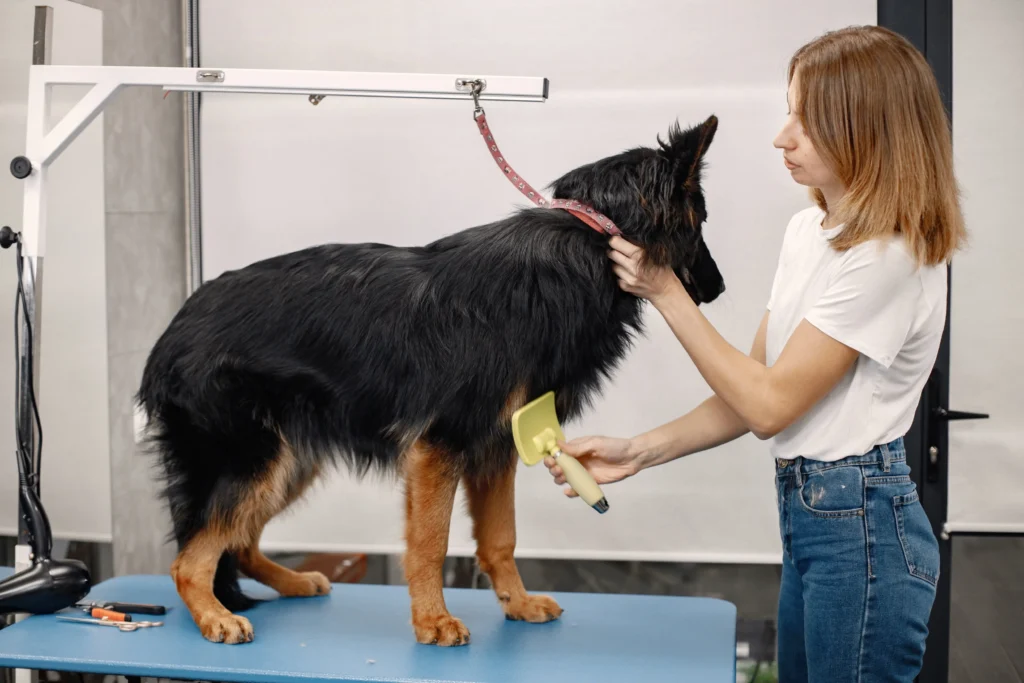
3. German Shepherd Dog
The German Shepherd Dog has a large athletic frame with a long rib cage and substantial thoracic depth. The chest is not as narrow as that of a Greyhound, but it extends deeply between the forelimbs.
German Shepherd Dogs are also among the large breeds in which GDV occurs, although individual risk depends on more than chest shape.
4. Weimaraner
The Weimaraner is a large sporting breed with a long body, athletic limbs and a distinctly deep chest. The brisket reaches approximately to elbow level and is followed by a noticeable abdominal rise.
Weimaraners also have strong epidemiological relevance to GDV. Veterinary studies have repeatedly identified the breed among dogs at increased risk.
5. Akita
The Akita has a powerful body with substantial width and depth through the chest. Its thorax appears broader than the chest of a sighthound but still has considerable vertical depth.
Akitas were included among the large and giant breeds examined in major prospective GDV research, illustrating that deep-chested conformation does not always produce a narrow-bodied appearance.
6. Irish Wolfhound
The Irish Wolfhound combines extreme height with a long, deep thorax. Its rib cage provides substantial vertical depth while the abdomen rises behind the ribs.
Irish Wolfhounds were also included in prospective research examining GDV incidence among large and giant breeds. Their giant size makes recognition of GDV particularly important.
7. Standard Poodle
The Standard Poodle has an athletic, relatively square body with a deep chest extending toward the elbows. The rib cage provides substantial depth without the heavy width seen in some giant working breeds.
Standard Poodles have also appeared consistently in veterinary studies examining breeds predisposed to GDV.
8. Irish Setter
The Irish Setter has a long, athletic sporting build with a deep thorax and relatively narrow body. Chest conformation in this breed has been studied directly in relation to GDV.
A study involving 155 Irish Setters found that dogs with the deepest thoraxes relative to chest width had substantially higher odds of previous GDV than dogs with shallower thoraxes.
9. Gordon Setter
The Gordon Setter has a strong sporting build with a deep chest and well-developed rib cage. It carries more body substance than the Irish Setter while retaining substantial vertical thoracic depth.
Historical veterinary risk analyses have also identified Gordon Setters among breeds with increased GDV susceptibility.
10. Newfoundland
The Newfoundland has a massive frame with a broad and deep thorax. Its conformation demonstrates why “broad-chested” and “deep-chested” are not mutually exclusive descriptions.
Newfoundlands were among the giant breeds included in prospective research on GDV incidence and risk factors.
11. Basset Hound
The Basset Hound has extremely short legs but a remarkably deep and full chest. The sternum is prominent, and the rib cage occupies a large proportion of the dog’s total height.
The breed demonstrates that chest depth is a matter of body proportions rather than absolute height.
12. Dachshund
The Dachshund has an elongated body, short limbs and a deep oval-shaped thorax. Its rib cage extends downward between the forelimbs despite the breed’s small overall stature.
Dachshunds therefore provide another clear example of a smaller dog with deep-chested anatomy.
13. Rottweiler
The Rottweiler has a muscular body with considerable width and depth through the chest. Its silhouette is broader than a Doberman or Greyhound, but the vertical depth of the thorax remains substantial.
Rottweilers have been included in multiple GDV studies. One lifetime-risk analysis estimated a lower GDV risk for Rottweilers than for Great Danes, showing that chest depth alone does not determine breed risk.
14. Saint Bernard
The Saint Bernard has a giant frame with a large, substantial thorax. Its chest is broader than that of most sighthounds but has sufficient depth to place the breed among giant dogs commonly considered at risk for GDV.
Saint Bernards were also included in major prospective studies of gastric dilatation-volvulus.
15. Bloodhound
The Bloodhound is a large scent hound with a long rib cage and substantial chest depth. The sternum extends downward between the forelimbs, producing a deeper body than its loose skin initially suggests.
Bloodhounds have also been represented in large-breed GDV research.
16. Old English Sheepdog
The Old English Sheepdog has a deep, capacious chest beneath its dense coat. Its heavy hair can obscure body proportions, so the position of the sternum and rib cage provides a more useful assessment than the external silhouette.
The breed shows why coat volume alone cannot be used to classify chest type.
17. Greyhound
The Greyhound is one of the clearest examples of deep-chested canine conformation. Its thorax extends far downward while the abdomen rises sharply behind the ribs.
This combination produces the familiar narrow waist and deep front body seen in racing and coursing sighthounds.
18. Borzoi
The Borzoi has a relatively narrow chest with great depth of brisket. Its body combines long limbs, deep ribs and a marked rise toward the abdomen.
The Borzoi therefore represents the classic narrow-and-deep chest pattern found among several sighthound breeds.
19. Saluki
The Saluki has a deep, moderately narrow chest combined with a light athletic frame. The thorax provides substantial vertical depth without excessive width.
Its body proportions resemble those of other coursing hounds developed for speed and sustained movement.
20. Rhodesian Ridgeback
The Rhodesian Ridgeback has a muscular body with a very deep, capacious chest that is not excessively wide. The brisket reaches approximately to elbow level.
Its conformation combines strength with substantial thoracic depth without producing the extreme narrowness of a Greyhound or Borzoi.
Which Breeds Have the Strongest Documented GDV Risk?
Great Danes have one of the strongest documented breed associations with GDV, while Weimaraners, Saint Bernards, Gordon Setters, Irish Setters and several other large breeds also show increased risk.
Breed risk varies substantially.
A Purdue University analysis estimated lifetime GDV risk across five breeds at approximately:
| Breed | Estimated Lifetime GDV Risk |
| Great Dane | 36.7% |
| Weimaraner | Intermediate risk within the five-breed model |
| Irish Setter | Intermediate risk within the five-breed model |
| Standard Poodle | Intermediate risk within the five-breed model |
| Rottweiler | 3.9% |
The important comparison is not simply “deep chest versus normal chest.” Great Danes and Rottweilers can both have substantial chest depth, yet their estimated risks differed considerably in this analysis.
Breed, genetics, age, feeding behavior and individual anatomy therefore contribute to the complete risk profile.
Why Does a Deep Chest Increase GDV Risk?
Greater thoracic depth relative to width is associated with increased GDV risk in susceptible dogs.
The strongest evidence comes from studies that measured thoracic proportions rather than merely describing dogs as “deep-chested.”
Researchers studying 155 Irish Setters divided dogs according to thoracic depth-to-width ratio. Dogs in the deepest-chest group had 8.45 times the odds of GDV compared with dogs in the shallowest group.
Family history also mattered. Having a relative, particularly a parent, with GDV increased risk.
A separate prospective study followed 1,914 dogs from 11 large and giant breeds. The incidence was 23 cases per 1,000 dog-years among large breeds and 26 cases per 1,000 dog-years among giant breeds.
These findings support an association between anatomy and GDV, but they do not mean every deep-chested dog develops the condition.
What Happens During GDV?
GDV occurs when the stomach becomes enlarged with gas, fluid or food and then rotates, preventing normal emptying and restricting circulation.
The rotation can:
- obstruct stomach emptying;
- restrict blood supply to stomach tissue;
- compress major abdominal blood vessels;
- reduce blood return to the heart;
- interfere with normal breathing;
- contribute to shock and organ injury.
GDV requires emergency veterinary treatment. Simple gastric dilation and gastric dilation with volvulus are related conditions, but stomach rotation makes GDV particularly dangerous.
Does Every Deep-Chested Dog Develop Bloat?
No. Deep chest conformation increases concern in susceptible breeds but does not determine whether an individual dog develops GDV.
A prospective Purdue University study of 1,637 large and giant-breed dogs identified several factors associated with increased GDV risk:
- increasing age;
- a first-degree relative with GDV;
- faster eating;
- use of a raised feeding bowl.
Dietary research involving 1,634 dogs also found that larger food volume per meal was associated with increased GDV risk. Risk was highest among large and giant dogs receiving a large food volume once daily.
Chest shape is therefore one part of a larger risk network.
Does Meal Size Affect Bloat Risk?
Large food volume per meal is associated with increased GDV risk in susceptible large and giant dogs.
A five-year study evaluated diet information from 1,634 dogs belonging to high-risk breeds. Dogs receiving larger amounts of food per kilogram of body weight at each meal had greater GDV risk.
The highest risk occurred when large or giant dogs received a large food volume once per day.
Dividing the daily ration into smaller meals therefore avoids delivering one unusually large volume to the stomach at a single feeding.
Does Eating Too Fast Increase GDV Risk?
Rapid eating has been associated with increased GDV risk in large and giant dogs.
A prospective study identified faster eating speed as a significant risk factor.
A slow-feeding bowl can reduce eating speed in dogs that gulp food. However, slowing food intake and proving prevention of GDV are different claims. Current evidence does not establish that a slow feeder itself guarantees protection from bloat.
The more accurate goal is controlling rapid eating, not presenting a particular bowl as a medical prevention device.
Should Deep-Chested Dogs Use Raised Food Bowls?
Raised food bowls are not recommended specifically as a GDV-prevention strategy because prospective research associated them with increased risk.
In one Purdue University cohort, raised feeding bowls were statistically associated with GDV in both large and giant dogs.
This does not mean every elevated bowl causes bloat. It means elevation should not be promoted as a proven preventive measure.
A veterinarian may still recommend an elevated feeding position for another medical or mobility-related reason.
Does Exercise Around Meals Cause Bloat?
A direct cause-and-effect relationship between exercise and GDV has not been established, but veterinary guidance commonly recommends avoiding intense activity around large meals in high-risk dogs.
Calm post-meal behavior is reasonable for susceptible breeds. Running, vigorous play and strenuous activity can be scheduled away from major meals without presenting exercise restriction as a guaranteed GDV-prevention method.
What Is Prophylactic Gastropexy?
Prophylactic gastropexy surgically attaches the stomach to the abdominal wall to reduce the risk of life-threatening stomach rotation.
The American College of Veterinary Surgeons identifies large or giant size, deep-chested conformation and a close relative with GDV among factors that can justify discussing preventive gastropexy with a veterinarian.
Great Danes, Rottweilers and Standard Poodles are examples of breeds for which the procedure may be considered.
Gastropexy prevents or greatly reduces volvulus, but it does not prevent the stomach from filling with gas, food or fluid.
The decision depends on:
- breed;
- individual chest conformation;
- family history;
- age;
- health status;
- previous abdominal surgery;
- veterinarian assessment.
Preventive gastropexy is therefore a veterinary decision rather than a routine requirement for every deep-chested dog.
What Are the Emergency Signs of GDV?
Repeated unproductive retching, abdominal enlargement, excessive drooling, restlessness, breathing difficulty, pale gums, weakness or collapse require immediate veterinary assessment.
Common warning signs include:
- repeated attempts to vomit with little or nothing produced;
- excessive drooling;
- pacing or inability to settle;
- abdominal pain or enlargement;
- rapid or difficult breathing;
- pale gums;
- weakness or collapse.
Visible abdominal swelling is not required before seeking care.
A deep-chested dog repeatedly trying to vomit without producing material requires emergency assessment. The pattern of symptoms and immediate response are covered in more detail in the guide to deep-chested dogs and bloat.
Do not attempt stomach tubing, abdominal puncture, massage or medication at home. Suspected GDV requires veterinary diagnosis, stabilization and, when volvulus is present, surgery.
How Can Owners Reduce Modifiable GDV Risks?
Owners can address several modifiable risk factors even though GDV cannot be completely prevented through routine management alone.
Seven practical measures are:
- Divide large daily food amounts rather than feeding one unusually large meal.
- Control rapid eating in dogs that consume food very quickly.
- Avoid using raised bowls specifically to prevent GDV unless a veterinarian recommends elevation for another reason.
- Keep vigorous activity away from large meals.
- Maintain an appropriate body condition through measured feeding and regular activity.
- Know the family history when a parent or sibling has experienced GDV.
- Discuss prophylactic gastropexy when breed, anatomy and family history indicate substantial risk.
These measures manage recognized risk factors. They do not eliminate the possibility of GDV.
Are Deep-Chested Dogs More Likely to Have Heart or Lung Problems?
Deep-chested conformation alone does not establish that a dog has heart or lung disease.
A deeper thorax changes body shape, but it is inaccurate to state that all deep-chested dogs have enlarged hearts, greater lung capacity or increased cardiovascular stress simply because of chest conformation.
Breed-specific cardiac and respiratory diseases need to be evaluated independently.
This distinction is important because chest anatomy should not be turned into unsupported medical conclusions.
Can Small Dogs Have a Deep Chest?
Yes. A dog does not need to be large to have substantial thoracic depth.
Dachshunds and Basset Hounds are examples. Both have short legs but deep rib cages extending low between the forelimbs.
Large size and deep chest frequently occur together, but they describe different anatomical attributes.
Are All Large Dogs Deep-Chested?
No. Large body size does not automatically produce deep-chested conformation.
Dogs differ in thoracic width, depth, rib curvature and overall proportions. Some large breeds have broad, rounded bodies, while others have much deeper and narrower thoraxes.
An individual dog’s body shape is more informative than size alone.
Can a Dog Have Both a Broad and Deep Chest?
Yes. Chest width and chest depth describe separate dimensions, so the same dog can have substantial width and substantial depth.
Rottweilers and Newfoundlands are useful examples. Their chests are much broader than those of Greyhounds but still have considerable vertical depth.
This is why “deep chest versus broad chest” is not a reliable either-or classification.
Does a Deep Chest Mean a Dog Will Get GDV?
No. A deep chest increases anatomical susceptibility in some breeds, but most risk assessment requires several factors.
Age, family history, breed, thoracic proportions, eating speed and meal volume can all contribute.
Chest conformation identifies a dog that deserves greater awareness; it does not predict an individual outcome.
Is a Pit Bull Considered Deep-Chested?
Pit bull-type dogs generally have broad, muscular chests rather than the narrow-and-deep silhouette seen in Greyhounds, Borzois or Dobermans.
Individual anatomy varies, and some dogs can have substantial chest depth. Pit bull-type dogs are not generally identified among the classic breeds with the strongest documented GDV predisposition.
Can a Mixed-Breed Dog Be Deep-Chested?
Yes. Deep chest conformation is an anatomical characteristic rather than a pedigree classification.
A mixed-breed dog’s rib cage can be deep, broad, narrow or intermediate depending on inherited body structure.
Assess the individual dog’s chest rather than relying solely on ancestry.
Does Gastropexy Eliminate Bloat Completely?
No. Gastropexy primarily prevents the stomach from rotating; it does not prevent gastric dilation itself.
A dog that has undergone gastropexy can still develop stomach distension and gastrointestinal illness.
Signs such as repeated retching, abdominal enlargement, pain or sudden weakness still justify veterinary assessment.
What Should Owners Remember About Deep-Chested Dog Breeds?
Deep-chested dog breeds have substantial vertical thoracic depth, and several large and giant breeds with this conformation also have increased GDV risk.
Great Danes, Doberman Pinschers, Weimaraners, Irish Setters, Standard Poodles, Greyhounds, Borzois and Irish Wolfhounds show some of the clearest deep-chested body shapes. Smaller dogs, including Dachshunds and Basset Hounds, demonstrate that chest depth is not limited to giant breeds.
Chest conformation also needs context. A broad chest can still be deep, and a deep chest does not automatically mean that a dog develops bloat.
The most useful approach combines correct identification of deep-chested dog breeds, awareness of GDV risk, control of modifiable feeding factors, knowledge of emergency signs and individual veterinary assessment.
People Also Ask
What are deep-chested dog breeds?
Deep-chested dog breeds have a chest that is relatively deep from the spine to the breastbone compared with its width. Great Danes, Doberman Pinschers, Weimaraners, German Shepherds, Irish Setters, and Standard Poodles are common examples.
Are deep-chested dogs more likely to develop bloat?
Yes. Deep-chested conformation is associated with a higher risk of gastric dilatation-volvulus (GDV), commonly called bloat. Risk varies by breed and individual dog, so deep-chested anatomy does not mean a dog will develop GDV.
Which dog breed has the highest risk of bloat?
Great Danes are consistently recognized among the dog breeds at particularly high risk for GDV. Other large, deep-chested breeds, including Saint Bernards, Weimaraners, and Irish Setters, can also have elevated risk.
What is GDV in dogs?
GDV, or gastric dilatation-volvulus, is a life-threatening condition in which the stomach becomes distended and may rotate. It can rapidly compromise blood flow and requires immediate veterinary treatment.
What are the warning signs of bloat in a deep-chested dog?
Common warning signs include a swollen or painful abdomen, repeated unproductive attempts to vomit, excessive drooling, restlessness, rapid breathing, weakness, pale gums, and collapse. Suspected GDV is an emergency.