


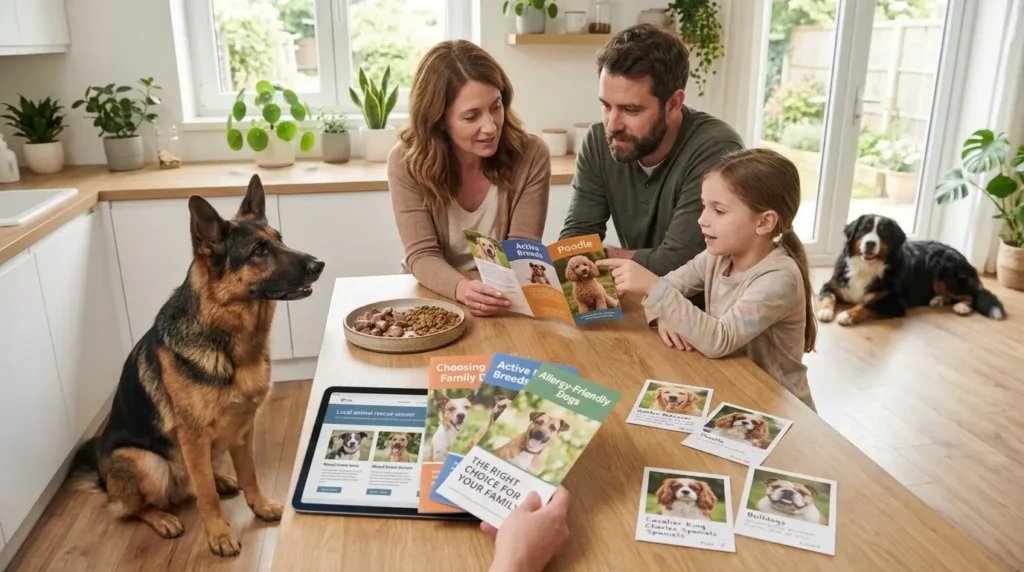
Picking a dog for a family is not about the face. It is more about how the dog fits into the home. A calm dog in a loud, busy house can feel stressed and unhappy. A high-energy dog in an apartment with no yard might become destructive just because it has too much energy and nowhere to use it. This guide helps you understand what makes a family dog. It covers which breeds usually work well and how to keep kids and dogs safe when they are together.
What makes a family dog?
A good family dog stays calm around noise and movement. It does not get upset easily when people move around or when there is a lot of activity. It is patient. Tolerates being touched, picked up or handled by children. It should be easy to train so that everyone in the house including kids can help with routines. Temperament matters more than the breed label. Every breed description shows a tendency, not a guarantee. So take breed traits as ideas, not fixed rules.
A nice family dog usually checks these boxes:
- Calm recovery. A sudden noise or a dropped toy startles it, but it settles quickly.
- Tolerance. It puts up with clumsy petting, within limits you enforce.
- Trainability. It learns house rules, such as not jumping on guests, without needing an expert handler.
- Matching energy. Its daily exercise needs fit the time your family really has.
Why does your family’s energy level matter so much?
Because it decides whether the dog is happy. Active families do well with a breed that enjoys exercise, while a low-energy breed can be a letdown for runners. The reverse is just as true. If your weekends are quiet, a high-drive breed will find its own entertainment, and you may not like it.
Which breeds make excellent family dogs?
No breed is right for every home, but several come up again and again as excellent family dogs because they’re sociable and trainable. The table below compares common choices in general terms. Individual dogs vary, so use it to narrow your list, not to decide.
| Breed | Size | Energy | Often suits | Watch for |
| Labrador Retriever | Large | High | Active families with children | Needs daily exercise, bouncy when young |
| Golden Retriever | Large | High | Busy, outdoorsy households | Needs a lot of exercise |
| Beagle | Small to medium | Moderate to high | Active families | Nose-led, can wander if not secured |
| Poodle (Toy, Miniature, Standard) | Varies | Moderate to high | Families who want a trainable dog | Can be more sensitive around small children |
| Cavalier King Charles Spaniel | Small | Moderate | Families wanting a small, affectionate dog | Ask the breeder about health screening |
| Newfoundland | Giant | Low to moderate | Roomy homes | Drool, bulk, large food bills |
| Saint Bernard | Giant | Low to moderate | Roomy, cool homes | See the section below chewyjollyes |
Two more things about breed lists. First, mixed-breed dogs from rescues can be wonderful family pets, and a good shelter will assess their behavior around children. Second, if you want to compare more breeds, our dog breed guides cover size, grooming and health in detail.
Are Saint Bernards good family dogs?
Often, yes, for a household with space, patience and a generous budget. The breed is known for being patient with kids, but its size means it can knock small children over by accident, so supervision matters more than ever.
What are Saint Bernards like to live with?
They’re gentle and people-focused. The breed loves its people and pines without human company, so it isn’t a dog to leave outside. They also drool and shed. Adults shed heavily twice a year, and they’re highly sensitive to heat. A cool, roomy house suits them far better than a hot flat.
What health risks and lifespan should you expect?
Plan for a shorter life than a smaller breed. Their life expectancy is roughly 8 to 10 years. Like other giant breeds, they’re prone to joint disorders and bloat. Bloat (gastric dilatation-volvulus, where the stomach twists) is an emergency.
Call an emergency vet immediately if your dog has:
- A swollen or hard belly
- Repeated retching with nothing coming up
- Restlessness, drooling or obvious pain
- Weakness or collapse
Don’t wait to see if it passes. Ask your vet about prevention, such as feeding routines and exercise timing, for your individual dog.
What does it cost to feed one?
A lot. One breed profile suggests roughly five to six cups of dry food a day over two meals, but amounts depend on age, weight and activity. Use our Dog Food Calculator as a starting point, and ask your vet to confirm. For puppies, large-breed growth food slows the rate of growth without changing the final size.
Can a family dog also be a pheasant hunting dog?
Yes, some can, as long as you’re realistic about the extra work. Dogs used for pheasants work as pointers, flushers or retrievers, and several of those breeds also live happily as pets.
- Flushers and retrievers. Labrador and Golden Retrievers and spaniels flush birds, and retrievers are especially strong at bringing them back.
- Versatile pointers. German Shorthaired Pointers and wirehaired pointing Griffons can also retrieve well.
- A caution on lines. Brittanys bred for hunting need more exercise and attention than those bred only as family dogs. That applies to most field-bred dogs. A puppy from working lines may be too intense for a quiet household.
If you plan to do both, choose a breeder who can describe the puppy’s parents in both roles. Start training with reward-based methods only. Force-free training builds a more reliable dog and a safer one around children. See our positive-reinforcement training guides for step-by-step methods.
How do you match a dog to your family?
Start with your household, not the breed list. Answer these honestly:
- Children’s ages. The AVMA has suggested waiting until children are older than four, because many bites involve younger children.
- Daily time. Who walks, feeds and trains the dog on a normal weekday?
- Space and climate. Giant, heat-sensitive or high-energy breeds need room and the right conditions.
- Alone time. Some breeds, like Bichons, don’t like being alone for long, so check your work-from-home reality.
- Allergies and grooming. PetMD’s list opens with allergies as a key question, and coats range from low-fuss to daily brushing.
- Budget. Food, insurance, training and vet care all scale with size and breed.
How do you keep kids and dogs safe together?
Supervise every interaction, teach children to respect the dog’s space, and learn the dog’s warning signs. The AVMA says young children should never be left alone with a dog, even a familiar family pet.
What are the basic house rules?
- Never leave a young child unsupervised with the dog.
- Leave the dog alone when it’s sleeping, eating or caring for puppies. This is an AVMA recommendation.
- Give the dog its own bed or crate as a retreat, and tell kids it’s off-limits.
- No tail-pulling, ear-grabbing or hugging around the neck.
- Ask permission before petting any unfamiliar dog.
What warning signs should you watch for?
A dog that turns away, stiffens, growls or tries to move out of reach is signaling discomfort. Step in calmly and give it space. Never punish a growl, because that teaches the dog to skip the warning and go straight to a bite.If a child is bitten and the skin is broken, or the bite is on the face or head, get medical care right away. Every bite deserves attention from a doctor.
What mistakes do families make when choosing a dog?
- Choosing on looks. A cute photo tells you nothing about energy, grooming or health.
- Assuming “gentle breed” means “safe alone with kids.” No breed is.
- Underestimating a giant breed’s costs and short lifespan. Plan for the heartbreak and the vet bills.
- Buying a field-bred puppy for a sofa-and-park life.
- Skipping training. Reward-based classes help the dog and the family learn together.
- Letting one person do everything. Share the routine so the dog doesn’t depend on one adult.
- Not meeting the dog first. Spend time with adult dogs of the breed, or with the specific rescue dog, before you commit.
For ongoing routines such as feeding, grooming and vet visits, see our dog care and health basics.
Before you bring one home
Spend a weekend thinking about who will walk the dog at 6 a.m. In the rain and how much it will cost each month. If that list still seems possible you are ready to start meeting dogs. Choose the dog that fits your home not the way around.
Frequently asked questions
Which family dogs are best for first-time owners?
Look for a dog that’s easy to train and that is not too sensitive. Labrador Retrievers, Poodles and Cavalier King Charles Spaniels are often recommended. Dogs that have a lot of energy and need a lot of work like Border Collies are usually better for people who have experience. Meet adult dogs of the breed. Talk to a trainer before making a decision.
Are Saint Bernards good family dogs?
They can be, for the home. They are known to be patient and kind with kids. They are big dogs so they can accidentally bump into small children. Expect a lot of drool, expensive food, trouble with heat and a lifespan of 8 to 10 years.
Can a good family dog also be a pheasant hunting dog?
Yes, some can. Labrador and Golden Retrievers, English Springer Spaniels and German Shorthaired Pointers are used for hunting. Also make great pets. Dogs that come from hunting lines usually need a lot more exercise and mental work than regular pet dogs so be honest about the time you can offer.
Which family dogs are best for first-time owners?
Look for a dog that’s easy to train and that is not too sensitive. Labrador Retrievers, Poodles and Cavalier King Charles Spaniels are often recommended. Dogs that have a lot of energy and need a lot of work like Border Collies are usually better for people who have experience. Meet adult dogs of the breed. Talk to a trainer before making a decision.