A Beagle can look like an easy family choice. The breed is compact, sociable, and sturdy enough for active play. Yet the same dog may follow a scent beyond recall, bay when left alone, steal accessible food, or gain weight without measured feeding.
That contrast matters when families compare family dogs with kids. A friendly reputation does not answer practical questions about child supervision, daily exercise, training difficulty, health screening, and long-term care. The Beagle dog breed fits some households extremely well, while other routines create avoidable frustration.
This guide examines Beagle personality, size, lifespan, exercise needs, feeding, grooming, health risks, and family suitability. It also explains evidence-based Beagle training tips for recall, household manners, food seeking, and time alone. The aim is simple: help you decide whether this happy, scent-driven companion matches your children, home, schedule, and expectations.
Is a Beagle the right family companion?
A Beagle is a strong match when your household can supervise children, secure exits, control food, and provide daily training. Scent-driven behavior, baying, and food seeking create the main friction points.
Beagles’ family appeal is due to their sociable temperament, manageable size, and pack-hound background. It also warns that an interesting scent can pull the dog away.
Individual behavior still matters. A 2022 study analyzed 2,155 dog genomes and 18,385 owner surveys. Breed explained only 9% of behavioral variation, although Beagle ancestry increased the likelihood of howling.
Use breed traits as planning signals. Then assess the specific dog around children, food, handling, visitors, and other animals.
What are the key Beagle facts?
The table separates breed-standard traits from household requirements. These figures describe a typical Beagle, not every individual.
| Attribute | Accredited figure | Family meaning |
| Height | 33 to 40 cm | Compact, but not fragile |
| Exercise | Up to 1 hour daily | Activity requires protected time |
| Grooming | Once weekly | Coat care stays simple |
| Coat | Short, dense, weatherproof | The dog still sheds |
| Home size | Small house listed as suitable | Routine matters more than floor area |
| Lifespan guidance | Over 12 years | Ownership carries a long commitment |
| Working role | Pack scent hound | Smell can outrank verbal cues |
A UK clinical study included 19,906 Beagles among 2,250,417 dogs. Beagles represented 0.88% of that veterinary population.
What defines the Beagle dog breed?
The Beagle is a small British pack hound developed to follow hares by scent. The Royal Kennel Club traces the established breed in England to the 15th century. Its records emphasize stamina, voice, and scenting ability.
Working in a pack favored social tolerance and persistence. It also favored independent tracking. A Beagle followed quarry through cover rather than waiting for repeated human direction.
That history helps explain modern domestic behavior. Your Beagle may seek company indoors, then become intensely task-focused after finding a scent outside. The behavior does not prove defiance. The environment has supplied a reward stronger than the current training history.
The breed standard describes balanced bones, muscular thighs, a dense weatherproof coat, and a body built for sustained movement. “Sturdy” does not mean free from inherited disease or safe for uncontrolled rough play.
Why does the Beagle dog breed follow scent?
The Beagle follows scent because people developed the breed to hunt hare in packs. That work rewarded persistence, stamina, independent tracking, and vocal communication.
The breed became established in England by the 15th century. Hunters followed Beagle packs on foot, unlike larger hounds commonly followed on horseback.
At home, scent drive appears around crumbs, shopping bags, bins, and garden trails. Outdoors, a lead, long line, closed gate, and current identification reduce escape risk.
“Sturdy build” has a specific meaning. The breed standard describes straight forelegs, muscular thighs, powerful loins, and strongly padded feet. Sturdy does not mean immune to disease or injury.
What is the Beagle personality like?
The typical Beagle personality is social, curious, food-motivated, vocal, and persistent. Behavior varies considerably within the breed.
Pack work encouraged close group movement. Modern Beagles often follow household activity, seek company, and investigate accessible food.
Vocal behavior includes barking, howling, and baying. Baying is the longer hound call linked with tracking, excitement, or frustration. The Royal Kennel Club describes the breed’s voice as musical.
Breed labels cannot replace observation. The UMass Chan study found no behavior exclusive to one breed across 78 breeds. Age predicted some behaviors better than breed.
Assess 4 areas before choosing a dog:
- Observe recovery after a sudden sound.
- Check comfort with gentle handling.
- Watch behavior near food and toys breeds.
- Record responses to children and unfamiliar dogs.
An adult rescue may provide clearer behavioral evidence than a young puppy.
Are Beagles good family dogs with kids?
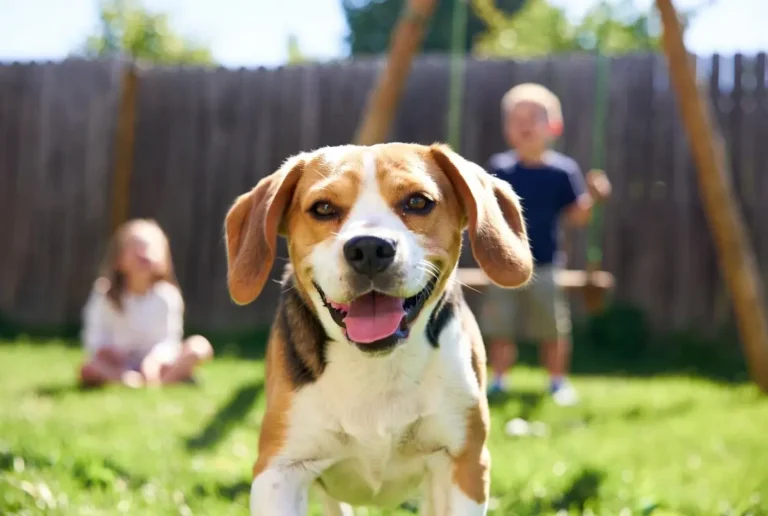
Beagles can rank among suitable family dogs with kids when adults supervise every interaction. Friendly tendencies do not remove bite risk or resource conflict.
The Centers for Disease Control and Prevention states that nearly 1 in 5 dog-bite victims requires medical attention. Children face more bites than adults, and most incidents involving young children occur with familiar dogs.
A hospital study examined 386 injured children. Children younger than six formed 52.8% of the sample. Younger children more often received bites from the family dog, inside the home, and around the face.
These figures do not identify Beagles as a high-risk breed. They explain why every family dog requires active management.
Use 5 family rules:
- Separate the dog during children’s meals.
- Protect the dog’s bed as a child-free area.
- Stop hugging, climbing, cornering, and chasing.
- End contact after hiding, freezing, growling, or head-turning.
- Supervise every interaction involving young children.
It is advised that adults do not disturb dogs while they are eating or sleeping. It is also advised to supervise around the family dog.
Which Beagle training tips work best?
Effective Beagle training tips use rewards, controlled environments, short sessions, and gradual distraction. Punishment does not remove scent drive.
A University of Lincoln study tested 63 dogs with off-lead problems. Researchers assigned 21 dogs to each training group. Each dog received up to 150 training minutes across five days.
Reward-focused trainers achieved better first-cue responses for “come” and “sit.” Their dogs responded faster than dogs trained with electronic collars. Electronic collars produced no lower disobedience rate.
An earlier study also used 63 dogs. 92% of owners reported improvement, with no efficacy advantage for electronic collars (e-collars). Collar-trained dogs showed more tension and yawning.
How do you train Beagle recall?
Build recall with a long line and high-value rewards. Start indoors, move into a secure garden, then add mild scent distractions.
Follow this sequence:
- Say the recall cue once.
- Move away to create motion.
- Reward the first turn toward you.
- Pay again at arrival.
- Release the dog back to sniffing sometimes.
- Increase distance after repeated success.
Returning loses value when every recall ends the walk. Occasional release makes environmental access part of the reward.
Keep the long line attached until the response holds across several secure locations. Roads, livestock, and unfenced areas leave no margin for unfinished training.
How do you teach household manners?
Teach one behavior for each common problem. Train “place” for visitors, “leave” for food, “drop” for stolen objects, and four paws down for greetings.
Use measured kibble from the daily ration during practice. This approach supports learning without adding uncounted calories.
Prevent rehearsal through gates, closed bins, cleared counters, and covered food. Repeated access to stolen food strengthens the exact behavior your family wants reduced.
How do you manage stealing and begging?
Prevent access with covered bins, cleared counters, closed cupboards, and separate eating areas. Management stops the dog from rehearsing theft.
Measure part of the daily ration for training. Teach “leave,” “drop,” and “place” as separate behaviors because each cue solves a different problem.
Can a Beagle stay home alone?
A Beagle can learn planned alone time, but sudden full-day absences create a poor starting point. Pack-oriented dogs can find abrupt isolation difficult.
Begin with short departures after exercise and toileting. Record sessions to check pacing, howling, scratching, drooling, or escape attempts.
Persistent distress requires veterinary assessment and qualified behavioral support.
How much exercise does a Beagle require?
A healthy adult Beagle generally receives up to one hour of daily exercise, adjusted for age, health, weather, and veterinary guidance. Scent work adds mental effort without excessive physical load.
A practical 60-minute day can include:
- Walk for 25 minutes with structured sniffing.
- Practice recall and lead skills for 10 minutes.
- Search for measured kibble for 10 minutes.
- Play or track securely for 15 minutes.
This schedule is an example, not a medical prescription. Puppies, senior dogs, and dogs with pain require different plans.
A garden does not replace exercise. Many Beagles spend garden time searching boundaries rather than moving continuously.
Can a Beagle live in a small house?
A Beagle can live in a small home when your routine covers exercise, toileting, training, and noise control. Shared walls make vocal behavior the main concern. A small house, a small or medium garden, and either town or country living are suitable.
A large home left empty for nine hours may suit poorly. A smaller home with structured walks and company may function better.
Check 4 housing factors:
- Secure doors and gates
- Protected food storage
- A quiet resting area
- A plan for departure howling
Apartment residents can record early departures. Evidence from a camera allows training before noise becomes a neighbor dispute.
How do you prevent weight gain in a Beagle?
Prevent weight gain through measured meals, counted rewards, monthly weight records, and body-condition checks. Begging does not measure calorie requirements.
The largest Beagle primary-care study reviewed 3,729 detailed records. Obesity affected 24.27% during 2019. That equals roughly 1 in 4 Beagles in the clinical sample.
The study reported a median adult bodyweight of 18.19 kilograms. Males averaged 19.70 kilograms, while females averaged 16.59 kilograms. Body size and obesity could both contribute.
Weight alone cannot define a healthy condition. The World Small Animal Veterinary Association uses a nine-point body-condition system. Scores 4 and 5 indicate ideal condition.
At ideal condition, you can feel the ribs under a light covering. A waist remains visible from above, with an abdominal tuck from the side.
Use this feeding process:
- Weigh the daily ration in grams.
- Remove training food from that ration.
- Record treats from every family member.
- Check body condition monthly.
- Review sustained changes with a veterinarian.
This system matters in homes with children, where dropped snacks can exceed the planned ration.
Which health problems affect Beagles most?
Obesity, dental disease, nail overgrowth, ear infection, and anal sac impaction led to diagnoses in a large UK Beagle sample.
| Diagnosed condition | One-year prevalence | Approximate frequency |
| Obesity | 24.27% | About 1 in 4 |
| Periodontal disease | 17.78% | About 1 in 6 |
| Overgrown nails | 11.61% | About 1 in 9 |
| Otitis externa | 11.18% | About 1 in 9 |
| Anal sac impaction | 10.59% | About 1 in 9 |
Researchers reviewed 3,729 detailed records. At the grouped level, dental disorders affected 21.48%, ear disorders 13.62%, and nail disorders 13.14%.
The study covered UK primary veterinary care during 2019. It does not represent every country or every Beagle.
How long do Beagles live?
Female Beagles reached a median of 11.70 years, compared with 10.75 years for males. Among 296 recorded biomedical causes, neoplasia accounted for 19.26%.
These figures support long-term planning for veterinary care, dental work, weight control, and senior monitoring.
Which Beagle health risks deserve attention?
The Beagle dog breed has a relatively long expected lifespan, but responsible ownership includes breed-specific screenings. The National Beagle Club lists epilepsy, allergies, hypothyroidism, hip dysplasia, and back problems among common concerns.
Its Canine Health Information Center requirements include:
- Hip evaluation
- Ophthalmologist eye examination
- Musladin-Lueke syndrome DNA testing
- Cardiac evaluation
- Autoimmune thyroiditis testing
Optional tests cover patellar luxation, Lafora epilepsy, Factor VII deficiency, and neonatal cerebellar cortical degeneration.
The Royal Kennel Club also identifies Lafora disease and neonatal cerebellar cortical degeneration as priority DNA tests. Other listed tests include Factor VII deficiency, Imerslund-Gräsbeck syndrome, and Musladin-Lueke syndrome.
Ask for named results, not verbal assurances. A health-tested parent can still produce an affected puppy, but documented screening reduces avoidable uncertainty.
Watch for 6 signs that require veterinary attention:
- Seizures
- Persistent itching
- Unexplained weight change
- Exercise intolerance
- Eye changes
- Spinal pain
Sudden weakness, collapse, breathing difficulty, or prolonged seizures require urgent veterinary care.
What grooming and routine care does a Beagle require?
The Beagle has a short, dense, weatherproof coat and sheds. Weekly brushing removes loose hair and creates a structured skin check.
Inspect the ears for odor, redness, discharge, pain, or repeated head shaking. The breed standard describes long, low-set ears that lie close to the cheeks. A veterinarian can identify infection and demonstrate safe cleaning.
Check nails, paws, teeth, eyes, and body weight during the same weekly routine. Keep dental care specific to dogs and ask your veterinary team about suitable products.
Preventive care also includes vaccination and parasite control based on location and exposure. Updated American Animal Hospital Association guidance lists distemper, adenovirus, parvovirus, rabies, and leptospirosis among core protections for dogs in the United States.
Local laws, disease patterns, travel, boarding, and outdoor exposure affect the exact schedule. Your veterinarian can align the plan with regional risk.
Who is the Beagle dog breed right for?
The Beagle suits a family whose routine matches its social nature, scent work, food motivation, and exercise requirements. Use the table as a decision filter before discussing appearance or popularity.
| Household factor | Stronger match | Weaker match |
| Children | Adults supervise and teach calm contact | Children climb on dogs or guard snacks poorly |
| Schedule | Someone provides company and gradual alone training | The dog stays alone for long, abrupt periods |
| Exercise | Daily walking and scent activities fit the routine | Exercise depends on occasional weekends |
| Training | Rewards, long-line practice, and management feel acceptable | The family expects immediate off-leash obedience |
| Home | Gates, fencing, food storage, and noise plans exist | Doors stay open and shared walls demand silence |
| Feeding | Portions and treats receive measurements | Food remains available without tracking |
| Health | Screening records and veterinary care fit the budget | The purchase price drives the full decision |
A strong match does not require a perfect home. It requires repeatable systems. Secure exits, measured meals, supervised child contact, and reward-based training address the breed’s most predictable risks.
How do you choose a Beagle responsibly?
Choose the individual dog through health evidence, observed behavior, household fit, and support after placement. Coat color, head shape, or an unusually small size carries less decision value.
For a puppy, review parental health certificates and verify registered results where databases permit access. Meet the mother, inspect the living environment, and ask how puppies experience people, surfaces, sounds, handling, and brief separation. The Royal Kennel Club advises breeders to provide parental health certificates, feeding details, and socialization information.
For a rescue Beagle, request behavior notes covering children, food, dogs, cats, handling, isolation, escape attempts, and noise. Arrange more than one meeting when the organization permits it.
Avoid sellers who market “rare” colors or “pocket” size as health advantages. American standards recognize two height varieties. The historical British miniature Beagle no longer represents a recognized modern variety.
Is the Beagle a good match for your family?
A Beagle can become a cheerful and sturdy family companion, but the match depends on daily routine rather than appearance. This scent hound needs secure exits, measured meals, regular exercise, reward-based training, and close supervision around young children.
The Beagle dog breed suits families that enjoy active walks and can manage barking, food-seeking, and selective recall. A busy household may suit the breed well when someone provides company and consistent boundaries. Long absences, open gates, and unmonitored feeding create a harder fit.
Review the individual dog’s behavior and verified health records before making a decision. A well-matched Beagle brings affection, curiosity, and energy into family life. The right preparation turns those traits into companionship instead of daily conflict.
Frequently asked questions
Are Beagles good family dogs with kids?
Beagles can suit families with children when adults supervise contact, separate food, protect rest areas, and teach respectful handling.
Is the Beagle dog breed easy to train?
The Beagle dog breed learns through rewards, but scent distractions make recall harder than indoor cue training.
What is the typical Beagle personality?
The typical Beagle personality is social, curious, food-driven, vocal, and persistent, although breed explains only part of individual behavior.
How much exercise does a Beagle require?
A healthy adult Beagle generally receives up to one hour of daily activity, including walks, sniffing, training, and secure play.
What are the most useful Beagle training tips?
Use high-value rewards, a long line, one clear cue, short sessions, controlled distractions, and measured food from the daily ration.
Does a Beagle fit your family?
A Beagle can become a happy, sturdy family companion when your routine matches the breed’s scent-hound design. Friendly behavior alone does not settle the decision.