Being a pet-parent certainly involves some hair-raising experiences. Like when your dog, or a once spry and steady dog such as suddenly experiences dizziness or loss of balance, tilts their head, or begins to stumble. These types of symptoms often lead us promptly toward vestibular disease. In this blog, I will take you through:
what the vestibular system is (so you know what has happened), how vestibular disease shows itself in dogs, what causes it (and how the veterinarian figures it out), how it is treated and how you can help your dog recover, what the prognosis is, and how to live with residual effects (think: neurological deficits).
I will rely on our current veterinary knowledge (and venture a bit further than “that’s it” type articles), so you are not only worried, but can feel prepared and confident.
1. What is the vestibular system—and why does it matter?
The primary cause for this condition is the vestibular system your dog possess; the compilation of anatomical components that keep him/her upright, coordinated, and their head and eyes throughout the movement in a steady position.
The vestibular system involves sensors in the inner ear (and to a much lesser degree, the middle ear) that sense movement and head position (Thomas, 2022).
It also involves the nerve connections and brain areas that process the sensory information and direct the body and eyes into movement in response to the vestibular information.
When something goes wrong in the vestibular system, your dog can feel as if the world is tilting, spinning, wobbling, or the like; something similar to humans suffering from vertigo.
Now that you have this context to which the symptoms make sense, that is, something that is typically autonomic (balance, eyes steady, walk straight) has broken down.
How common is it — and who gets it?
| Parameter | Finding / Statistic | Source / Reference |
| Prevalence of vestibular disease | ≈ 0.08% of dogs under primary veterinary care | (Orlandi et al., 2020) |
| Number of dogs studied | 905,544 total; 759 diagnosed (≈ 0.084%) | (Vestibular Disease in dogs: Old Dog Syndrome, 2020). |
| Average age at diagnosis | 12.7 years | (Vestibular Disease in dogs: Old Dog Syndrome, 2020). |
| Breed risk – French Bulldog | Odds Ratio (OR) ≈ 9.25 compared to crossbreeds | (Radulescu et al., 2020) |
| Breed risk – English Bulldog | OR ≈ 6.53 | (Radulescu et al., 2020) |
| Breed risk – Cavalier King Charles Spaniel | OR ≈ 3.56 | (Radulescu et al., 2020) |
| Typical age group (idiopathic cases) | Most common in dogs > 9 years old | (Mertens et al., 2023) |
2. How will vestibular disease present?
Being aware of early and still pronounced signs can prove beneficial. A few of the more recognised signs of vestibular disease include:
Head tilt (one ear lower than the other): If your dog is tilting the head to one side, it reflects the vestibular disease side.
Loss of balance/stumbling/circle walking: dogs can lean to one side, drift, bump into things, or fall/ stumble.
Nystagmus: involuntary movements of the eyeballs quickly “flick” from side to side or up and down.
3. What leads to vestibular disease (and how veterinarians identify it)
Vestibular disease is not just one disease, but a syndrome (the system being the inner ear, middle ear and/or vestibular nerve). The cause could be peripheral (inner/middle ear + nerve) or central (brainstem/back of brain).
Some of the common causes:
Idiopathic vestibular disease: meaning “we don’t know the exact cause”. Very common in older dogs.
Inner or middle ear infections (otitis media/interna) that extend into the vestibular apparatus.
Trauma/head injury to the ear or skull that affects the vestibular apparatus.
Tumours or polyps in the ear or brain that may be pressing on the vestibular structures.
Hypothyroidism (low thyroid) in some cases.
Ototoxic drugs (rarely) affect inner ear balance receptors.
Diagnosis
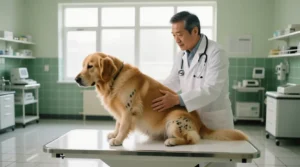
Because many conditions are similar to vestibular disease, the veterinary will perform a systematic work-up:
- Full medical history: when started, how fast, any trauma prior, see any indications of ear infection.
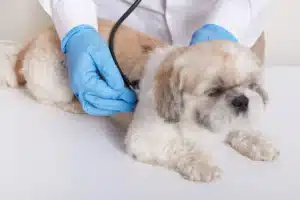
- Physical /neurological exam: Checking eye movements, head tilt, walking, and checking ear canals.
- Ear exam (otoscope) to check for infection, ruptured eardrum, etc.
- Bloodwork (CBC, chemistry, possibly thyroid), blood pressure.
- Imaging if needed (CT scan, MRI) if needed.
4. Treatment & What You Can Do at Home
Treatment will depend on the cause. Here’s how it breaks down:
If there is a cause identified (i.e. ear infection): treat the ear infection (antibiotics, ear flushing), and the vestibular signs may resolve.
If the cause is idiopathic (unknown): then supportive care is often the path forward. Rest, fluids if needed, anti-nausea meds.
If there is a central cause (brain tumour/infection): this is more complicated and will often involve a workup by neurology, surgery, etc.
What you can do at home
- As a dog owner, you play a significant role in their recovery. Some things you can do include:
- Create a calm, safe environment: Remove any slick surfaces, any rugs they might slip on, and keep them from jumping or climbing stairs.
- Elevate food and water bowls so they do not have to stretch to get to them or awkwardly move their head.
- Give them some soft padding/bedding if they are lying down more than normal.
- Help them stand/walk gently if they are unsteady, use a towel or a sling if need be.
- Be patient: the most intense period is the first 24-48 hours; after that, solicited improvement often begins (Thomas, 2022).
When to contact the vet
Because vestibular signs can mask more serious problems, you will want to sync up with your veterinarian if.
5. Prognosis – what to expect and considerations for the future
The reassuring aspect is that while the presentation may be dramatic, the prognosis for many dogs, and particularly for idiopathic peripheral cases, is frequently favourable.
Here are some specifics:
Most dogs will show improvement within 72 hours after the onset of the worst signs (Vin.com, 2025).
The recovery time may be 2-3 weeks in less severe cases and could take as long as 4-5 weeks, depending on the severity of the symptoms.
Some dogs may have mild residual head tilt or wobble/ataxia for the remainder of their life, but many will adjust and be happy and content.
If the cause is central (brain tumour, etc.), prognosis is more guarded and prompt treatment is helpful.
Living with residual effects
If your dog has a slightly head-tilted posture or remains stable with wobble/ataxia, it is manageable.
Your veterinarian might recommend follow-up visits to ensure that an unexpected secondary issue has not developed.
You may make some adjustments to your home environment (anti-slip after mats, ramps instead of stairs).
You should encourage your dog to move confidently – take short walks and play gentle games, but do not make high demands regarding agility if balance remains unstable.
6. My “Owner’s list” for you to print
This a short form that you can keep near your dog’s collar, or vet reference, or phone:
Sudden head tilt, possibly with stumbling or circling?
Vet evaluated and scheduled an appointment; discussed a known vs an idiopathic cause.
It’s a safe home environment for your pup: no slippery floors, block all stairs, keep food/water dish low.
Soft bedding or carpet, and limits to jumping or climbing are helpful.
Minimal monitoring for eating/drinking is not stressful to your dog: If they have not eaten/drunk in more than 24 hours, call your veterinarian.
In the 72-hr range, you will begin to see some improvement, but should not feel the need to push. If not, take the next step of contacting your vet.
In the long run, embrace a residual head tilt if stable; build a life together that accommodates.
7. Conclusion
It is hard to see your dog off-balance, head tilted, sometimes walking like they have spun around too many times! It helps to know that for many dogs, this is manageable, recovery is typically the case, and with time, care, and your all-important patience, you and your dog can get back to feeling (and being) more like themselves.
The take-home message is in recognising these conditions quickly, having a veterinarian see your dog to rule out something serious, caring at home to support them, and just plainly being patient throughout the course of recovery.
References
Mertens, A.M., Schenk, H.C. and Volk, H.A., 2023. Current definition, diagnosis, and treatment of canine and feline idiopathic vestibular syndrome. Frontiers in veterinary science, 10, p.1263976.
Orlandi, R., Gutierrez-Quintana, R., Carletti, B., Cooper, C., Brocal, J., Silva, S. and Gonçalves, R., 2020. Clinical signs, MRI findings and outcome in dogs with peripheral vestibular disease: a retrospective study. BMC Veterinary Research, 16(1), p.159.
Radulescu, S.M., Humm, K., Eramanis, L.M., Volk, H.A., Church, D.B., Brodbelt, D. and O’Neill, D.G., 2020. Vestibular disease in dogs under UK primary veterinary care: Epidemiology and clinical management. Journal of veterinary internal medicine, 34(5), pp.1993-2004.
Thomas, J. (2022). Vestibular Disease in Dogs. [online] www.petmd.com. Available at: https://www.petmd.com/dog/conditions/neurological/vestibular-disease-dogs.
Vestibular Disease in dogs: ‘Old Dog Syndrome’. (2020). Available at: https://www.rvc.ac.uk/Media/Default/VetCompass/201103%20Vestibular%20infographic.pdf? [Accessed 8 Nov. 2025].
Vin.com. (2025) Vestibular Disease in Dogs and Cats. [online] Available at: https://veterinarypartner.vin.com/default.aspx?id=4951444&pid=19239&utm [Accessed 8 Nov. 2025].