

The Havanese is a small Cuban companion breed with a friendly, people-focused temperament, a long, low-shedding coat, moderate exercise needs, and a strong tendency to stay close to you throughout the day. Its breed standards describe an affectionate, intelligent, playful dog that fits apartment living well, but daily coat care and regular social contact shape the real ownership experience.
You get two practical benefits from this guide.
- You get a fact-based picture of Havanese daily life.
- You get a clearer way to decide whether the breed matches your schedule, grooming tolerance, and noise tolerance.
Which questions does this Havanese guide answer?
This article follows the main Havanese search path in a logical order. It moves from breed identity to temperament, barking, grooming, exercise, health testing, and owner fit, because that is how most prospective owners narrow the decision.
- What is a Havanese dog breed?
- What does the Havanese temperament feel like at home?
- Does a Havanese bark a lot?
- How much grooming does a Havanese need?
- What does daily life with a Havanese look like?
- Which health facts and breeder checks matter?
- Is a Havanese right for your home?
What makes the Havanese worth researching closely?
The Havanese is not a generic toy dog. The breed combines high social attachment, high coat maintenance, moderate activity, and long lifespan, which means your ownership experience depends less on size and more on routine. The Havanese breed ranked No. 25 in the AKC’s 2025 popularity list, which shows strong demand and broad visibility among US owners.
You also have more health data than many owners realize. The Havanese Club of America has run large breed surveys across 2004, 2012, 2017, 2018 to 2019, 2022, and 2023 to 2024, which gives this breed a better internal evidence trail than many small companion dogs receive in public discussion.
What is a Havanese dog breed?
The Havanese, a bichon-type dog, is the national dog of Cuba and a small companion breed in the Bichon family with a long silky or wavy coat, a springy gait, and a strong social orientation toward people.
The physical numbers are compact but useful. Some guides list 8.5 to 11.5 inches in height and 7 to 13 pounds in weight, while the Federation Cynologique Internationale (FCI) sets the ideal height at 23 to 27 cm with a tolerance of 21 to 29 cm. That range keeps the breed easy to carry, easy to house, and easier to manage in smaller living spaces.
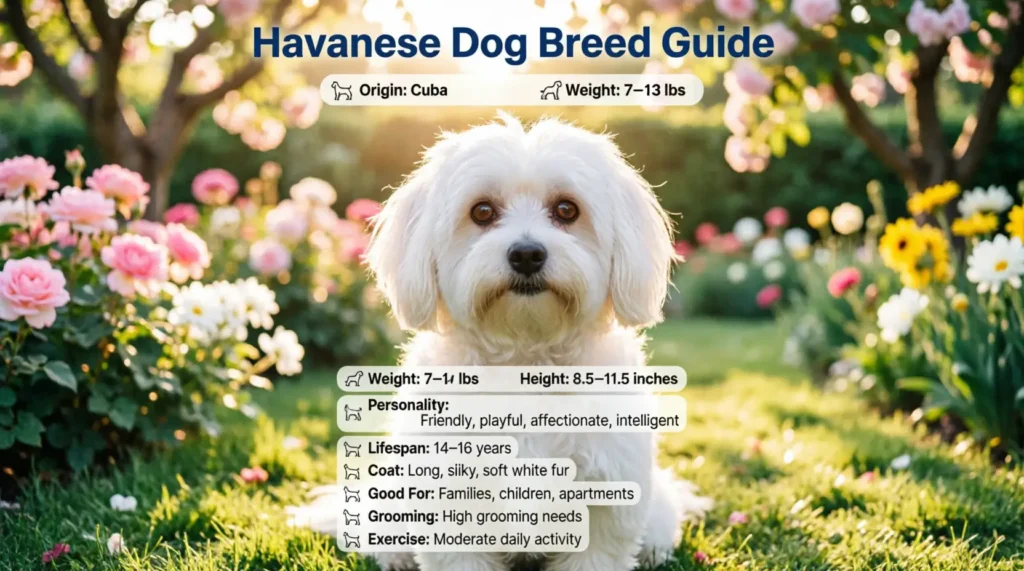
Quick Havanese facts
This table gives the measurable breed facts that affect daily ownership most directly. It focuses on dimensions, coat workload, exercise, and lifespan instead of show-ring detail.
| Trait | Havanese fact | Why it matters |
| Height | 8.5 to 11.5 inches | Small body fits apartments and travel carriers |
| Weight | 7 to 13 pounds | Easy handling, but toy-size fragility still matters |
| Exercise | Up to 30 minutes per day | Moderate activity needs, not a sedentary breed |
| Grooming | Every day | Coat care becomes a daily commitment |
| Shedding | No or very low | Less loose hair, more brushing time |
| Lifespan | 14 to 16 years; about 15 years in HCA surveys | Long ownership horizon changes cost and care planning |
The pattern is simple. The Havanese stays physically small, but the breed asks for a larger time commitment than the size suggests. The coat and the companion temperament create most of that demand.
What is the truth about the Havanese temperament?
Havanese temperament is friendly, playful, intelligent, and highly people-focused. The breed is as friendly, playful, alert, and intelligent as possible. The Havanese is easy to train, a charmer, and a dog that plays endlessly.
In daily life, that temperament looks like shadowing, greeting behavior, lap-seeking, and quick emotional response to your tone or movement. You usually don’t get a detached dog. You usually get a dog that notices where you are, what you are doing, and whether the routine has changed.
That social intensity explains why many owners call the Havanese a velcro dog. The phrase is informal, but the behavior is not accidental. Breed standards and breed-club material consistently frame companionship as a core function of the Havanese, not a side trait.
What does a Havanese temperament look like in a home?
You usually see 5 pra ctical temperament patterns in Havanese homes.
- Seek contact, because the breed stays socially engaged with people.
- Read the mood, because the breed reacts quickly to voice and tone.
- Learn routines, because the breed is intelligent and cue-sensitive.
- Invite play, because the breed keeps a light, active social style.
- Notice the change, because alertness is part of the breed profile.
Those traits create clear benefits.
- You get a companion dog that integrates into family life quickly.
- You get a breed that usually responds well to short, reward-based training.
- You get a small dog that can stay engaged without extreme exercise loads.
Those traits also create clear limits.
- You get less independence than many owners expect from a small breed.
- You get a higher risk of clingy behavior if daily alone time stays too long.
- You get more reactivity to household noise and movement than the breed’s soft expression suggests.
Does a Havanese bark a lot?
A Havanese often barks as an alert dog, not as a guarding dog. The breed is an excellent watchdog. The Havanese is easy to train as an alarm dog. Those two descriptions point to vocal alerting, especially around doors, in hallways, with visitors, and during routine disruptions.
That distinction matters in real homes. In an apartment, alert barking often starts at elevator traffic, footsteps, or corridor doors. In a house, alert barking often starts at gates, deliveries, passing dogs, or visitor movement. The breed’s small size lowers its space requirement, but it does not lower its sound awareness.
What triggers Havanese barking most often?
There are 5 common triggers for barking in Havanese households.
- Notice movement, such as hallway traffic or passing cars.
- Notice separation, such as leaving a room or leaving home.
- Notice novelty, such as guests, repair visits, or new objects.
- Notice frustration, such as blocked access to you or to play.
- Notice reinforcement, if barking gets attention every time.
The important truth is not that every Havanese barks excessively. The important truth is that the breed has the alertness and learning speed to turn unmanaged barking into a fixed household pattern. That is why early response matters more than late correction.
How do you reduce Havanese barking in daily life?
Reduce barking by shaping quiet behavior before the trigger escalates. Reward quiet observation, limit overused window access, rehearse short departures, and keep greetings low-key. Those strategies fit a sensitive companion breed better than harsh interruption.
If your home has thin walls, shared corridors, or frequent deliveries, this issue deserves extra weight in your breed decision. A Havanese can fit apartment life well, but only if you manage sound triggers with consistency.
How much grooming does a Havanese need?
A Havanese needs daily grooming. The long, soft, silky coat needs daily grooming to stay free of mats and tangles.
This is the most misunderstood part of Havanese ownership. Low shedding does not mean low maintenance. Low shedding often means the loose hair stays in the coat, which increases knotting, felting, and skin-surface debris retention unless you comb and separate the coat regularly.
The coat length explains the workload. The outer coat can reach 12-18 cm in an adult dog. That length gives the breed its look, but it also increases friction mats behind the ears, under the collar, in the armpits, and around the legs.
What does Havanese grooming include?
A practical Havanese grooming routine includes:
- Comb the full coat to catch tangles before they tighten.
- Check the ears to spot debris and irritation early.
- Clean the eye area to reduce crusting and coat staining.
- Trim nails and feet to protect gait and traction.
- Bathe and dry on schedule to reset coat texture and cleanliness.
| Grooming task | What it controls | What happens if you skip it |
| Full comb-through | Matting and hidden tangles | Tangles tighten close to the skin |
| Ear check | Wax, debris, moisture | Irritation and odor build faster |
| Eye-area wipe | Tear residue and staining | Crusting and staining increase |
| Foot and nail care | Traction and gait comfort | Slipping and overgrowth increase |
| Bath and dry routine | Coat texture and cleanliness | Dirt retention and matting increase |
A shorter pet trim can reduce coat time, but a short trim does not eliminate grooming. It only lowers the amount of daily detangling. Nails, ears, eyes, skin checks, and bathing still stay on your schedule.
What does daily life with a Havanese actually feel like?
Daily life with a Havanese feels close, interactive, and routine-driven. You are likely to spend the day with a dog that wants visual contact, likes room-to-room proximity, and shifts between rest, play, and check-ins with you. That pattern follows directly from the breed’s companion history and standard temperament descriptions.
A realistic Havanese day often includes a morning walk, indoor play, short training sessions, grooming time, social contact, and another walk or play period later in the day. Up to 30 minutes per day gives a useful baseline, but mental engagement also matters because the breed learns quickly and notices household patterns fast.
What daily challenges come with a Havanese?
There are 4 recurring Havanese challenges:
- Manage coat time, because the coat does not maintain itself.
- Manage alone time, because attachment often runs high.
- Manage noise exposure, because alert barking starts easily.
- Manage consistency, because this breed learns household patterns fast.
The challenges are manageable, but the pattern stays specific. You get a small companion dog with moderate exercise needs and above-average human-contact demand. That is a strong fit for some homes and a poor fit for others.
How much exercise and training does a Havanese need?
A Havanese needs moderate exercise and frequent short training. Short sessions work well because the breed is alert and socially motivated. A Havanese often values interaction itself as a reward. That is why clear repetition and calm handling usually work better than pressure.
Which activities suit a Havanese best?
Choose activities that combine movement and contact.
- Walk short routes to burn energy without overloading joints.
- Play indoors, because the breed adapts well to smaller homes.
- Teach tricks, because the breed is intelligent and socially engaged.
- Use food puzzles, because mental work lowers boredom.
- Practice recall and settle, because household control matters daily.
The exercise truth is simple. The Havanese is not a couch ornament, but the breed is also not a heavy-output dog. Moderate exercise plus frequent interaction fits the profile better than either extreme.
Which health facts matter before you choose a Havanese?
The most useful health fact is that breeder screening matters more than breed reputation alone. CHIC testing for Havanese currently includes OFA hips, OFA patellas, and annual CAER eye exams. That is the core health-testing set the parent club asks breeders to document.
The age and timing details matter too. Patella certification is performed after 1 year of age, while hip certification is performed after 2 years of age. Those dates help you assess whether a breeder’s paperwork reflects completed screening or incomplete screening.
What do Havanese lifespan statistics actually show?
Two decades of breed surveys suggest a natural lifespan of about 15 years. The 2017 Longevity Survey used data from 512 Havanese and found an average lifespan of about 13.0 ± 0.3 years, with a second broader peak centered around 14.5 years, and almost a third of dogs surviving to between 15 and 19 years.
That same 2017 report also found a narrower early-mortality peak near 9.6 years involving about 20% of the population in the sample. That does not mean one in five Havanese always dies early. It means the breed’s lifespan curve is not perfectly smooth, and some subgroups in the survey died meaningfully earlier than the rest.
Which breed-specific health numbers are worth knowing?
A peer-reviewed Norwegian study on Havanese eye-screening data included 1,156 dogs and found 168 affected with distichiasis, for a prevalence of 14.5% with a 95% confidence interval of 12.5% to 16.6%. Most affected dogs were graded mild. That number matters because eye screening is part of the core testing set.
The 2018-2019 Rainbow Bridge Survey Report adds mortality detail from 156 Havanese. It reported cancers more often in males at 37.5% ± 8.5% than in females at 17.9% ± 5.0%, and listed kidney disease or kidney failure as a primary cause in 9.6% ± 2.5% of the survey population at an average death age of 14.2 ± 0.9 years.
Patellar luxation is not unique to Havanese, but it is especially relevant because it is a core Havanese screening item. Medial patellar luxation occurs 12 times more often in small breeds than in large breeds, which explains why small companion breeds receive special attention for patella checks.
Which Havanese health points deserve the most attention?
Focus on 5 health checkpoints when you evaluate a breeder or an adult Havanese.
- Check eyes, because eye screening stays part of the core testing set.
- Check patellas, because knee stability matters in small breeds.
- Check hips for hip evaluation in CHIC screening.
- Check breeder records, because open reporting improves traceability.
- Check the lifespan context, because a long-lived breed carries long-term care costs.
These checkpoints do not mean every Havanese becomes medically complex. They mean you improve your odds when you choose from breeders who document testing and disclose results through recognized systems such as OFA and CHIC.
| Health checkpoint | Quantified fact | Why you should ask |
| Eye exams | Annual CAER is part of CHIC for Havanese | Eye issues such as distichiasis have a documented breed prevalence |
| Patellas | OFA patellas required; test after 1 year | Small breeds carry a much higher patellar luxation risk |
| Hips | OFA hips required; final test after 2 years | Hips in the core screening set |
| Lifespan context | About 15 years of natural lifespan | Long lifespan changes long-term care and cost planning |
| Cause-of-death records | 156-dog Rainbow Bridge survey exists | Breeders with data literacy usually document more clearly |
Is a Havanese right for your home?
A Havanese fits homes that want daily companionship, can handle daily coat care, and can shape barking early. The breed fits less well when your schedule involves long daily isolation, low tolerance for grooming, or a strong dislike of alert vocal behavior.
Decision framework
| Home factor | Strong Havanese fit | Weak Havanese fit |
| Time at home | Frequent presence | Long daily absence |
| Grooming tolerance | Daily coat care | Low-maintenance expectation |
| Noise tolerance | Early barking management | Strong dislike of alert barking |
| Space | Apartment or house | Space alone does not solve behavior |
| Training style | Calm and consistent | Harsh or inconsistent handling |
The decision point is not size alone. The real decision point is whether your routine matches a social, coat-heavy, alert companion breed that may stay with you for 14 to 16 years or more.
Final verdict: The Havanese is not difficult, but it is specific
The Havanese is easy to admire from a distance, but the better question is whether the breed fits your real routine. The numbers and breed standards point to the same conclusion: you get a small dog with a 7 to 13 pound frame, a 14 to 16 year life expectancy, daily grooming needs, up to 30 minutes of exercise, and a temperament built around close human contact. That mix makes the Havanese an excellent companion for the right home, but not a low-effort dog for every home.
If you want a cheerful, people-focused dog that learns quickly, adapts well to smaller spaces, and stays deeply involved in your daily life, the Havanese gives you a strong match. If you want a quiet, independent, low-maintenance breed, the same facts point you in a different direction. That is the real truth about the Havanese dog breed: the breed’s biggest strengths and biggest demands come from the same place, which is its close attachment to you, its alert nature, and its high-maintenance coat.
Frequently Asked Questions
Is a Havanese a good family dog?
Yes, a Havanese is generally a good family dog because the breed is friendly, playful, and strongly people-focused.
Does a Havanese bark a lot?
A Havanese often barks as an alert dog, especially at doors, visitors, hallway noise, and sudden routine changes.
How much grooming does a Havanese need?
A Havanese needs daily grooming because the long, low-shedding coat mats and tangles easily without regular combing.
Is a Havanese low shedding?
Yes, a Havanese is low shedding, but low shedding does not mean low maintenance because loose hair stays trapped in the coat.
How much exercise does a Havanese need?
A Havanese needs moderate exercise, with around 30 minutes per day as a practical benchmark.
Can a Havanese live in an apartment?
Yes, a Havanese can live well in an apartment because the breed is small, adaptable, and suited to indoor companion life.
How long does a Havanese usually live?
A Havanese usually lives about 14 to 16 years, with Havanese Club of America survey data also pointing to a natural lifespan of about 15 years.
Is a Havanese easy to train?
Yes, a Havanese is usually easy to train because the breed is intelligent, alert, and responsive to calm, reward-based repetition.
What health checks matter most for a Havanese?
The most important Havanese health checks are OFA hips, OFA patellas, and annual CAER eye exams.
Is a Havanese the right dog for first-time owners?
A Havanese can suit first-time owners well if you can handle daily grooming, regular companionship, and early barking management.