

What is the main difference between a Goldendoodle and a Labradoodle?
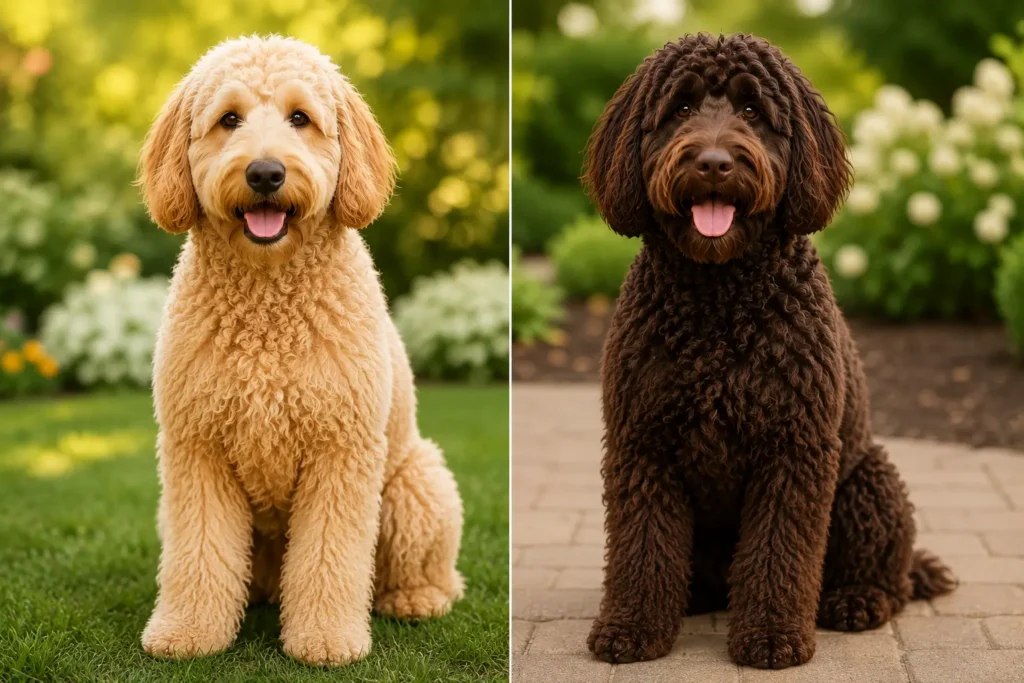
The main difference is the non-Poodle parent breed. A Goldendoodle is a Golden Retriever and Poodle mix. A Labradoodle is a Labrador Retriever and Poodle mix.
This parent-breed difference changes temperament, energy pattern, coat tendency, social behavior, and family fit. Both dogs belong to the wider group of Poodle mixes, often called doodle breeds.
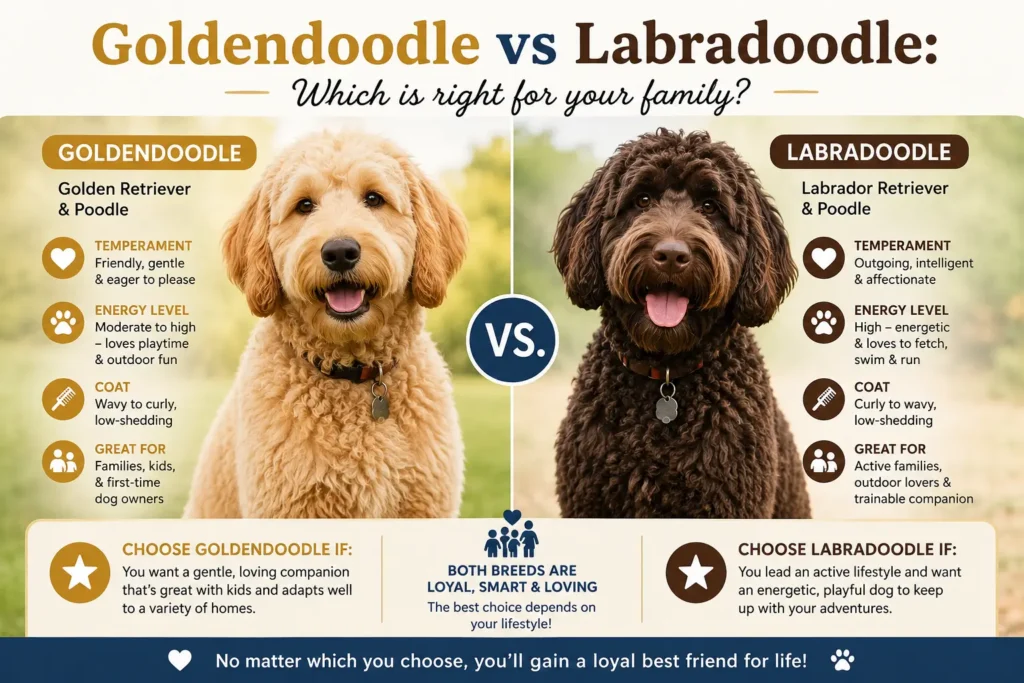
A Goldendoodle usually suits families that want a softer, affectionate, people-focused companion. A Labradoodle usually suits active homes that want a playful, energetic, and trainable dog with stronger working-dog drive.
Both dogs can be excellent family pets. The right choice depends on 6 factors: allergies, grooming time, exercise routine, training ability, home size, and breeder quality.
Quick answer: Which doodle is right?
Choose a Goldendoodle if you want a gentle, affectionate, child-friendly dog with strong companion traits. Choose a Labradoodle if you want a more athletic, playful, and active Poodle mix.
This goldendoodle vs labradoodle comparison does not have one universal winner. Both dogs can fit families, couples, and active owners. The better dog is the one that matches your daily routine.
A calm household with children may prefer a Goldendoodle. A highly active household that enjoys long walks, fetch, hiking, swimming, or outdoor training may prefer a Labradoodle.
Goldendoodle vs Labradoodle comparison table
This doodle breed comparison table explains the main differences by parentage, coat, energy, grooming, allergies, size, training, and family suitability.
| Feature | Goldendoodle | Labradoodle |
| Parent breeds | Golden Retriever and Poodle | Labrador Retriever and Poodle |
| Common temperament | Affectionate, social, gentle | Playful, energetic, outgoing |
| Energy level | Medium to high | High |
| Coat type | Wavy, curly, or straight | Wavy, curly, fleece-like, or straight |
| Shedding level | Low to moderate, varies by coat | Low to moderate, varies by coat |
| Allergy fit | Better with curlier coats, not allergy-free | Better with curlier coats, not allergy-free |
| Grooming demand | High | High |
| Training response | Strong with positive reinforcement | Strong with positive reinforcement |
| Best for | Families wanting a soft companion | Active homes wanting a sportier dog |
| Main risk | Separation anxiety and coat matting | Overexcitement and coat matting |
Both breeds need structured care. A doodle is not a low-maintenance dog because the coat can mat quickly, and the mind needs daily stimulation.
Are Goldendoodles and Labradoodles hypoallergenic family dogs?
Goldendoodles and Labradoodles are not fully hypoallergenic family dogs because no dog is completely allergen-free. They may cause fewer symptoms for some people when they inherit a low-shedding, curly Poodle-type coat.
According to Mayo Clinic pet allergy guidance, allergens from dogs are found in dander, saliva, urine, sweat, and fur. A curly coat may trap loose hair and dander, but the dog still produces allergens.
This matters for allergy-sensitive families. A breeder cannot honestly guarantee that a puppy is hypoallergenic. The safest method is to spend time with the specific puppy or adult dog before adoption.
For allergy-sensitive homes, check 5 factors:
- Choose a curlier coat over a flat coat.
- Meet the dog before purchase or adoption.
- Test reactions from direct contact.
- Ask about shedding in both parent lines.
- Keep grooming, washing, vacuuming, and bedding hygiene consistent.
A poodle mix guide should always separate low-shedding from hypoallergenic. Low-shedding means less loose hair. Hypoallergenic means reduced allergy risk. It does not mean zero allergy risk.
Which breed sheds less?
Neither breed has guaranteed low shedding, but curlier Goldendoodles and Labradoodles usually shed less than straighter-coated dogs. Coat genetics decide shedding more than the breed name.
An F1 Goldendoodle or Labradoodle has 50 percent Poodle and 50 percent Retriever background. That dog can inherit a curly coat, wavy coat, or flatter retriever-like coat.
An F1B doodle is usually bred back to a Poodle. This often increases the chance of a curlier, lower-shedding coat. It does not guarantee an allergy-safe dog.
There are 3 coat categories to understand:
- Curly coat: usually lower shedding and higher grooming demand.
- Wavy coat: often balanced, but shedding varies.
- Straight or flat coat: often more shedding and more retriever-like.
A family choosing between Goldendoodle vs Labradoodle should judge the individual coat, not only the breed label.
Which dog is better for children?
Goldendoodles often fit young families better because many inherit the Golden Retriever’s gentle and people-focused nature. Labradoodles can also be excellent with children when trained, exercised, and socialized early.
The Golden Retriever contributes friendly, devoted, and companion-focused traits. This parent-breed influence makes Golden Retriever temperament important when comparing the softer family side of Goldendoodles.
The Labrador Retriever contributes outgoing, energetic, and athletic traits. This makes many Labradoodles more playful and physically active around children.
The child-friendly difference is usually about energy control. Goldendoodles may feel softer in family settings. Labradoodles may feel bouncier and more physically active.
For families with toddlers, the best dog is calm, trained, supervised, and properly exercised. A high-energy doodle can knock over small children during excited play.
Use 5 rules for children and doodles:
- Supervise every interaction with young children.
- Teach children not to pull ears, tails, or coats.
- Train the dog to sit before greeting.
- Give the dog a quiet rest space.
- Avoid rough indoor play with puppies and children.
A family dog is shaped by breed traits, training, socialization, and household routine.
Which dog needs more exercise?
Labradoodles usually need more exercise because Labrador Retriever and Poodle lines are both active working-dog lines. Goldendoodles also need daily movement, training, and play.
A standard Labradoodle often suits owners who enjoy outdoor activities. Running, swimming, fetch, hiking, and scent games can fit this dog well.
A Goldendoodle also needs activity, but many families find the emotional companionship easier to manage than the Labradoodle’s athletic drive.
Most adult doodles need daily activity through walks, play, training, and enrichment. Puppies need shorter sessions because growing joints are still developing.
A tired doodle behaves better. An under-exercised doodle may bark, chew, jump, dig, mouth, or demand attention.
Which dog is easier to train?
Both Goldendoodles and Labradoodles are highly trainable when owners use consistent, reward-based training. The Poodle parent adds intelligence, and the Retriever parent adds people-oriented working ability.
Goldendoodles often respond well to praise, food rewards, and gentle handling. Labradoodles often respond well to active training, retrieving games, and structured tasks.
The Poodle parent contributes strong learning ability in both mixes, so Poodle intelligence helps explain why Goldendoodles and Labradoodles often learn commands, routines, and problem-solving tasks quickly.
Training should begin early. The first 6 months shape greeting manners, crate comfort, recall, leash walking, bite inhibition, grooming tolerance, and calm behavior.
Focus on 7 foundation skills:
- Sit before greeting.
- Come when called.
- Walk without pulling.
- Stay on a mat.
- Drop toys on cue.
- Accept brushing.
- Settle when visitors arrive.
A smart dog is not automatically easy. Smart dogs learn good and bad habits quickly.
Which doodle needs more grooming?
Both Goldendoodles and Labradoodles need high grooming care because curly and wavy coats can mat close to the skin. The grooming burden is similar in both breeds.
A doodle coat can mat around the ears, armpits, chest, belly, tail, collar area, and legs. Mats can pull the skin and cause discomfort.
Most doodles need brushing several times per week. Curly-coated dogs may need daily line brushing. Professional grooming often happens every 6 to 8 weeks, depending on coat density and haircut length.
A Labradoodle’s coat, ears, joints, and exercise needs make health and grooming care central to long-term ownership.
A proper grooming routine includes:
- Brush with a slicker brush.
- Check the coat with a metal comb.
- Trim hair around the eyes.
- Clean ears after bathing or swimming.
- Trim nails regularly.
- Book professional coat maintenance.
A doodle is not a wash-and-wear dog. The teddy-bear look requires time, tools, and grooming cost.
Which dog is healthier?
Neither dog is automatically healthier because health depends on parent genetics, screening, breeding ethics, diet, weight, exercise, and veterinary care. Both breeds can inherit health risks from Poodles and Retrievers.
Goldendoodles may inherit issues linked with Golden Retrievers and Poodles. Labradoodles may inherit issues linked with Labrador Retrievers and Poodles.
Common health concerns can include hip dysplasia, elbow dysplasia, eye disease, ear infections, allergies, skin problems, and inherited conditions. Larger doodles also need careful weight control to protect joints.
A responsible breeder provides health testing for dogs before breeding. This matters more than the doodle name, coat color, or puppy price.
Ask for 6 health documents before buying:
- Hip evaluation.
- Elbow evaluation.
- Eye exam.
- Genetic disease testing relevant to parent breeds.
- Veterinary records for puppies.
- Written health contract.
A healthy doodle starts with tested parents, not marketing claims.
Which dog is better for apartment living?
A smaller Goldendoodle or Labradoodle can live in an apartment when exercise, training, grooming, and noise control are consistent. Standard sizes are harder to manage in small homes.
Mini Goldendoodles and Mini Labradoodles may suit apartments better than standard dogs. However, size does not remove energy. A small doodle can still bark, jump, chew, and demand activity.
Apartment owners should consider 5 needs:
- Daily outdoor walks.
- Indoor calm training.
- Elevator and hallway manners.
- Noise control.
- Regular grooming access.
A house with a yard helps, but a yard does not replace walks or training.
Which dog is better for first-time owners?
Goldendoodles are often easier for first-time owners because many have a softer companion temperament. Labradoodles can suit first-time owners who already enjoy active routines and structured training.
The first-time owner challenge is not only temperament. It is coat maintenance, exercise planning, puppy training, socialization, and breeder selection.
A first-time owner may prefer a mature rescue dog with known behavior. Adult dogs often give clearer information about size, coat, shedding, energy, and temperament.
Choose a puppy only when the breeder provides parent testing, socialization, grooming exposure, and honest guidance about coat and behavior.
Which dog is better for active owners?
Labradoodles usually fit active owners better because many have strong play, retrieving, swimming, and exercise drive. Goldendoodles can also be active, especially standard-sized dogs from athletic parent lines.
A Labradoodle may enjoy longer walks, outdoor games, dog sports, and training routines. A Goldendoodle may enjoy the same activities but often adds a stronger cuddle-focused companion style.
Active owners should still train rest. A dog that runs every day but never learns calm behavior can become overstimulated.
The best routine includes movement, mental work, food puzzles, leash practice, and quiet recovery.
Which breed has better temperament?
Goldendoodles usually lean more affectionate and gentle, while Labradoodles usually lean more playful and energetic. Individual temperament still depends on the puppy’s parents, breeder, early handling, training, and home environment.
A 2019 behavioral study compared Goldendoodles, Labradoodles, and their parent breeds using 5,141 owner surveys. The study found first-generation crossbreeds often fall between their parent breeds, with some behavioral exceptions.
This means a doodle puppy is not a predictable copy of a Golden Retriever, Labrador Retriever, or Poodle. Mixed-breed genetics can create variation within the same litter.
Meet the parent dogs when possible. Parent behavior is one of the best practical clues for puppy behavior.
What generation is best: F1, F1B, or multigenerational?
The best doodle generation depends on coat, allergy risk, breeder quality, and temperament goals. F1, F1B, and multigenerational labels describe ancestry, not guaranteed behavior.
An F1 doodle has one Poodle parent and one Retriever parent. An F1B doodle usually has one F1 doodle parent and one Poodle parent. A multigenerational doodle comes from doodle-to-doodle breeding across several generations.
Use this simple guide:
| Generation | Meaning | Common reason people choose it |
| F1 | 50 percent Poodle and 50 percent Retriever | Balanced mixed traits |
| F1B | Usually 75 percent Poodle influence | Higher chance of curlier coat |
| F2 | Two F1 doodle parents | More coat and trait variation |
| Multigenerational | Doodle lines bred over generations | More breeder-controlled traits when done responsibly |
Generation labels help with questions, but they do not replace parent testing or puppy evaluation.
How do you choose a responsible breeder?
Choose a breeder who health-tests parent dogs, explains coat genetics, socializes puppies, and refuses to guarantee a hypoallergenic puppy. Ethical breeding is more important than the doodle label.
The American Kennel Club advises buyers to look for a responsible breeder who allows buyers to meet at least one parent dog, keeps clean premises, and answers health and temperament questions.
Avoid breeders who sell only by color, size, or “teddy bear” appearance. Avoid breeders who refuse health records or prevent buyers from asking about parent dogs.
A responsible breeder answers 8 questions:
- Which health tests were completed on both parents?
- What are the parent dogs’ temperaments?
- What generation is the litter?
- What coat types appeared in previous litters?
- How are puppies socialized?
- What grooming exposure do puppies receive?
- What return policy exists if the home cannot keep the dog?
- What support is provided after purchase?
A reputable rescue is also a strong option. Adult doodles in rescue often have known coat, size, and temperament.
Goldendoodle vs Labradoodle: which is right for you?
A Goldendoodle is right for you if you want a gentle, affectionate, family-focused dog. A Labradoodle is right for you if you want a more athletic, playful, and energetic dog.
Choose a Goldendoodle when your home needs:
- A softer companion temperament.
- Strong people attachment.
- Good child compatibility.
- Moderate to high activity.
- Daily grooming tolerance.
Choose a Labradoodle when your home needs:
- Higher outdoor activity.
- Strong play and retrieving drive.
- A trainable working-style companion.
- A dog for walks, hikes, or swimming.
- Consistent structure and exercise.
Both dogs need grooming, training, socialization, health testing, and daily attention. The best dog is the one whose adult size, coat, temperament, and energy match your real household routine.
Final answer
Goldendoodle vs Labradoodle comes down to lifestyle fit, not popularity. A Goldendoodle usually fits families that want a gentle and affectionate companion. A Labradoodle usually fits active owners who want a playful and energetic Poodle mix.
Both can be good hypoallergenic family dogs for some allergy-sensitive homes, but neither is allergy-free. Both need grooming, training, exercise, and responsible breeding.
The right choice is the individual dog with tested parents, a suitable coat, stable temperament, and daily car
Frequently Asked Questions
Is a Goldendoodle calmer than a Labradoodle?
A Goldendoodle is often calmer than a Labradoodle, but temperament varies by parent dogs, training, exercise, and puppy socialization.
Is a Labradoodle more active than a Goldendoodle?
A Labradoodle is usually more active because Labrador Retriever and Poodle backgrounds both contribute strong working-dog energy.
Which doodle is best for allergies?
A curlier-coated Goldendoodle or Labradoodle may suit some allergy-sensitive homes, but no doodle is completely hypoallergenic.
Which doodle is better with children?
A Goldendoodle often suits children better because many have gentle companion traits, but trained Labradoodles can also be excellent family dogs.
Which breed costs more to groom?
Goldendoodles and Labradoodles have similar grooming costs because both can have dense curly or wavy coats that need professional maintenance.
Is a Goldendoodle or Labradoodle better for first-time owners?
A Goldendoodle is often better for first-time owners, while a Labradoodle better suits first-time owners with active routines and training commitment.
Can Goldendoodles and Labradoodles be left alone?
Goldendoodles and Labradoodles can be left alone for short periods after training, but both can develop separation problems without gradual independence training.
Are Labradoodles and Goldendoodles official dog breeds?
Labradoodles and Goldendoodles are Poodle crossbreeds, not standardized purebred breeds with fully predictable traits.