


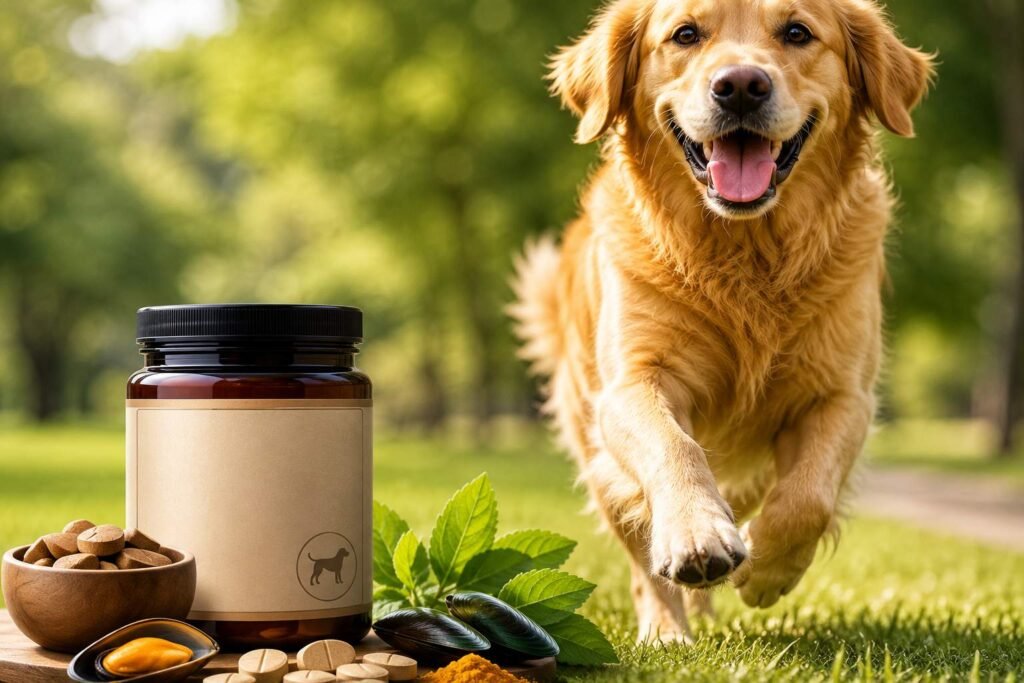
Joint health supplements for dog joints support strong mobility by helping cartilage, inflammatory balance, joint lubrication, and daily comfort. The best evidence favors omega-3 fatty acids, while glucosamine, chondroitin, collagen, green lipped mussel, hyaluronic acid, and MSM need product specific review.
Dog joint health deserves practical attention because osteoarthritis is common and often under-recognized. Veterinary literature commonly cites osteoarthritis in about 20% of adult dogs, while large primary care datasets report lower diagnosed prevalence because many early cases never reach formal diagnosis. A study of more than 450,000 dogs reported an annual appendicular osteoarthritis prevalence of 2.5% in UK primary-care records.
This blog gives you 2 useful outcomes.
- You learn how joint health supplements support strong dog joints
- You learn which claims deserve caution before you buy a chew, capsule, powder, oil, or therapeutic diet.
What are Joint Health Supplements for Dog Joints?
Joint health supplements for dog joints are oral products that support cartilage, joint fluid, inflammation balance, and mobility in dogs. These products come as soft chews, tablets, capsules, powders, liquids, fish oils, and therapeutic diets.
Cornell University College of Veterinary Medicine lists common joint supplement ingredients, including:
- Glucosamine
- Chondroitin Sulfate
- Methylsulfonylmethane (MSM)
- Omega-3 fatty acids EPA
- DHA
- Hyaluronic acid
- Green-lipped mussel
- Undenatured type-II collagen
A joint supplement is not a pain medicine. Pain medicine acts through drug-regulated pain and inflammation pathways. A supplement usually supports joint structure, inflammatory balance, cartilage metabolism, or movement comfort.
How do joint health supplements support strong dog joints?
Joint health supplements support strong dog joints through 5 ways:
- Cartilage support
- Inflammation control
- Joint lubrication
- Antioxidant activity
- Mobility maintenance
The result depends on the ingredient, dose, product testing, body weight, and joint disease stage.
A healthy dog joint includes cartilage, synovial fluid, ligaments, tendons, joint capsule, and surrounding muscle. Osteoarthritis disrupts that whole structure. MSD Veterinary Manual describes osteoarthritis as progressive cartilage breakdown with joint effusion, osteophytes, synovitis, inflammatory mediators, and pain from periarticular and subarticular tissues.
No supplement simply “rebuilds” a damaged joint. That sounds good on a label, but it is too neat. A better suggest is this: some joint supplements assist selected dogs maintain mobility, support cartilage related biology, or reduce inflammatory pressure when the rest of the joint care plan also makes sense.
How common are dog joint problems?
Dog joint problems are common because osteoarthritis risk rises with age, weight, orthopedic disease, and previous injury. Prevalence figures differ because researchers measure different dog populations.
A review reports North American osteoarthritis prevalence near 20% of dogs over 1 year of age. A large primary care study of more than 450,000 dogs found 2.5% annual period prevalence for appendicular osteoarthritis. Risk rose when dogs were older than 8 years, heavier, and neutered.
Another risk factor study examined 131,140 dogs and looked at age, sex, body weight, breed, neuter status, and age at neutering. The value of that dataset is simple: dog joint risk rarely comes from one cause. It stacks.
Dog Joint Risk Overview
A supplement choice becomes more useful when you know the dog’s risk pattern. A young working dog, a senior Labrador, and an overweight dachshund need different decisions.
| Figure | What the number means | Why it matters for joint supplements |
| Adult dog osteoarthritis estimate | About 20% | Joint support is not only a senior dog topic |
| Large primary-care OA dataset | More than 450,000 dogs | Diagnosed cases show only part of the burden |
| Annual appendicular OA prevalence | 2.5% | Mild or early cases may not appear in records |
| Higher risk age marker | Older than 8 years | Senior dogs often need broader joint care |
| Risk Factor dataset | 31,140 dogs | Weight, breed, age, and neuter status affect risk |
Which dog joint problems make supplements relevant?
Joint supplements become relevant for dogs with osteoarthritis risk, hip dysplasia, elbow dysplasia, cruciate ligament injury, aging stiffness, high activity load, or breed related orthopedic risk. Supplements fit best before severe mobility loss.
Common osteoarthritis sites include:
- Hips
- Elbows
- Shoulders
- Stifles
- Carpi
- Tarsi
MSD Veterinary Manual links osteoarthritis with cartilage deterioration, joint fluid change, bone remodelling, synovitis, and pain.
Large breed dogs, senior dogs, overweight dogs, athletic dogs, and dogs with previous orthopedic injury often receive joint health supplements earlier. Puppies from breeds with known hip or elbow risk need veterinary guidance first because growth rate, phosphorus,calories, calcium, and exercise affect orthopedic development.
A mobility log and veterinary exam help separate joint support needs from unrelated causes of limping or stiffness.
What role does body weight play in strong dog joints?
Body weight changes joint supplement value because excess weight adds load and inflammatory pressure to dog joints. A supplement works inside the dog’s real body condition.
A recent study using Banfield Pet Hospital records included about 4.9 million dogs and cats from last few years. In dogs, overweight or obese condition during growth increased the odds of overweight or obese condition in adulthood, with an odds ratio of 1.85.
Long term feeding data also connects lean body condition with joint aging. A recent study followed 48 dogs from 7 litters. Dogs fed 25% less than their paired littermates had lower prevalence and later onset of hip osteoarthritis. The control fed group showed first radiographic hip osteoarthritis at a median 6 years, while the restricted fed group reached that point at 12 years.
Weight and joint supplement decision table
| Weight factor | Quantified data | Practical meaning |
| Banfield records | About 4.9 million dogs and cats | Body condition data has large-scale support |
| Growth to adult weight risk | Odds ratio 1.85 in dogs | Early weight patterns can follow dogs into adulthood |
| Labrador feeding study | 48 dogs from 7 litters | Lean feeding changed joint-aging outcomes |
| Diet restriction | 25% less food | Leaner dogs had delayed hip osteoarthritis |
| First hip OA finding | 6 years vs 12 years | Weight control affected timing, not just appearance |
| Lifespan difference | 1.8 years longer | Lean body condition supports more than joints |
Which ingredients have the strongest Suggestions?
Omega 3 fatty acids have the strongest support among common dog joint supplements, especially EPA rich fish oil and EPA rich diets. Glucosamine and chondroitin remain common.
Cornell identifies omega 3 fatty acids from fish oil as the joint supplement with the most current literature support. Cornell also notes that omega 3 concentration varies by product, so the EPA and DHA amounts matter more than the phrase “fish oil.”
MSD Veterinary Manual reports EPA supplementation at 50 to 100 mg/kg by mouth every 24 hours and EPA rich diets with improved gait and mobility in dogs. MSD also notes an NSAID sparing effect in dogs receiving EPA rich support.
Ingredient evidence table
The table compares common dog joint supplement ingredients by intended role and evidence caution.
| Ingredient | Main joint role | Evidence signal | Practical caution |
| Omega 3 EPA and DHA | Inflammatory balance and mobility | Stronger support than most nutraceuticals | Dose, calories, and medications matter |
| Green-lipped mussel | Cartilage and inflammation support | Cornell cites supportive studies and a dose | Product source and dose matter |
| Undenatured type-II collagen | Cartilage-related immune and mobility support | Newer dog studies show targeted promise | Funding and product-specific data matter |
| Glucosamine | Cartilage matrix support | Mixed evidence | Ingredient name alone is not enough |
| Chondroitin sulfate | Proteoglycan support | Mixed to weak evidence | Often bundled with glucosamine |
| Hyaluronic acid | Synovial fluid support | Questionable oral benefit | Label claims need proof |
| MSM | Comfort and sulfur donor support | Limited dog-specific evidence | Often added to combination chews |
| Turmeric or curcumin | Inflammatory pathway interest | Mechanistic, less certain clinically | Absorption and interactions matter |
How do omega-3 fatty acids support strong dog joints?
Omega-3 fatty acids support strong dog joints by helping regulate inflammatory pathways that affect pain, mobility, and gait. EPA is the omega 3 fatty acid most often highlighted in osteoarthritis guidance.
Osteoarthritis is not just “wear and tear.” MSD describes the disease as a progressive process involving cartilage breakdown, inflammation, joint capsule changes, and pain. That biology explains why anti-inflammatory nutrition matters in dog joint care.
A multicentre veterinary study found that an omega 3 enriched test food raised blood omega 3 concentrations and appeared to improve the arthritic condition in pet dogs with osteoarthritis. The study matters because it connects blood fatty acid change with clinical mobility observations.
A recent study gives a practical fish oil dosing example of 1 teaspoon per 20 pounds of ideal dog weight, while also warning that product concentration varies. MSD gives a more clinical EPA reference of 50 to 100 mg/kg every 24 hours for dogs with osteoarthritis.
Omega-3 dose context
These table explain why “contains fish oil” is incomplete. You need to know EPA and DHA milligrams, dog weight, calorie impact, medical history, and current medications.
| Source context | Quantified dose or detail | How to use it |
| MSD Veterinary Manual | 50 to 100 mg/kg EPA daily | Clinical reference for dogs with OA |
| Today’s Veterinary Practice | 50 to 220 mg/kg EPA plus DHA | Therapeutic range, higher for OA |
| CSU Veterinary Health System | 310 mg/kg⁰·⁷⁵ EPA plus DHA maximum | Veterinary ceiling, not a starting target |
| 2024 omega 3 review | About 70 mg/kg EPA plus DHA | Example of study-level exposure |
How do glucosamine and chondroitin support dog joints?
Glucosamine and chondroitin support dog joints by supplying compounds linked to cartilage matrix and proteoglycan structure, but pain relief remains inconsistent, because use them as support ingredients, not magical substance.
Glucosamine hydrochloride and chondroitin sulfate are common because cartilage contains glycosaminoglycans and proteoglycans.
A recent study states that glucosamine hydrochloride and chondroitin sulfate are commonly used in dogs with osteoarthritis.
MSD Veterinary Manual also describes glucosamine and chondroitin as common nutraceuticals, while noting that systematic-review evidence does not support these products as reliable osteoarthritis pain-management tools in dogs and cats.
That does not mean every glucosamine and chondroitin product is worthless. It means you track the dog, not the marketing. Easier rising, longer comfortable walks, and better stair use matter more than the ingredient name.
How does collagen support strong dog joints?
Collagen supports dog joints by targeting cartilage related pathways, especially when the product uses undenatured type II collagen. Generic collagen and UC II style ingredients are vary.
Cornell lists undenatured type-II collagen as a joint supplement ingredient and notes that it comes from chicken sternums. It also states that this ingredient may work best when given separately, rather than mixed with glucosamine and chondroitin at the same mealtime.
Collagen claims require careful language. Collagen does not rebuild advanced arthritis in a direct mechanical way. A more accurate statement is that selected collagen forms may support cartilage related pathways and mobility in some dogs.
How does Green Lipped Mussel Support Dog Joints?
Green lipped mussel supports dog joints through marine lipids, cartilage related compounds, and inflammation linked routes. It appears on many joint supplement labels as Perna canaliculus or Perna mussel.
Cornell states that green-lipped mussel extracts from New Zealand can support cartilage and reduce inflammation in dogs with arthritis. Cornell gives a required dose of 77 mg/kg body weight per day for beneficial results.
That number helps you read labels. A product can say “green-lipped mussel” but provide far less than the studied dose. The active amount per chew matters.
Dogs with shellfish sensitivity, pancreatitis history, or complex medication plans need veterinary review before green lipped mussel supplementation. The ingredient may be useful, but it still belongs in a planned joint care program.
How does hyaluronic acid support joint lubrication?
Hyaluronic acid supports joint lubrication by contributing to synovial fluid viscosity. Synovial fluid reduces friction between joint surfaces. Hyaluronic acid contributes to that fluid’s viscoelastic quality.
MSD Veterinary Manual notes that commercial hyaluronic acid products exist for humans and animals, but their benefit in treating osteoarthritis remains questionable.
This does not make hyaluronic acid irrelevant. It means the you needs product specific proof. Ask whether the supplement has dog specific studies, dose transparency, quality testing, and veterinary support.
What signs suggest your dog may benefit from joint support?
A dog may benefit from joint support when:
- Stiffness
- Slow rising
- Reduced jumping
- Limping
- Stair hesitation
- Shorter walks
- Play avoidance appears
These signs need veterinary assessment because joint pain has look alikes.
Watch for these patterns:
- Rising slowly after sleep or long rest.
- Pausing before stairs, sofas.
- Limping after exercise or cold weather.
- Shortening walks without an obvious reason.
- Licking one limb or one joint area.
- Shifting weight away from one side.
- Reacting differently during touch, grooming.
How do you choose a quality joint supplement for dogs?
Choose a dog joint supplement by checking
- Diagnosis
- Active dose
- Quality oversight
- Safety cautions
- Product transparency
- Response tracking
- A good supplement label tells you more than flavor
The National Animal Supplement Council says its Quality Seal identifies companies committed to quality, vigilance, and continuous improvement. To display the seal, companies must pass an independent quality audit, maintain a quality control manual, use an adverse event reporting system, follow labelling guidelines, include FDA CVM recommended caution statements, and submit to random independent product testing.
Use this purchase framework:
- Confirm the diagnosis: Ask whether the issue is arthritis, dysplasia, ligament injury, spinal pain.
- Check the active dose: Compare milligrams per serving, not only ingredient names.
- Use ideal body weight: Current weight can mislead dosing when the dog is overweight.
- Check quality oversight: Look for seal, batch testing,veterinary brand support.
- Avoid duplicate stacking: Do not combine several products with the same fish oil, glucosamine.
- Track response: Compare week 0 and week 8.
- Report side effects. Stop and call your veterinarian after vomiting, diarrhea, or unusual behavior.
How long do dog joint supplements take to work?
Dog joint supplements usually require 4 to 12 weeks of continous use before you judge mobility response. Joint related conditions do not change overnight.
The recent UC-II plus Boswellia study used 8 weeks of supplementation and reported owner-evaluated mobility improvement at 4 weeks. Cornell’s guidance also treats joint supplements as products owners discuss over time with veterinarians, not one-week fixes.
8-week dog joint supplement tracker
This table gives a simple tracking system for dog joint supplement response.
| Week | What to track | Useful sign |
| Week 0 | Baseline video and mobility score | Clear starting point |
| Week 2 | Stool, appetite, vomiting, itching | Product tolerance |
| Week 4 | Rising and stair use | Less hesitation |
| Week 6 | Walk distance and recovery | Longer comfortable activity |
| Week 8 | Vet review or owner score | Continue, adjust, or stop |
Are joint supplements enough for arthritis?
Joint supplements alone are usually not enough for dogs with moderate or critical osteoarthritis. Most dogs need multimodal care with weight management, pain treatment, rehabilitation, and selected supplements.
MSD Veterinary Manual states that NSAIDs remain the most predictably effective treatment for osteoarthritis pain, while nutraceuticals fit as supportive tools.
A Development Group created international recommendations for osteoarthritis management by disease stage. The framework treats osteoarthritis as a staged condition that needs practical, multimodal care rather than a single-product answer.
A practical joint care plan can include:
- Weight optimization for load and inflammatory control.
- Controlled walking instead of random high-impact activity.
- Omega 3 support when dose and calories fit.
- Medication when pain limits normal function.
- Rehabilitation for muscle support and gait quality.
- Home changes such as rugs, ramps and raised beds.
What is the best supplement strategy by dog type?
The best supplement strategy depends several factors like:
- Age
- Breed
- Body weight
- Activity level
- Injury history
- Osteoarthritis stage.
A senior Labrador, a young agility dog, and an overweight dachshund do not need the same plan.
Large-breed puppies
Large breed puppies need growth controlled nutrition first. Rapid growth, excess calories, calcium-phosphorus balance, and exercise load can affect orthopedic development. Supplement use belongs under veterinary guidance.
Active adult dogs
Active adult dogs may benefit from omega 3 support, recovery Aware exercise, and early monitoring. Repeated hard ball chasing, skidding, can overload joints even when the dog looks fit.
Senior dogs
Senior dogs often need multimodal support. Joint supplements may help mobility, but pain control, nail care, and shorter controlled walks often produce the clearest daily improvement.
Overweight dogs
Overweight dogs need calorie control before calorie dense oils. Cornell warns that fish oil adds calories and may not fit overweight dogs until the full diet plan makes sense.
Dogs with diagnosed osteoarthritis
Dogs with diagnosed osteoarthritis need staged care. Supplements can support the plan, but veterinary pain assessment, medication decisions, and periodic monitoring carry more weight.
What safety risks come with dog joint supplements?
Dog joint supplements can cause safety issues when dosing is wrong, products are stacked, labels lack transparency, or dogs have medical conditions. Natural ingredients still require dose control.
Veterinarian advises owners to treat joint supplements like drugs and keep them out of reach because overdose is possible.
Fish oil can add calories and may affect bleeding risk in selected cases. Shellfish derived products may concern sensitive dogs.
Use this safety checklist:
- Check diagnosis before purchase.
- Check dose against ideal body weight.
- Check calories from oils and chews.
- Check interactions with medications and surgery plans.
- Check response with a written mobility log.
- Check adverse effects such as vomiting, diarrhea, itching, sedation, or bleeding signs.
Call your veterinarian before adding a supplement to a puppy, pregnant dog, dog with kidney disease, liver disease, pancreatitis, bleeding disorder, immune-mediated disease, or a chronic medication plan.
Quick self check: does your dog need joint support?
Use this checklist before buying joint health supplements for dog joints.
- Score mobility: Can your dog rise, walk, and turn normally?
- Check weight: Can you feel ribs without pressing hard?
- Review activity: Does your dog chase, jump, or climb often?
- Check age: Is your dog senior, giant breed, or previously injured?
- Ask your vet: Is the issue arthritis, dysplasia, ligament injury, spinal pain, or another pain source?
- Read the label: Does the product show active ingredient amounts per serving?
- Track results: Can you compare week 0 and week 8 movement?
Frequently asked questions
Do joint health supplements support strong dog joints?
Yes, joint health supplements can support strong dog joints by helping cartilage, inflammation balance, lubrication, and mobility, but results depend on ingredient evidence, dose, quality, diagnosis, and body weight.
What is the best joint supplement ingredient for dogs?
Omega-3 fatty acids, especially EPA-rich fish oil or EPA-rich diets, have stronger veterinary support than most common dog joint supplement ingredients. MSD cites EPA at 50 to 100 mg/kg daily for dogs with osteoarthritis.
Are glucosamine and chondroitin good for dog joints?
Glucosamine and chondroitin may support cartilage-related pathways, but dog osteoarthritis evidence remains mixed, and systematic reviews do not support them as reliable pain-management products.
Can joint supplements replace arthritis medicine?
Joint supplements usually do not replace arthritis medicine for dogs with painful osteoarthritis because medications remain more predictable for clinical pain control. Supplements fit best inside a multimodal joint care plan.
How long does a dog joint supplement take to show results?
Most dog joint supplement trials need 4 to 12 weeks before you judge stiffness, rising, walking, stairs, and recovery after exercise. A recent UC-II plus Boswellia study reported owner-evaluated changes by 4 weeks within an 8-week trial.
Can puppies take joint supplements?
Puppies can receive joint support only with veterinary guidance, especially large-breed puppies with growth, mineral balance, calorie, or orthopedic risk concerns.
The bottom line on dog joint supplements
Joint health supplements support strong dog joints by helping cartilage biology, inflammatory balance, joint lubrication, and daily mobility, especially when paired with lean weight, controlled exercise, and veterinary diagnosis. The best-supported supplement category is omega-3 fatty acids.
Start with the dog, not the product. Confirm the diagnosis. Choose a quality-tested supplement. Match the dose to ideal body weight. Track movement for 8 weeks. Keep the dog lean. Reduce high-impact habits that overload hips, elbows, knees, wrists, ankles, and shoulders.
Strong dog joints do not come from one chew. They come from a plan that makes the joint’s daily workload match the dog’s body, age, activity, and pain level.