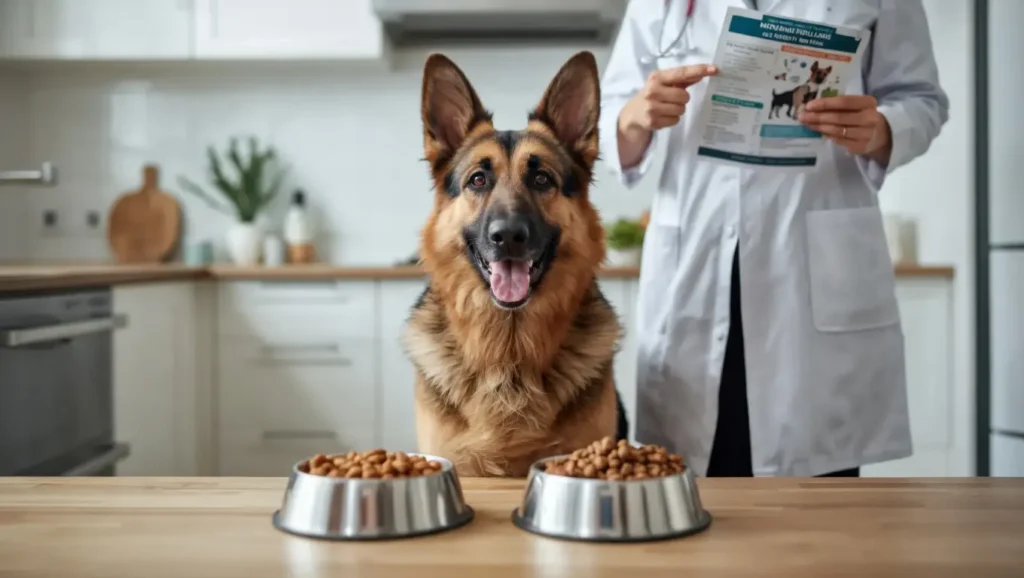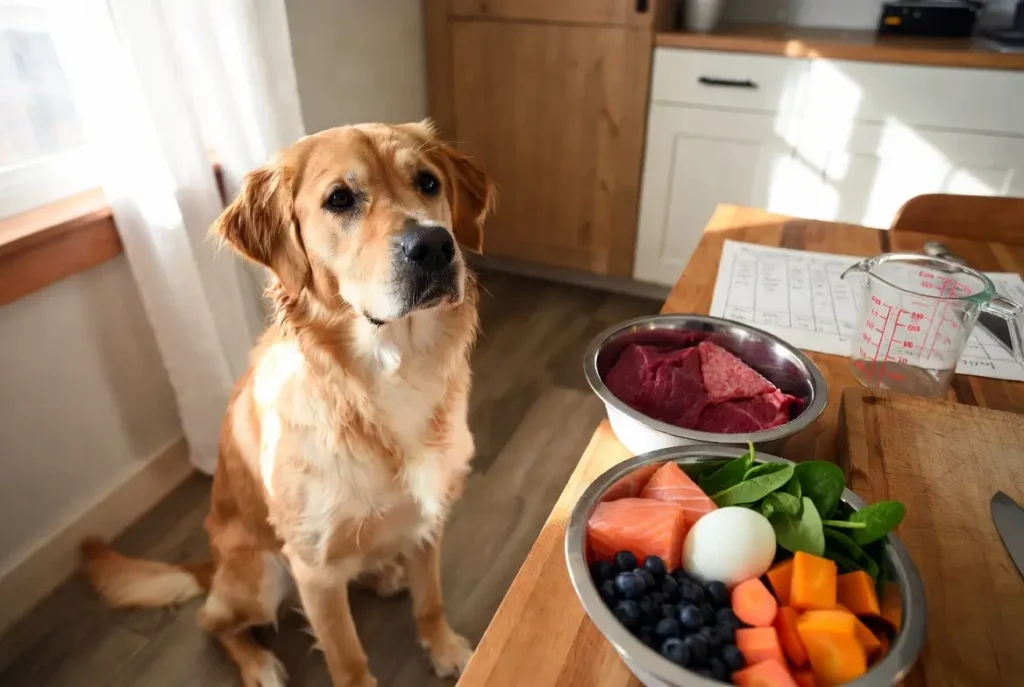


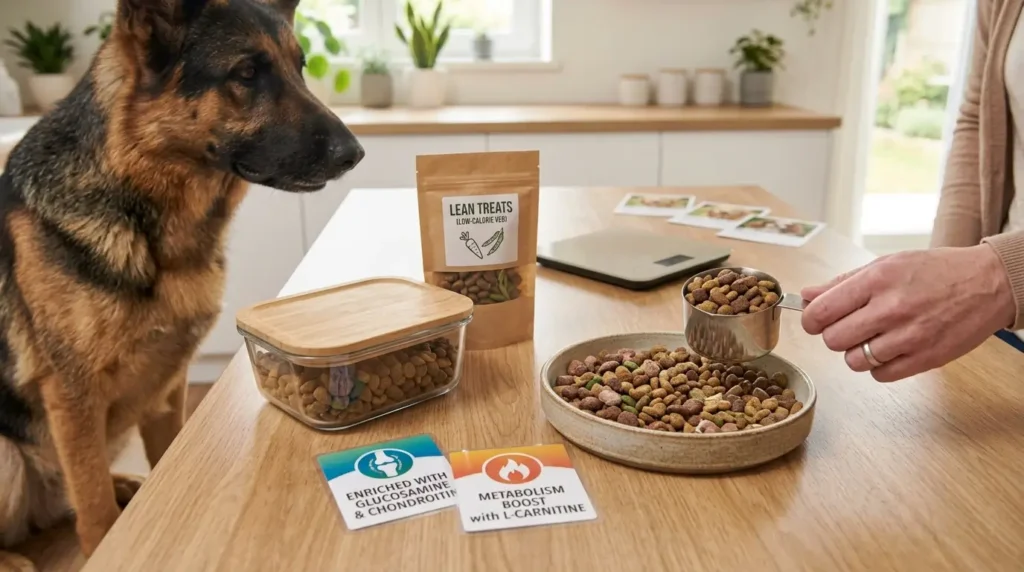
Weight control dog food for large dogs is a calorie-controlled diet designed to reduce or maintain body weight while providing enough protein, vitamins, minerals, and essential fatty acids for a large dog’s nutritional needs. The best options combine lower energy density with adequate protein and carefully measured portions.
Large dogs can gain excess weight when calorie intake consistently exceeds energy expenditure. The problem is particularly important because additional body weight places more mechanical stress on joints and can worsen mobility problems.
AAHA recommends assessing both body condition score (BCS) and muscle condition score (MCS) when making nutritional decisions. An ideal canine body condition is generally around 4–5 on a 9-point scale.
Weight control therefore means reducing excess body fat while preserving lean muscle, not simply feeding the smallest possible amount of food.
What Is Weight Control Dog Food for Large Dogs?
Weight control dog food is formulated to provide fewer calories while maintaining adequate concentrations of essential nutrients during calorie restriction.
A calorie-controlled formula may contain:
- Higher protein
- Moderate or reduced fat
- Increased dietary fiber
- Controlled calorie density
- Essential fatty acids
- Vitamins and minerals
- L-carnitine in some formulations
Merck Veterinary Manual notes that therapeutic weight-loss diets are formulated specifically so calories can be restricted while required nutrients remain available in appropriate amounts. Many also contain increased protein and fiber.
This differs from simply feeding much less of ordinary adult dog food.
Why Does Weight Control Matter for Large Dogs?
Weight control matters because large dogs already carry greater absolute body mass, and excess fat adds additional load to joints and reduces mobility.
Extra weight can affect:
- Walking endurance
- Running
- Stair climbing
- Joint movement
- Exercise tolerance
- Heat tolerance
- Overall quality of life
Obesity also involves more than mechanical weight.
Adipose tissue is metabolically active and contributes to inflammatory processes. Excess weight has been associated with orthopedic, respiratory, metabolic, and other health problems.
These health effects explain why obesity in dogs requires more attention than simply changing a dog’s appearance.
How Do You Know if a Large Dog Is Overweight?
An overweight dog usually has ribs that are difficult to feel, reduced waist definition, and less abdominal tuck when viewed from the side.
Veterinarians commonly use a 9-point body condition score.
A simplified interpretation is:
| Body Condition Score | General Interpretation |
| 1–3/9 | Underweight |
| 4–5/9 | Ideal |
| 6/9 | Above ideal |
| 7/9 | Overweight |
| 8–9/9 | Obese |
Merck notes that an ideal dog has ribs that are easily felt beneath slight fat cover, a visible waist from above, and an abdominal tuck from the side.
Each point above ideal on the 9-point scale corresponds roughly to an additional 5% body fat according to the body-condition framework described by Merck.
Body weight alone cannot determine whether a large dog is overweight because healthy weight differs substantially among breeds and individual dogs.
What Are the Best Low-Calorie Dog Food Options for Large Dogs?
The best low-calorie options are complete weight-management diets with controlled calories, adequate protein, suitable fiber, moderate fat, and appropriate nutrient concentrations.
Several dietary approaches can work.
1. Veterinary Weight-Loss Diets
Veterinary weight-loss diets are among the most nutritionally controlled options for dogs requiring significant calorie restriction.
These foods are designed to provide adequate nutrients even when fewer calories are consumed.
Merck cautions that heavily restricting an ordinary maintenance diet can result in inadequate intake of some nutrients because maintenance foods are designed to be consumed at normal maintenance calorie levels.
Therapeutic weight-loss diets commonly emphasize:
- Controlled calories
- Adequate or increased protein
- Increased fiber
- Controlled fat
- Vitamin and mineral fortification
They can be particularly useful for substantially overweight large dogs.
2. High-Protein Weight Control Food
Higher-protein weight-control diets can help preserve lean body tissue while calories are restricted.
Healthy weight loss should primarily reduce fat rather than muscle.
AAHA notes that higher-protein diets can help spare lean mass during calorie restriction.
Protein also contributes to:
- Muscle maintenance
- Tissue repair
- Enzymes
- Hormones
- Immune proteins
- Skin and coat structure
Protein needs still depend on the dog’s health.
Dogs with certain medical conditions may require individualized nutritional recommendations.
3. Higher-Fiber Weight Control Food
Dietary fiber can lower calorie density and may increase satiety in some dogs.
Fiber adds volume without supplying the same energy density as fat.
Weight-management foods may contain fiber sources such as:
- Beet pulp
- Cellulose
- Pea fiber
- Pumpkin
- Psyllium
- Vegetable fibers
AAHA notes that added fiber can reduce caloric density and contribute to satiety in weight-loss diets.
Higher fiber does not automatically make a food better. Excessive fiber may affect stool quality or acceptance in individual dogs.
4. Reduced-Fat Dog Food
Reducing dietary fat can decrease calorie density because fat provides more than twice as many calories per gram as protein or carbohydrate.
Fat supplies approximately:
- 9 kcal per gram of fat
- 4 kcal per gram of protein
- 4 kcal per gram of carbohydrate
A moderate reduction in dietary fat can therefore lower calories without requiring an extreme reduction in food volume.
Dogs still require essential fatty acids, so weight-control food should not simply eliminate fat.
5. Portion-Controlled Adult Dog Food
A regular complete adult diet can sometimes maintain a healthy weight when calorie density is appropriate and portions are accurately controlled.
Not every large dog requires a therapeutic diet.
A dog slightly above ideal condition may respond to:
- Accurate food measurement
- Reduced treats
- Elimination of table scraps
- Increased activity
- Smaller portions
However, Merck cautions against severe calorie restriction using ordinary maintenance foods because the dog may receive inadequate amounts of other nutrients.
Dogs requiring substantial weight loss may therefore benefit more from a food specifically formulated for weight management.
What Should Large-Dog Weight Control Food Contain?
A suitable weight-control food should provide complete nutrition while reducing calorie density enough to create a controlled energy deficit.
Evaluate these 6 characteristics.
1. Controlled Calories
Calories per cup or can directly affect portion size.
For example:
| Food | kcal per cup | Calories from 3 cups |
| Food A | 280 kcal | 840 kcal |
| Food B | 350 kcal | 1,050 kcal |
| Food C | 420 kcal | 1,260 kcal |
The difference between Food A and Food C is 420 calories from the same three-cup volume.
That illustrates why measuring only “cups of food” without checking calorie density can be misleading.
2. Adequate Protein
Protein supports lean muscle while the dog loses body fat.
AAHA specifically recommends considering diets with sufficient protein during calorie restriction because preservation of lean tissue is an important part of healthy weight management.
3. Appropriate Fiber
Fiber can increase food volume while reducing overall energy density.
It may also improve meal satisfaction in some dogs.
4. Moderate Fat
Weight-control diets commonly contain less fat than energy-dense maintenance foods while still supplying essential fatty acids.
The exact amount varies by formulation.
5. Complete Vitamins and Minerals
A calorie-restricted diet still needs to provide all essential micronutrients.
This is why merely reducing an ordinary food by a very large percentage is not always nutritionally equivalent to feeding a diet formulated for weight loss.
6. Suitable Life-Stage Nutrition
Adult weight-control food is not automatically appropriate for growing large-breed puppies.
Growth and adult maintenance have different nutritional requirements.
How Many Calories Does a Large Dog Need for Weight Loss?
Calorie needs depend on ideal body weight, body condition, age, activity, neuter status, and individual metabolism.
AAHA uses resting energy requirement as a starting point:
RER = 70 × body weight in kilograms^0.75
Maintenance energy requirement is then estimated by applying an appropriate life-stage or activity factor.
AAHA lists general factors such as:
| Dog Category | Approximate RER Multiplier |
| Inactive or obesity-prone adult | 1.0–1.2 |
| Neutered adult | 1.4–1.6 |
| Intact adult | 1.6–1.8 |
| Weight loss starting estimate | About 1.0 |
These values are starting estimates rather than guaranteed calorie prescriptions.
An individual dog’s real requirement can differ.
A dog feeding calculator can make the initial calorie calculation easier, but body weight and BCS still need to be monitored as portions are adjusted.
How Fast Should a Large Dog Lose Weight?
A reasonable weight-loss target for many overweight dogs is approximately 1% of body weight per week.
Merck identifies about 1% weekly body-weight loss as a reasonable goal and recommends adjusting the feeding program according to the dog’s response.
For example:
| Starting Weight | 1% of Body Weight |
| 30 kg | 0.30 kg |
| 40 kg | 0.40 kg |
| 50 kg | 0.50 kg |
| 60 kg | 0.60 kg |
These numbers demonstrate the calculation rather than prescribe an exact target for every dog.
A veterinarian may choose a slower rate depending on:
- Age
- Medical conditions
- Muscle condition
- Mobility
- Starting body condition
- Previous calorie intake
Rapid food restriction without nutritional planning is unnecessary.
Why Is Muscle Preservation Important During Weight Loss?
Weight loss should primarily reduce excess fat while preserving as much lean muscle as possible.
Muscle supports:
- Mobility
- Strength
- Joint stability
- Metabolic function
- Physical activity
Large dogs with mobility limitations can lose muscle when activity falls.
That can create a cycle:
Joint discomfort → reduced activity → muscle loss → lower energy expenditure → further weight gain.
AAHA therefore recommends evaluating muscle condition separately from body condition.
A dog can be overweight and still have muscle loss.
Should Large Dogs Eat Special Large-Breed Weight Control Food?
Large-breed-specific food can be useful, but the calorie and nutrient profile matters more than the words “large breed” on the package.
A suitable adult large-dog weight-management food may consider:
- Lower calorie density
- Appropriate protein
- Controlled fat
- Fiber
- Larger kibble size
- Joint-support nutrients in some formulas
Breed size still affects calorie needs.
AAHA notes that small dogs generally use more calories per pound than larger dogs, while activity and life stage further modify energy requirements.
Therefore, feeding amounts should not be based only on body weight.
Is Weight Control Food Appropriate for Large-Breed Puppies?
Adult weight-control diets generally should not be used as substitutes for properly formulated large-breed puppy food.
Large and giant-breed puppies require controlled growth rather than intentional adult-style weight loss.
AAHA notes that some large and giant breeds may not reach skeletal maturity until approximately 15–16 months. Maintaining a lean body condition and avoiding excessive calcium intake are particularly important during this period.
For a growing dog expected to become large, appropriately formulated large-breed puppy food is designed around growth requirements rather than adult calorie restriction.
A puppy that appears overweight should be assessed before being moved onto an adult weight-loss diet.
Is Weight Control Food Good for Senior Large Dogs?
Weight-control food can be appropriate for overweight senior dogs, but older age does not automatically mean calories should always be reduced.
Energy requirements often decrease as dogs age, but individual variation is substantial.
AAHA also notes that older dogs may experience:
- Muscle loss
- Changes in activity
- Changes in energy requirements
- Chronic disease
Body condition and muscle condition therefore need to be evaluated together.
A senior dog losing muscle but maintaining body fat may require a different nutritional strategy from a younger obese dog.
Should You Feed Less Regular Dog Food or Switch to Weight Control Food?
Small calorie reductions can sometimes be achieved by reducing portions, but substantial restriction is better managed with food formulated specifically for weight loss.
Consider a dog eating 1,200 kcal per day.
Reducing intake by 10% gives:
1,200 × 0.90 = 1,080 kcal/day
Reducing the same diet by 40% gives:
1,200 × 0.60 = 720 kcal/day
At larger reductions, the dog receives substantially less of every nutrient contained in the original food.
Merck notes that heavily restricting ordinary maintenance diets can result in insufficient nutrient intake. Therapeutic weight-loss diets are designed to avoid this problem by supplying appropriate nutrients at lower calorie intakes.
That nutritional distinction is central to weight-management dog food rather than simply feeding increasingly smaller portions of a standard formula.
Is Wet or Dry Food Better for Weight Control?
Neither wet nor dry food is automatically better for weight loss; calorie intake and nutritional adequacy determine the result.
Dry foods generally contain less water and more calories per gram.
Wet foods contain more moisture and may provide greater food volume for a given number of calories in some formulations.
However, individual products vary substantially.
Compare:
- kcal per cup
- kcal per can
- kcal per kilogram
- feeding amount
- protein
- fat
- fiber
The feeding format matters less than the total daily calories consumed.
Are Grain-Free Foods Better for Weight Loss?
Grain-free dog food is not inherently lower in calories or more effective for weight loss.
Removing grains does not automatically reduce energy density.
Grain-free foods may use alternative carbohydrate sources such as:
- Potatoes
- Peas
- Lentils
- Chickpeas
- Sweet potatoes
The relevant weight-control variables are calorie density, nutrient balance, portion size, and the dog’s total daily intake.
Weight management and grain inclusion are separate nutritional questions.
Can Carrots Help a Large Dog Lose Weight?
Small pieces of carrot can replace more calorie-dense treats, but carrots do not cause weight loss by themselves.
AAHA specifically reminds owners that even vegetables such as carrots and green beans contain calories.
Plain carrots can still be useful because they generally contain fewer calories than many biscuits or fatty treats.
The nutritional role of dog food with carrots is therefore different from using vegetables as unlimited “free” snacks.
All calories still count toward the daily target.
How Many Treats Can a Large Dog Have During Weight Loss?
Treats should generally provide less than 10% of total daily calories, with most calories coming from complete and balanced food.
Merck recommends restricting treats to less than 10% of total calorie intake because most treats are not complete and balanced.
For example:
A dog receiving 900 kcal per day would receive no more than approximately:
900 × 0.10 = 90 kcal from treats
That leaves at least approximately:
810 kcal from complete nutrition
Treat calories can come from:
- Training treats
- Biscuits
- Dental chews
- Table food
- Peanut butter
- Meat pieces
- Vegetables
All need to be counted.
Should You Use a Measuring Cup for Weight-Control Dog Food?
Accurate portion measurement is important because small daily overfeeding errors accumulate over weeks and months.
For example, suppose a food contains 360 kcal per cup.
An extra ¼ cup provides:
360 × 0.25 = 90 extra calories
If that amount is unintentionally added every day, calorie intake can substantially exceed the intended weight-loss target.
Kitchen gram scales provide greater precision than loosely filled cups, particularly when portions are being carefully controlled.
How Often Should an Overweight Large Dog Be Fed?
Dividing the daily calorie allowance into two or more measured meals can make intake easier to control than free-choice feeding.
Merck recommends dividing the daily calorie allowance into multiple meals rather than one large meal during weight management.
Structured meals also make it easier to track:
- Appetite
- Actual intake
- Treat consumption
- Missed meals
- Portion accuracy
Leaving a bowl permanently full makes calorie intake much harder to measure.
Does Exercise Matter if the Dog Eats Low-Calorie Food?
Yes. Weight-loss programs are most effective when calorie control is combined with appropriate physical activity.
Merck identifies both caloric restriction and exercise as important components of successful canine weight-loss programs.
Activities can include:
- Controlled walks
- Gradually longer walks
- Swimming where appropriate
- Low-impact play
- Food-puzzle activities
- Veterinary rehabilitation exercises
Exercise plans need modification for large dogs with arthritis, orthopedic disease, heart disease, or severe obesity.
Food restriction cannot compensate for every mobility problem, and excessive exercise can be unsafe in poorly conditioned dogs.
How Do You Choose Weight Control Dog Food for a Large Dog?
Choose weight-control food by comparing calories, protein, fat, fiber, nutritional adequacy, life stage, and the dog’s individual medical needs.
Use this 6-point check.
1. Compare Calories
Check kcal per cup, can, tray, or gram.
Do not rely only on marketing terms such as:
- Light
- Lean
- Healthy weight
- Fit
- Weight control
Actual calorie density matters.
2. Check Protein
Adequate protein helps maintain lean tissue during calorie restriction.
3. Review Fat
Lower or moderate fat can reduce calorie density, but the diet still needs essential fatty acids.
4. Review Fiber
Additional fiber can reduce energy density and increase food volume.
5. Check Nutritional Adequacy
The diet should provide complete nutrition for its intended life stage.
6. Consider Medical Conditions
Joint disease, endocrine disorders, gastrointestinal disease, and other conditions can change the optimal dietary approach.
These factors are more useful than evaluating a food from one front-label claim when choosing the best dog food for an individual large dog.
What Mistakes Prevent Large Dogs From Losing Weight?
The most common weight-control mistakes involve inaccurate portions, uncounted treats, inconsistent feeding, and unrealistic calorie targets.
Avoid these 8 mistakes:
- Free-feeding: Food left available throughout the day prevents accurate intake measurement.
- Estimating portions by eye: Small measuring errors can add substantial calories.
- Ignoring treats: Treat calories count toward daily intake.
- Sharing table food: Human food can contain substantial calories in small portions.
- Using an ordinary diet for severe restriction: Nutrient intake may become inadequate.
- Reducing food without monitoring weight: The correct calorie target is individual.
- Changing food without considering calorie density: Equal cup volumes can contain very different calories.
- Stopping the plan at the first plateau: Calorie requirements may need adjustment as body weight changes.
How Often Should a Large Dog Be Weighed During Weight Loss?
Regular weight checks are necessary because calculated calorie requirements are only starting estimates.
Merck recommends monitoring dogs approximately every 2 weeks during active weight-loss programs and adjusting the plan according to results.
At each assessment, consider:
- Body weight
- Body condition score
- Muscle condition
- Appetite
- Stool quality
- Activity
- Treat intake
A dog losing too quickly may require more calories.
A dog not losing despite good adherence may require further calorie adjustment or veterinary evaluation.
What Happens After a Large Dog Reaches Its Target Weight?
Calories need to be increased from active weight-loss levels to a maintenance amount that prevents weight regain.
Weight management has two phases:
- Weight reduction
- Weight maintenance
Merck identifies achieving ideal body condition as the short-term goal and maintaining that condition as the long-term goal.
Returning immediately to the previous feeding pattern can recreate the calorie surplus that caused weight gain.
Continue:
- Measured meals
- Controlled treats
- Regular weighing
- Body-condition checks
- Appropriate activity
The maintenance amount may require several adjustments before the dog’s weight stabilizes.
Frequently Asked Questions
What is the best weight control dog food for large dogs?
A complete calorie-controlled diet with adequate protein, appropriate fiber, moderate fat, and suitable micronutrient levels is the best general option.
Is low-fat dog food good for weight loss?
Lower-fat food can reduce calorie density because fat supplies about 9 kcal per gram, but total calories and complete nutritional balance still determine weight loss.
Is high-protein food good for overweight dogs?
Adequate or increased dietary protein can help preserve lean body mass during calorie restriction.
How much should a large dog eat to lose weight?
The amount depends on ideal body weight, current calorie intake, activity, body condition, and the food’s calorie density. Calculated calorie requirements should be adjusted according to actual weight-loss response.
Can I simply feed my large dog less food?
Modest portion reduction may work for mild weight control, but severe restriction of ordinary maintenance food can reduce essential nutrient intake.A formulated weight-loss diet may be more appropriate when substantial calorie restriction is necessary.
Should large dogs eat grain-free food to lose weight?
No. Grain-free food is not inherently lower in calories or better for weight loss. Calorie density and portion size matter more.
How fast should a large dog lose weight?
Approximately 1% of body weight per week is a reasonable general target for many overweight dogs, although individual plans vary.
Final Takeaway
Weight control dog food for large dogs works best when it reduces calorie intake while maintaining adequate protein and complete nutrition.
Large dogs do not lose weight safely by simply eating the smallest possible quantity of food. Significant calorie restriction using ordinary maintenance food can also reduce intake of essential nutrients. Diets formulated specifically for weight loss solve this problem by providing controlled calories with nutrient concentrations appropriate for smaller feeding amounts.
For most overweight large dogs, the core strategy includes measured meals, controlled calorie intake, adequate protein, limited treats, appropriate activity, and regular body-condition monitoring.
Body condition matters more than an arbitrary number on the scale. An ideal dog has palpable ribs with slight fat cover, a visible waist, and an abdominal tuck. Once that condition is reached, calorie intake needs to shift from active weight reduction to long-term maintenance.
The most effective low-calorie food is therefore not necessarily the product with the fewest calories per cup. It is the complete diet that creates a manageable calorie deficit while preserving muscle, meeting nutrient requirements, and allowing the dog to reach and maintain an ideal body condition.