
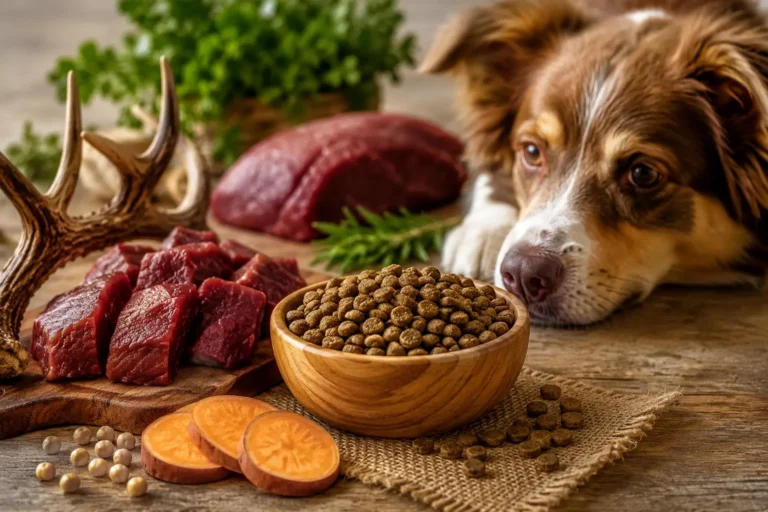
Limited ingredient venison dog food can help selected dogs with suspected food allergies when venison is genuinely new to that dog’s diet. The benefit comes from excluding suspected dietary allergens, usually proteins, rather than from venison being inherently hypoallergenic.
A dog that has already eaten venison in kibble, treats, canned food, chews, or mixed-protein diets has already been exposed to it. Previous exposure matters because a novel protein must be selected according to the individual dog’s complete dietary history.
The UC Davis School of Veterinary Medicine states that no diet is inherently hypoallergenic; suitability depends on which ingredients an individual animal has previously consumed.
Limited ingredient food also has a different role from a veterinary elimination diet. A commercial venison recipe may be useful for everyday feeding, while diagnosis of a true food allergy requires a controlled elimination trial followed by dietary challenge. The Merck Veterinary Manual identifies this elimination-and-rechallenge approach as the only reliable method for confirming food allergy.
What Is Limited Ingredient Venison Dog Food?
Limited ingredient venison dog food generally contains a restricted range of ingredients and uses venison as a principal animal protein. However, a limited ingredient label alone does not make the food appropriate for a diagnostic allergy trial.
The purpose of a limited ingredient diet is to reduce dietary variables. Formulas may combine venison with ingredients such as potatoes, sweet potatoes, peas, rice, oils, vitamins, and minerals.
Three related terms have different meanings:
| Diet type | Protein approach | Primary purpose |
| Limited ingredient diet | Restricts the number or variety of ingredients | Simplifies the diet |
| Novel protein diet | Uses a protein the individual dog has not previously eaten | Limits exposure to previously encountered proteins |
| Hydrolyzed protein diet | Contains proteins broken into smaller peptides | Reduces the likelihood of immune recognition |
A limited ingredient diet can therefore contain venison without being a true novel-protein diet for that particular dog.
For example, venison is no longer novel for a dog that previously ate venison treats, even when its main kibble contained chicken.
Is Venison Good for Dogs With Food Allergies?
Venison can be useful when the dog has not previously consumed it and the complete food excludes other suspected allergens. Previous non-exposure makes venison potentially useful, but it does not guarantee tolerance.
Food allergy is an adverse immune response to components of the diet. Proteins are particularly important food allergens in dogs. The Merck Veterinary Manual lists beef, dairy products, chicken, wheat, and lamb among the most frequently recognized canine food allergens.
A peer-reviewed review examined 297 dogs with documented cutaneous adverse food reactions. The reported allergen sources included:
- Beef — 34%
- Dairy products — 17%
- Chicken — 15%
- Wheat — 13%
- Soy — 6%
- Lamb — 5%
- Corn — 4%
- Egg — 4%
The original research is available through BMC Veterinary Research / PubMed Central.
These percentages describe allergen sources reported among the 297 affected dogs in the reviewed studies. They do not mean that 34% of all dogs are allergic to beef or that venison is incapable of causing an allergic reaction.
Is Venison a Novel Protein for Every Dog?
No. Venison is a novel protein only for a dog that has not previously consumed it and for which venison is appropriate after reviewing the complete dietary history.
“Novel” means new to the individual dog. It does not mean non-allergenic.
A dog’s previous exposure can come from:
- dry or canned dog food;
- training treats;
- jerky;
- table scraps;
- chews;
- supplements;
- previous therapeutic diets;
- foods containing multiple animal proteins.
UC Davis emphasizes that veterinarians need a thorough diet history before selecting a novel-antigen diet because the chosen protein and carbohydrate sources need to be unfamiliar to the individual animal.
Can Beef-Allergic Dogs Eat Venison?
Venison requires additional consideration in dogs that react to beef because immunologic cross-reactivity among ruminant proteins is possible.
The University of Illinois College of Veterinary Medicine reported in its 2026 diagnostic food-trial guidance that dogs allergic to beef may have a higher likelihood of cross-reacting with other ruminant proteins, including lamb, venison, and bison.
Merck similarly advises caution when choosing novel proteins from animal species closely related to previously fed species. However, Merck also notes that the clinical importance of some laboratory-observed protein cross-reactivity remains uncertain.
This does not mean every beef-allergic dog is allergic to venison. It means protein selection needs to consider more than whether the ingredient looks unusual on a food label.
What Are the Signs of Food Allergy in Dogs?
Food allergy can cause persistent itching, recurrent skin or ear disease, and gastrointestinal signs in some dogs.
The Merck Veterinary Manual lists pruritus, hair loss, recurrent bacterial or yeast dermatitis, and recurrent otitis externa among recognized manifestations.
UC Davis also describes signs such as:
- non-seasonal itching;
- recurrent ear infections;
- recurrent skin infections;
- hair loss;
- vomiting;
- diarrhea;
- belching;
- excess intestinal gas;
- stomach rumbling;
- scooting;
- recurrent anal-gland problems.
Food allergy is not the only explanation for these signs. Flea allergy, environmental allergy, infections, parasites, and gastrointestinal disorders can produce similar symptoms.
Persistent vomiting and dog diarrhea therefore need to be considered within the dog’s complete clinical picture rather than automatically attributed to venison, chicken, grain, or another ingredient.
Diet, medications, intestinal microorganisms, disease, and feeding patterns can also affect dog gut health.
How Is a Dog Food Allergy Diagnosed?
A strict elimination diet followed by controlled dietary challenge is the reference method for diagnosing canine food allergy.
Changing from chicken kibble to venison kibble and observing improvement is not enough to establish a diagnosis.
The Merck Veterinary Manual states that serology, saliva testing, hair analysis, intradermal testing, and several other commercial approaches do not consistently correlate with clinical food reactions.
University of Illinois guidance likewise states that serum, intradermal, saliva, and hair testing are not dependable substitutes for a controlled food trial.
A diagnostic trial involves three main stages.
1. Remove Previous Dietary Exposures
The dog receives one carefully selected diet. Depending on the case, that diet may use:
- a genuinely novel protein;
- hydrolyzed protein;
- both novel and hydrolyzed ingredients;
- an elemental amino-acid formulation.
The selected diet depends on the dog’s feeding history and clinical circumstances.
2. Feed the Trial Diet Exclusively
The prescribed food has to be the dog’s only relevant dietary exposure throughout the trial.
The Merck Veterinary Manual specifically identifies hidden food sources that can interfere with testing, including rawhide chews, pill pockets, table food, flavored vitamin or mineral supplements, certain oral supplements, and flavored toys.
Other potential exposures include training treats, food used for giving tablets, flavored toothpaste, and chewable medications or parasite preventatives.
3. Reintroduce the Previous Diet
Improvement during elimination is followed by dietary challenge to determine whether the original signs return.
Merck explains that some dogs improve during an elimination trial but fail to relapse when challenged. Such improvement cannot confirm food allergy by itself.
After rechallenge, clinical signs can return within hours or days, although some positive responses take approximately 10–14 days to become apparent.
How Long Does a Food Elimination Trial Take?
A diagnostic food trial for skin-related food allergy generally lasts at least 8 weeks, although some veterinary protocols continue for 10–12 weeks when necessary.
The University of Illinois states that approximately 95% of affected dogs respond by 8 weeks during a properly conducted restrictive food trial.
UC Davis describes 8–12 weeks as an average diet-trial period and emphasizes that the prescribed diet must be fed exclusively.
Merck cites a literature review indicating that a minimum of around 10 weeks may identify 95% of food-allergic patients. Merck also distinguishes gastrointestinal food trials, which may be shorter, from dermatologic trials, which commonly require 8–12 weeks.
The different figures are not necessarily contradictory. Trial length depends on the clinical signs, the protocol used, concurrent treatment, secondary infections, and the individual patient’s response.
Can Treats Ruin a Venison Elimination Diet?
Yes. A treat can introduce an excluded protein and reduce the diagnostic value of a venison food trial.
A food trial covers everything the dog eats, not only the main meal.
Products that can interfere include:
- meat-based treats;
- Dental chews;
- Rawhide;
- Table scraps;
- pill pockets;
- food-flavored supplements;
- chewable medications;
- flavored parasite preventatives.
Strict dietary consistency matters because a trial cannot separate the effects of venison from other dietary proteins when several uncontrolled exposures occur at the same time.
Is Limited Ingredient the Same as Hypoallergenic?
No. A limited-ingredient label does not mean a diet is hypoallergenic for a particular dog.
The number of ingredients is only one characteristic of a food.
A six-ingredient diet can still cause a reaction when one of those six ingredients is an allergen for that dog. Conversely, a diet with more ingredients can be tolerated when none triggers the individual’s adverse reaction.
UC Davis explicitly states that no diet is inherently hypoallergenic because the suitability of antigen sources depends on the animal’s dietary history.
The better questions are:
- Which proteins does the diet contain?
- Has the dog consumed those proteins before?
- Does the food contain additional suspected allergens?
- Is cross-contamination sufficiently controlled for the intended purpose?
- Does the food provide appropriate nutrition?
Is Venison Better Than Hydrolyzed Protein?
Venison can be useful when it is genuinely novel, while hydrolyzed protein can be more practical when previous dietary exposure is extensive or uncertain.
Hydrolysis breaks dietary proteins into smaller peptides. Merck explains that these fragments are more difficult for the immune system to detect and react to. However, hydrolysis does not reduce the risk to zero. Some sensitized animals can still respond, especially to partially hydrolyzed diets.
Merck distinguishes:
- Partially hydrolyzed proteins, generally under 5 kilodaltons;
- Extensively hydrolyzed proteins, generally under 3 kilodaltons and sometimes ≤1 kilodalton;
- Elemental diets, which use synthetic amino acids.
Extensively hydrolyzed diets are less likely than partially hydrolyzed diets to cause clinically significant reactions in animals sensitized to the original protein.
The practical difference is clearer in this comparison:
| Situation | Novel venison diet | Hydrolyzed diet |
| Dog has never eaten venison | Potential option | Potential option |
| Complete diet history is known | Novelty easier to assess | Still appropriate |
| Many proteins have already been fed | More difficult to find a truly novel protein | Often more practical |
| Previous diet is unknown | Novelty difficult to establish | Often easier to control |
| Formal diagnostic trial | Requires careful product selection | Common veterinary approach |
| Long-term feeding | Possible if complete, balanced and tolerated | Possible when nutritionally appropriate |
Neither approach is universally superior.
Can Over-the-Counter Venison Dog Food Diagnose an Allergy?
Over-the-counter venison dog food can simplify a dog’s diet, but it is less dependable than a carefully controlled veterinary diet when the goal is a diagnostic elimination trial.
One major concern is undeclared or unintended proteins.
A 2018 systematic review examined studies comparing commercial pet-food labels with laboratory testing. Unexpected ingredients were detected in 0–83% of tested diets, with a median of 45%. Among foods marketed with novel or limited ingredients for restrictive diets, reported discrepancies ranged from 33% to 83%.
Importantly, the researchers did not conclude that every trace contaminant causes an allergic reaction. The clinical effect depends on the contaminating allergen, amount present, and sensitivity of the individual animal.
An earlier laboratory study provides particularly relevant evidence for venison diets. Researchers tested four over-the-counter dry venison dog foods for soy, poultry, and beef proteins.
Three of the four foods tested positive for soy protein that was not declared as a soy ingredient, and one also tested positive for undeclared beef protein. None of the four diets met the researchers’ criteria for a diagnostic elimination diet because each contained common pet-food proteins either listed or detected during testing.
This evidence supports an important distinction:
An everyday limited-ingredient venison food and a diet selected for a controlled diagnostic food trial are not necessarily interchangeable.
What Should You Check on a Venison Dog Food Label?
Check the nutritional adequacy statement, intended life stage, complete ingredient list, feeding directions, and manufacturer information before selecting a venison dog food.
The front-of-package phrase “venison recipe” does not provide enough information by itself.
Check the Nutritional Adequacy Statement
The Association of American Feed Control Officials pet-food labeling guidance describes the nutritional adequacy statement as one of the most important parts of a pet-food label.
AAFCO defines:
- Complete — the product contains all required nutrients.
- Balanced — those nutrients are present in appropriate proportions.
The statement also identifies the intended life stage, such as:
- growth;
- adult maintenance;
- gestation/lactation;
- all life stages.
Understanding what AAFCO does makes terms such as nutritional adequacy, nutrient profiles, life stages, and feeding tests easier to interpret.
Check Every Animal-Protein Source
Look beyond venison.
Depending on the formulation, the ingredient list may contain:
- other meat proteins;
- egg;
- fish;
- poultry ingredients;
- liver;
- meat meals;
- broths;
- animal-derived flavoring ingredients.
For a restrictive diet, every relevant protein source needs to be compared with the dog’s previous food history.
Check the Intended Life Stage
A food formulated for adult maintenance is not automatically suitable for puppy growth.
AAFCO notes that nutrient amounts and ratios differ across recognized life stages.
Check More Than the Ingredient List
The World Small Animal Veterinary Association cautions that the ingredient list by itself provides little information about ingredient quality or the overall nutritional quality of a food.
Manufacturer expertise, nutritional formulation, quality control, and the suitability of the food for the individual dog also matter when owners choose the best dog food.
Does Venison Dog Food Need to Be Grain-Free?
No. A venison dog food does not need to be grain-free simply because a dog has suspected food allergies.
Food allergy concerns individual dietary allergens rather than the entire category of “grains.”
In the review of 297 food-reactive dogs, wheat was reported in 13% of affected dogs, but beef, dairy products, and chicken were reported more frequently. Rice accounted for only five dogs in that dataset.
This does not mean wheat or another grain cannot cause a reaction. It means removing every grain without identifying the dog’s trigger does not automatically make a diet more appropriate.
The broader nutritional differences between grain-free vs grain dog food are separate from the question of whether venison functions as an appropriate novel protein.
Can Dogs Become Allergic to Venison?
Yes. Dogs can develop an adverse immune response to venison just as they can to other dietary proteins.
Novel protein describes previous exposure. It does not describe a permanent biological property of the meat.
UC Davis notes that allergies can change and develop throughout an animal’s life, meaning foods tolerated previously can later be associated with allergic signs.
A dog that initially tolerates venison but later develops persistent itching, recurrent ear disease, or gastrointestinal signs therefore requires reassessment rather than an assumption that venison must remain safe indefinitely.
Can Dogs Eat Venison Dog Food Every Day?
Dogs can eat a venison-based food every day when the complete diet is nutritionally adequate for the dog’s life stage, meets the dog’s nutritional requirements, and is well tolerated.
Venison meat by itself is not equivalent to a complete commercial diet.
For long-term feeding, the total formulation matters. Proteins, fats, essential fatty acids, minerals, vitamins, calories, and other required nutrients have to be supplied in appropriate amounts and proportions.
AAFCO’s nutritional adequacy statement helps distinguish complete-and-balanced foods from products intended only for intermittent or supplemental feeding.
Who May Benefit From Limited Ingredient Venison Dog Food?
The strongest candidate is a dog with a clearly documented dietary history, little or no previous venison exposure, and a reason to restrict previously consumed proteins.
Venison may make sense when:
- previous food exposure is known;
- venison has not previously been eaten;
- the formula excludes suspected triggers;
- the food is complete and balanced for the intended life stage;
- the dog tolerates venison;
- the diet’s manufacturing controls match its purpose.
Venison becomes less useful as a diagnostic novel protein when previous venison exposure has occurred, many different proteins have already been fed, dietary history is unknown, or related ruminant proteins present a cross-reactivity concern.
In those situations, a veterinarian may select a more extensively hydrolyzed or elemental therapeutic diet instead.
Is Limited Ingredient Venison Dog Food Best for Allergies?
Limited ingredient venison dog food can be a useful option for selected dogs, but it is not automatically the best diet for every dog with allergies.
The most important questions are individual:
- Has the dog eaten venison before?
- Which other proteins has the dog consumed?
- Are additional animal proteins present?
- Is the food being used for everyday feeding or diagnosis?
- Is the recipe nutritionally complete for that dog?
- Could another allergy or disease explain the symptoms?
A “limited ingredient” label does not confirm diagnostic purity. A “grain-free” label does not make venison more hypoallergenic. A “novel protein” is only novel in relation to an individual dog’s history.
For suspected food allergy, a carefully controlled elimination trial followed by dietary rechallenge provides stronger evidence than repeatedly switching between commercial foods.
Frequently Asked Questions
Is venison less allergenic than chicken for dogs?
Venison may be less likely to trigger an existing reaction when a dog has never eaten venison, but venison is not inherently less allergenic than chicken. Previous exposure and individual sensitivity determine suitability.
How quickly can venison dog food reduce allergy symptoms?
Some dogs improve within several weeks, but dermatologic food trials generally continue for at least 8 weeks and sometimes 10–12 weeks.
Can a dog develop an allergy to venison later?
Yes. Dogs can develop new dietary allergies after previously tolerating an ingredient.
Does limited ingredient mean single protein?
No. A limited ingredient food can contain several animal-derived ingredients, so the complete ingredient list and previous dietary exposure need to be evaluated.
Can treats interfere with a venison food trial?
Yes. Treats, table foods, chews, supplements, and flavored medications can introduce excluded proteins and compromise a diagnostic elimination trial.
Can a blood test diagnose food allergy in dogs?
No currently available blood test reliably replaces a controlled elimination diet and dietary challenge for confirming canine food allergy.
The Bottom Line on Venison for Dogs With Allergies
Limited ingredient venison dog food works best when venison is genuinely new to the individual dog’s diet, the complete formulation avoids known triggers, and the food provides appropriate nutrition.
Venison is not automatically hypoallergenic. It may also require additional consideration in dogs with beef allergy because cross-reactivity among ruminant proteins is possible. Over-the-counter limited ingredient foods can be appropriate for ordinary feeding, but they do not provide the same degree of ingredient control expected from a diet selected specifically for a diagnostic elimination trial.
For suspected food allergy, the clearest path is to document previous food exposure, select an appropriate novel or hydrolyzed diet, eliminate outside food sources, maintain the trial for an adequate period, and confirm improvement through controlled dietary rechallenge.