

You take your dog outside and she squats. Nothing. Maybe a couple drops. She tries again five minutes later. Same thing. If your dog not urinating keeps happening, this isn’t something you ignore and see how it goes. A complete blockage can go bad really fast.
Let’s talk about what actually happens, why it matters, and what your vet’s going to do about it.
Is Your Dog Actually Not Urinating or Just Peeing Less Often?
The first thing to figure out is what’s actually coming out when she squats.
A dog who pees less frequently but gets a normal stream out is completely different from a dog trying constantly and producing almost nothing. Huge difference.
What to watch for:
- Normal stream coming out regularly (normal)
- Constant squatting with barely any drops (problem)
- Straining hard and getting nothing (emergency)
- Dribbling instead of stream (concern)
- Whining or crying while trying to pee (pain signal)
If you can safely watch one bathroom trip without delaying getting her to the vet, do it. Normal stream means one thing. Constant squatting with dribbles or nothing means something’s blocking the flow.
According to the MSD Veterinary Manual, when a dog keeps trying to pee with almost nothing coming out, that’s a classic sign of a urine blockage. Some blocked dogs also get a hard, painful, swollen bladder that you can feel.
If she’s trying over and over and barely anything’s coming out, treat this as urgent.
What Signs Mean You Go to the Vet Right Now?
No urine plus repeated straining is the biggest red flag. But if she’s also in pain, throwing up, weak, or has a swollen belly, that makes it even more serious.
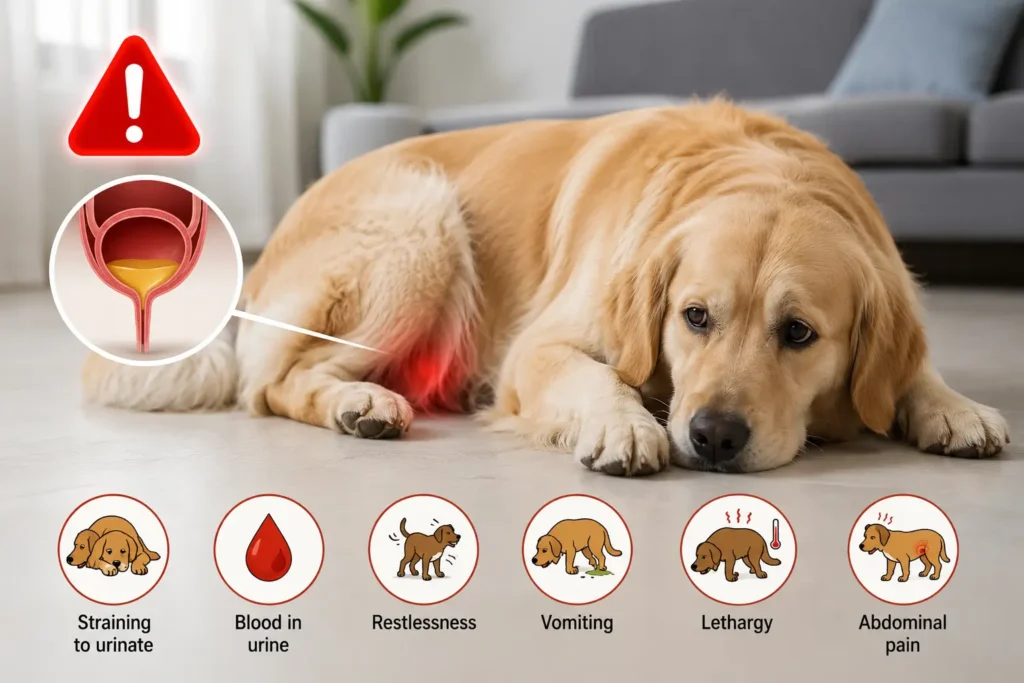
Emergency signs that need immediate vet care:
- Repeated squatting with nothing coming out
- Only drops if anything at all
- Crying or whining when she tries
- Blood in the urine
- Belly feels hard and painful to touch
- Restless behavior that turns into lethargy
- Vomiting
Cornell reports that inability to urinate, a hard firm bladder, belly pain, vomiting, and lethargy are all signs of urinary stone obstruction. It also says inability to urinate is a medical emergency.
A dog not urinating with several of these signs doesn’t stay home trying remedies. She is going to the vet clinic right now.
What Exactly Is a Urinary Obstruction or Blocked Dog Urine?
A urine blockage means urine can’t flow normally through the urinary tract. It can be partial where a little bit still gets through—or complete—where nothing comes out.
How blocked urine happens:
The urethra is the tube that carries pee from the bladder out of the body. Something narrows or blocks this tube.
| What Causes Blocked Urine What Happens | |
| Stones stuck in urethra | Complete or partial blockage |
| Scar tissue in urethra | Narrowing of the passage |
| Tumors in bladder/urethra | Obstruction and swelling |
| Prostate disease | Urine backed up in bladder |
| Trauma to urinary tract | Internal damage blocking flow |
| External pressure | Compression of urethra |
The real question is: is urine actually leaving the bladder or is it trapped?
Why Does a Urine Blockage Become Dangerous So Fast?
Urine carries waste and electrolytes out of your dog’s body. When it can’t go anywhere, that waste builds up inside. Potassium levels spike dangerously.
What happens when a dog can’t urinate:
- Waste products build up in the bloodstream
- Potassium levels rise to dangerous levels
- Electrolyte imbalance affects the whole body
- Heart rhythm problems can develop
- Organs begin to fail without treatment
According to the MSD Veterinary Manual, a complete blockage can cause uremia in 36 to 48 hours. If nothing’s done, depression and vomiting show up first. Then diarrhea and dehydration. She can go into a coma. Dangerously high potassium also causes heart rhythm problems.
Don’t use those 36 to 48 hours as a waiting period. A complete blockage is already an emergency the moment you realize it’s happening.
What Causes a Dog Not Urinating?
A bunch of different problems can cause the same scary situation at home. Stones get attention, but they’re not the only possibility. When people search for “dog not urinating,” they’re usually dealing with one of several causes.
Common causes of urine blockage:
- Stones lodged in the urethra
- Scar tissue narrowing the urethra
- Prostate enlargement or disease
- Tumors in bladder, urethra, or prostate
- Trauma to the urinary tract
- Nerve problems affecting bladder emptying
- Severe kidney damage barely producing urine
A completely full bladder that won’t empty is different from kidneys barely making urine. That’s another reason a dog that can’t urinate can’t be figured out just by looking at symptoms. You need actual vet testing.
Our dog food and urinary health guide covers how diet matters for some urinary diseases. But food can’t force open a complete blockage.
That’s not a food problem that’s a mechanical problem.
Is Straining Always From Urinary Obstruction?
Nope. Straining comes from several different issues, not just obstruction.
What causes straining in dogs:
- Bladder inflammation
- Bladder stones
- Urinary tract infection
- Prostate problems
- Actual urine blockage
- Sometimes constipation (owners mistake it for urinary straining)
Watch the posture and what actually comes out. A dog trying to pee squats or lifts a leg repeatedly and produces drops. A dog trying to poop holds a different stance and might pass stool or mucus or nothing.
Don’t waste hours trying to figure out which one if your dog looks painful or sick. Your vet can feel the bladder and know immediately what’s happening.
If your dog’s peeing fine but suddenly having accidents inside, that’s a different problem. Check out our article on adult dog house training for when accidents need a vet visit.
Do Male Dogs Get Urinary Obstruction More Often Than Females?
Male dogs can be harder to unblock when stones get stuck in the narrower parts of the urethra. The actual risk depends on what’s causing the problem.
Why male dogs block more:
- Male urethra is narrower and longer
- Stones more likely to get stuck
- Female anatomy allows easier passage
- Gender difference affects stone type risk
Cornell mentions that with cystinuria (a genetic condition), blockage from stones is more common in males because of how male anatomy is shaped. Both males and females can form cystine stones, but the male urethra makes it more likely a stone gets stuck.
If your male dog keeps straining and dribbling, don’t just assume he’s got a urinary tract infection. Could be, but could also be a urine blockage.
What Does Your Vet Actually Check First?
The vet’s first job is figuring out if the bladder is full, painful, and can’t empty.
Vet diagnostic steps:
- Physical examination and bladder palpation
- Bloodwork and electrolyte testing
- Urinalysis to check for blood/protein
- X-rays to look for stones
- Ultrasound for better imaging
- EKG if potassium is high or heart rhythm is a concern
The MSD Veterinary Manual recommends X-rays, urinalysis, kidney values, and electrolyte checks. Advanced imaging helps in certain cases.
For a dog not urinating, the vet might change the order of tests if your dog’s really sick. Stabilizing her comes first, then diagnostics.
Typical timeline for testing:
| Order Test Why | ||
| 1 | Physical exam | Find the problem |
| 2 | Bloodwork | Check electrolytes |
| 3 | Urinalysis | Look for blood/crystals |
| 4 | X-rays | Find stones |
| 5 | Ultrasound | See details if needed |
How Does the Vet Actually Fix Blocked Urine?
The blockage has to come out. Usually that starts with a urinary catheter.
Treatment steps for a urine blockage:
- Catheterization to restore urine flow
- Pushing stones back into bladder if needed
- Surgery if catheter doesn’t work
- Stent placement in severe cases
- Urinary bypass surgery if absolutely necessary
The MSD Veterinary Manual says the main priorities are stabilization, releasing pressure from the bladder, and fixing the obstruction. This is why emergency vet care is critical here. A complete blockage isn’t something that gets fixed with extra water, supplements, or different food at home.
What Should You Never Try at Home?
Don’t do these things when your dog can’t urinate:
What NOT to do:
- Don’t squeeze or press on the bladder
- Don’t push hard on the abdomen
- Don’t give leftover antibiotics
- Don’t force large amounts of water into a vomiting dog
- Don’t wait for supplements to “flush” a stone out
- Don’t delay getting to the vet
Pushing on a swollen, painful bladder hurts your dog. Meds without a diagnosis mess things up. Supplements won’t clear a mechanical blockage.
For people dealing with emergency vet dogs situations, here’s what helps: call the vet clinic or emergency hospital. Tell them clearly: “My dog keeps trying to pee and barely anything or nothing is coming out.”
That gets the important info across fast.
What Happens After the Vet Removes the Blockage?
Some dogs pee a ton after an obstruction’s relieved. The MSD Veterinary Manual notes that increased urine production can last 1 to 5 days after treatment. During that time, the vet’s watching hydration and electrolytes closely.
Post-treatment care:
- Monitor urine output for 1-5 days
- Check electrolytes regularly
- Ensure adequate hydration
- Watch for complications
- Prevent recurrence
But the vet still has to figure out why it happened in the first place. A stone needs to be analyzed. A urinary tract infection needs culture testing. Prostate disease needs treatment. A stricture or tumor changes everything.
The next steps depend on that cause, not just that pee’s flowing again.
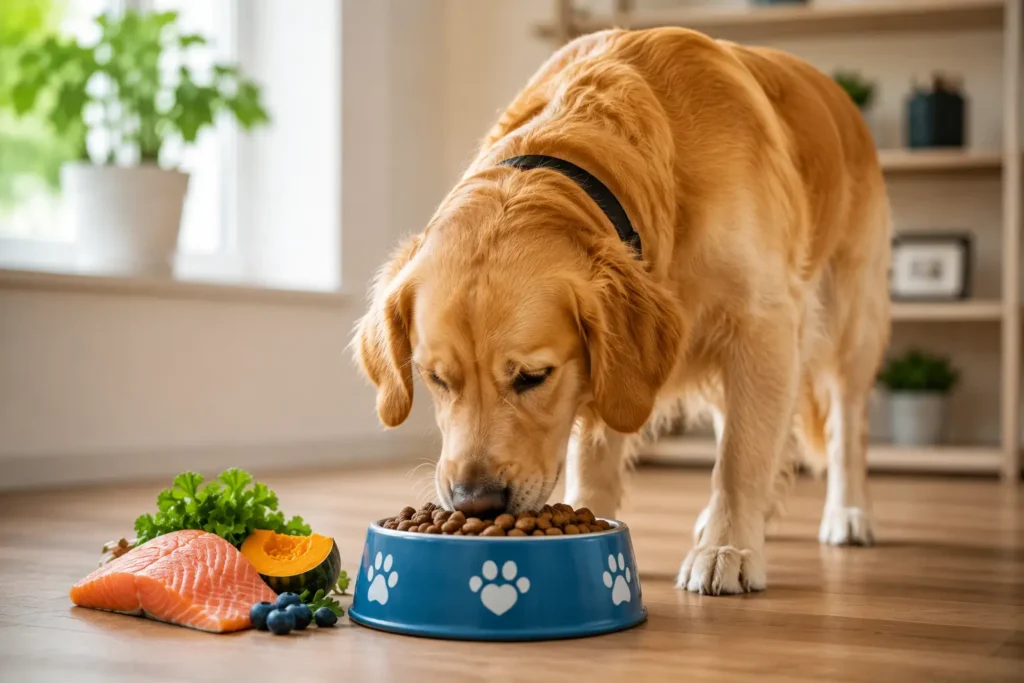
Can Food Prevent Another Episode of Urine Blockage?
Sometimes diet helps reduce recurrence, but it depends on the type of stone or urinary disease involved.
Different stones, different diets:
| Stone Type Diet Approach What Helps | ||
| Struvite | Prescription diet | Lower magnesium/phosphorus |
| Cystine | Specialized diet | Lower protein, higher pH |
| Urate | Purine-restricted | Limit purines |
| Calcium oxalate | Calcium-controlled | Lower calcium, moderate protein |
Struvite stones, cystine stones, urate stones, and calcium oxalate stones don’t all work the same way. A diet that fixes one problem can be wrong for another.
That’s why you want the vet to analyze the stone type, check the urinalysis, and make a diagnosis first.
What Information Should You Bring for Emergency Vet Dogs?
Bring the timeline with you. This info helps the vet work faster.
Timeline information:
- When your dog last peed normally
- How many times she’s tried to pee
- Whether any drops are coming out now
- Whether you saw blood in urine
- Whether she’s throwing up
- If her belly feels painful
- Any history of bladder stones
Questions People Keep Asking About Dog Not Urinating
How serious is a dog not urinating?
A dog that cannot urinate despite trying repeatedly could have a complete blockage, which is a vet emergency. Waste and potassium build up fast and can cause organ failure.
Can she still have a urine blockage if drops come out?
Yeah. Partial blockage lets small amounts through. Drops don’t mean there’s no obstruction when she’s straining, in pain, has blood in urine, or keeps trying.
What exactly does blocked dog urine mean?
Blocked dog urine usually means urine can’t flow normally because something’s partially or completely blocking the urinary tract somewhere.
Is urinary obstruction always from stones?
No. Obstruction can come from stones, tumors, narrowing, prostate disease, trauma, outside pressure, or nerve problems.
Can a urinary tract infection stop a dog from peeing?
An infection can cause frequent painful attempts and small amounts. But complete inability to pee points to obstruction or something more serious.
When should I call emergency vet dogs?
When a dog repeatedly strains with little or nothing coming out, especially with pain, vomiting, weakness, firm belly, or collapse.
Can I give her more water and wait?
No. Extra water doesn’t clear a complete blockage. Inability to urinate needs vet assessment, not a water trial.
What’s the difference between straining to pee and straining to poop?
Peeing: squatting or lifting leg, produces drops of urine. Pooping: different posture, produces stool or nothing.
What Should You Do Right Now?
If your dog’s peeing normally:
- Keep watching the pattern
- Call your regular vet if urination clearly changed
- Don’t wait if pattern gets worse
If your dog not urinating means constant squatting:
- Call a vet clinic now
- Describe the problem clearly
- Don’t try home remedies
- Get her assessed immediately
If she also has these signs:
- Vomiting (call now)
- Weakness (call now)
- Painful belly (call now)
- Collapse (call emergency vet immediately)
Don’t try to press the bladder or fix it with food. Get the problem identified first. Once the emergency’s handled, the cause tells you what happens next.
Our dog diseases library has more on other urinary issues. For understanding the diet’s role after treatment, check our urinary health and food guide.