

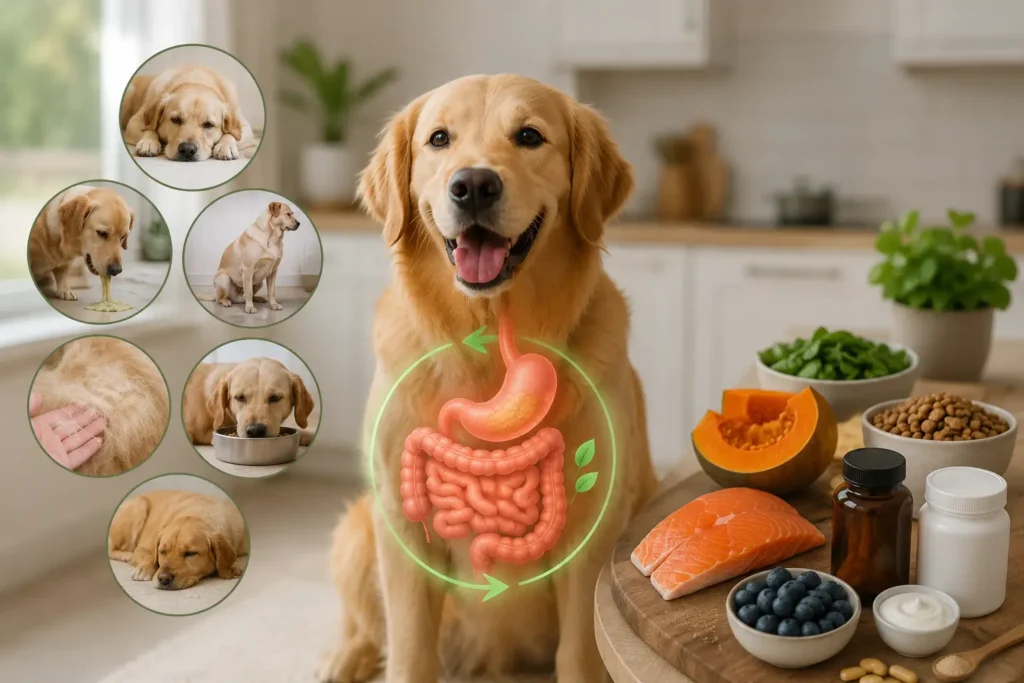
Dog gut health matters because the digestive tract controls stool quality, food tolerance, nutrient use, immune activity, and early disease signals. The clearest dog gut health symptoms are diarrhea, vomiting, gas, appetite change, weight change, bad stool odor, dull coat, and low energy.
MSD Veterinary Manual defines chronic enteropathies as gastrointestinal signs such as vomiting, anorexia, and diarrhea that last 3 weeks or longer. That 3-week point matters because persistent symptoms need a veterinary plan, not another random supplement.
This guide explains dog gut health through symptoms, diet, and supplements. You get practical checks, quantified data, and veterinary-backed decision points.
Key entities in dog gut health
Dog gut health includes several connected entities: dog, gastrointestinal tract, intestinal microbiome, stool quality, diarrhea, vomiting, gas, appetite, body condition, diet, protein, fat, fiber, probiotics, prebiotics, postbiotics, food-responsive enteropathy, and chronic enteropathy.
WSAVA states that its global nutrition guidelines help veterinary teams feed pets according to an “optimal and individually tailored nutrition plan.” That is the right frame for gut health. One dog may need a slower food transition. Another may need a hydrolyzed protein diet.
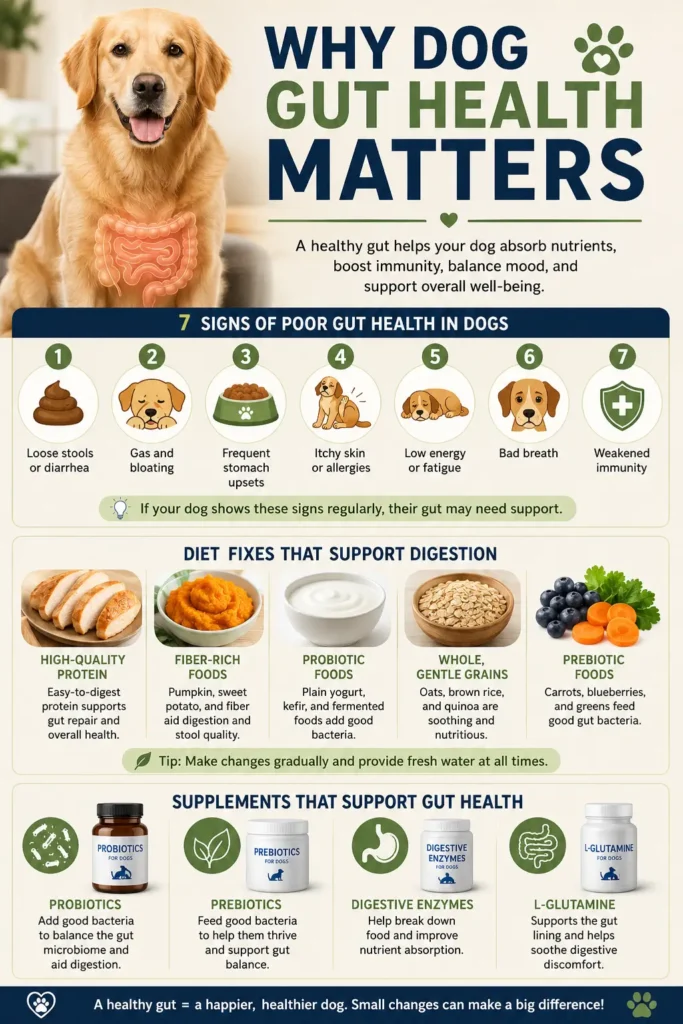
What is dog gut health?
Dog gut health is the functional condition of a dog’s digestive tract, gut microbiome, stool pattern, nutrient absorption, gut barrier, and immune response. A healthy dog gut usually gives you steady stool, and good tolerance to a perfect diet.
The gut microbiome is part of that system. It includes bacteria and microbial products that interact with food, fiber, bile acids, and the intestinal lining. Change the dog’s food and the gut environment changes. Sometimes that change is quiet. Sometimes you get soft stool by Friday.
Veterinary medicine uses symptom duration to separate short term upset from chronic disease. MSD Veterinary Manual describes chronic enteropathy as gastrointestinal signs lasting 3 weeks or longer. Diagnosis depends on history, clinical signs, and response to treatment.
Therapy can include dietary changes, microbiome modulation, or cytotoxic drugs in selected cases.
Why does dog gut health matter?
Dog gut health matters because digestion affects stool quality, body condition, nutrient use, food tolerance, and disease detection. If your dog’s gut keeps reacting, every food and supplement change becomes guesswork. The gut health of a dog mainly define its overall health and well being.
A Scientific study reported that dog ownership in the United States increased from 51% of households in 2024 to 53% in 2025, equal to 71 million dog-owning households. It also reported that the United States pet industry reached $158 billion in 2025 and is projected at $165 billion in 2026.
Dog gut health facts and figures
The table below summarizes the main data points that affect dog gut health decisions. The figures show why symptoms, diet, and supplements belong in one decision framework.
| Dog gut health area | Studied figure or standard | Why it matters |
| Dog ownership | 71 million United States households in 2025 | More owners need clear digestive health guidance. |
| Dog ownership growth | 51% of households in 2024 to 53% in 2025 | The dog nutrition and supplement audience is growing. |
| Pet industry spending | $158 billion in 2025 | Diet, treats, supplements, and veterinary care carry real cost. |
| Chronic gut symptom timeline | 3 weeks or longer | Persistent diarrhea, vomiting, or appetite loss needs veterinary assessment. |
| Diet response in one chronic enteropathy report | 55.7%, or 39 of 70 dogs | Diet can resolve signs in selected chronic gut cases. |
| Antibiotic response in the same report | 30%, or 21 of 70 dogs | Not every chronic gut case is diet-only. |
| Treat allowance | No more than 10% of daily calories | Treats can affect stool quality and diet-trial accuracy. |
| Nutrition risk screening | Treats or table food above 10% of calories | WSAVA flags this as a nutrition risk factor. |
What are the main symptoms of poor dog gut health?
The 7 main symptoms of poor dog gut health:
1. Diarrhea
2. Vomiting
3. Gas
4. Appetite change
5. Weight change
6. Bad stool odor
7. Dull coat with low energy
One sign matters less than the pattern.
1. Diarrhea or soft stool
Diarrhea is the most visible dog gut health symptom because stool form reflects water balance, gut movement, diet tolerance, and microbial activity. Soft stool can follow a new food, a rich treat, parasites, infection, or garbage eating.
Duration changes the meaning. A soft stool after a new treat is not the same as diarrhea that keeps coming back for 3 weeks. MSD Veterinary Manual uses the 3 weeks or longer timeline for chronic enteropathy, with signs such as vomiting, anorexia, and diarrhea.
A practical stool check uses 4 details:
- Record stool form, from firm to watery.
- Record stool frequency, including night-time urgency.
- Record mucus, blood, or black color.
- Record diet changes during the previous 72 hours.
2. Vomiting
Vomiting becomes more serious when vomiting repeats, appears with diarrhea, or appears with weakness, blood, or appetite loss. One vomiting episode after a known food mistake may settle. Repeated vomiting needs a clearer response.
MSD Veterinary Manual says vomiting can come from digestive disease, disorder. That range is wide. Too wide for blind supplement testing.
Use this quick rule:
- Monitor one mild episode if the dog acts normal.
- Call a veterinarian for repeated vomiting.
- Seek urgent care for blood, collapse, severe weakness, pain, or dehydration.
3. Gas and bloating
Gas and bloating can come from fermentation, swallowed air, sudden diet change, high-fat scraps, fast eating, or poorly tolerated ingredients. Gas alone can be mild. Gas with other condition like diarrhea, or appetite loss deserves more attention.
The supplement category matters here. Probiotics add selected live microorganisms. Prebiotics feed selected microorganisms. Postbiotics provide microbial products or inactivated microbial materials. These are not the same thing.
A 2025 review on biotic supplementation in dogs and cats describes probiotics, prebiotics, synbiotics, and postbiotics as researched tools for gastroenteropathies, but it also makes the obvious point: results depend on product type and clinical context.
4. Appetite change
Appetite change can signal nausea, pain, gut inflammation, obstruction, pancreatitis, or food intolerance. Appetite loss matters more when vomiting, diarrhea, or weight loss appears with it.
Some dogs eat less because they feel sick. Some eat more because food is not being absorbed well. Some look hungry because treats trained the habit.
MSD Veterinary Manual includes anorexia among chronic enteropathy signs. A dog that skips 1 meal during mild stomach upset differs from a dog that refuses food for a full day and vomits.
5. Weight gain or weight loss
Weight change matters because body condition reflects calories, digestion, absorption, disease, and feeding habits. Weight loss with diarrhea can suggest malabsorption, chronic inflammation, parasites, endocrine disease, cancer, or inadequate intake.
Weight gain matters too. It changes calorie needs, fat tolerance, treat allowance, fiber choices, and stool response.
A previous report on dogs with chronic enteropathy found 55.7%, or 39 of 70 dogs, responded to dietary changes. Another 30%, or 21 of 70 dogs, responded to antibiotics. That split shows why diet matters, but it also shows why diet is not the only pathway.
6. Bad stool odor
Bad stool odor can reflect diet composition, protein fermentation, infection, maldigestion, or sudden microbial change. Odor alone does not diagnose disease. Odor with diarrhea, vomiting, weight loss, or appetite loss is different.
Common odor triggers include:
- High-fat table scraps
- Sudden protein change
- Too many soft chews
- Spoiled food or garbage
- Overfeeding
7. Dull coat and low energy
Dull coat and low energy can reflect poor nutrition, chronic inflammation, nutrient malabsorption, parasites, or non-digestive illness. Gut health belongs in the review, but gut health does not explain everything.
Coat quality depends on usable protein, essential fatty acids, zinc, copper, vitamins, calories, and the dog’s disease status. A dog eating an incomplete homemade diet may look like a “gut health” case. The real issue may be formulation.
WSAVA nutrition guidelines emphasize individualized nutrition plans because malnutrition, obesity, diet quality, and feeding practices all affect pet health.
When do dog gut symptoms need a veterinarian?
Dog gut symptoms need a veterinarian when vomiting or diarrhea persists, blood appears, appetite drops, weight changes, pain occurs, dehydration appears, or signs approach 3 weeks. Puppies, seniors, and dogs with existing disease need faster care.
Call a veterinarian for:
- Blood in stool or vomit
- Repeated vomiting
- Diarrhea that persists or returns
- Weight loss
- Appetite loss with weakness
- Severe gas with pain or bloating
- Dehydration signs
- Gut signs while using medication
- Any digestive pattern close to 3 weeks
How does diet affect dog gut health?
Diet affects dog gut health through protein digestibility, fat level, fiber type, carbohydrate source, ingredient tolerance, calorie control, and nutrient completeness. The gut reacts to what reaches it every day.
Food responsive enteropathy proves the diet connection. In one previous report cited by Kawano and colleagues, 39 of 70 dogs, or 55.7%, with chronic enteropathy responded to dietary change. The same report found 21 of 70 dogs, or 30%, responded to antibiotics.
Frontiers describes food-responsive enteropathy as chronic intestinal disease that resolves or improves within 2 to 4 weeks after an elimination diet using limited-ingredient novel protein or hydrolyzed protein.
Complete and balanced food
Complete and balanced dog food supplies the nutrients required for the declared life stage. That statement matters more than label trends.
A complete diet is the baseline. If the diet misses calcium, essential fatty acids, trace minerals, stool and coat problems can appear even before anyone thinks about disease.
WSAVA also flags unconventional diets, including raw, homemade, vegetarian, or unfamiliar diets, as nutrition screening risk factors. That does not mean every homemade diet is wrong. It means an unusual diet needs closer review.
Protein source and digestibility
Protein affects stool volume, stool odor, food tolerance, and immune exposure. Some dogs improve with novel protein diets. Some improve with hydrolyzed protein diets.
A novel protein diet uses a protein the dog has not commonly eaten. Examples include rabbit, venison, duck, or selected fish, depending on diet history. A hydrolyzed protein diet uses proteins broken into smaller fragments.
A diet trial fails when hidden ingredients sneak in. One flavored chew. One daily scrap. One “tiny bite.” That can be enough to confuse the result.
Fat level
Fat affects calorie density, digestive tolerance, gastric emptying, and stool quality. High-fat leftovers can trigger vomiting or diarrhea in sensitive dogs.
Low fat is not always correct. A lean working dog and an overweight couch loving dog do not need the same plan. A dog with pancreatitis history has different priorities again.
For overweight dogs, calorie density matters. The recent Banfield dataset found that dogs recorded as overweight or obese during growth had higher odds of adult overweight or obesity, with an odds ratio of 1.85.
Fiber type
Fiber affects stool water, fermentation, satiety, microbial metabolites, and colon function. Soluble fibers, such as psyllium and beet pulp, can support stool form. Insoluble fibers can increase bulk.
Fiber can help. Fiber can also backfire. Too much fermentable fiber may increase gas. Too little may do nothing. A dog with blood, vomiting, or weight loss needs veterinary assessment before fiber experiments.
What diet fixes support dog gut health?
The most useful dog gut health diet fixes are consistent feeding, measured portions, complete food, gradual transitions, fiber adjustment, and treat control. Small, controlled changes beat constant switching.
Use a 7-day food transition
A 7-day food transition gives the gut time to adjust to new ingredients and nutrient levels. Many dogs tolerate food changes better when the old diet decreases slowly.
Use this Timeine:
- Days 1 and 2: 75% current food and 25% new food
- Days 3 and 4: 50% current food and 50% new food
- Days 5 and 6: 25% current food and 75% new food
- Day 7: 100% new food
Slow down if stool softens. Call a veterinarian first if the dog already has repeated vomiting or any other related condition.
Build a feeding record
A feeding record turns vague digestive complaints into usable data. No app required. A phone note works.
Track these 6 items for 14 days:
· Food name and amount
· Treat name and amount
· Stool form and frequency
· Vomiting episodes
· Appetite and energy
· Body weight or body condition score
A 14-day record often shows patterns that memory misses. Diet trials also become cleaner because the owner can see which changes happened before stool changes
Reduce treat noise
Treat reduction improves dog gut health evaluation because treats can hide the real diet signal. If treats exceed 10% of daily calories, stool changes may come from treats rather than the main food.
Do supplements help dog gut health?
Dog gut health supplements can help selected dogs, but results depend on symptom pattern, diagnosis, strain, dose, and diet context. Probiotics, prebiotics, postbiotics, fiber, and digestive enzymes are separate tools.
Probiotics for dogs
Probiotics for dogs contain live microorganisms intended to support gut microbial balance. They may fit some dogs during antibiotic recovery, diet transition, or selected diarrhea cases.
Cornell notes that probiotics can be started several days before a known stressful event, such as boarding or moving. Cornell also states that probiotics can be given daily as part of long-term health care.
Prebiotics for dogs
Prebiotics for dogs are substrates that feed selected beneficial gut microorganisms. Examples include inulin, mannan oligosaccharides, psyllium, beet pulp, and selected resistant starches.
Prebiotics can support stool quality and microbial metabolites. They can also increase gas if the dose or fiber type does not fit the dog.
Prebiotics also create gas in some dogs. Start with a clear goal and veterinary advice for dogs in the severe cases.
Postbiotics for dogs
Postbiotics are microbial products, metabolites, or inactivated microbial materials that may support digestive function without adding live organisms. This category is getting more attention because live microbe survival is not the only possible gut-support route.
Evidence still depends on the product. A postbiotic blend in one study does not prove every postbiotic chew works for every dog. Ingredient formula, baseline symptoms, diet, and study population all matter.
Fiber supplements
Fiber supplements can support stool form, satiety, anal gland comfort, and diet transition tolerance. Psyllium can bind water and improve stool form in selected dogs. Beet pulp can support fermentation and stool quality in some formulas.
Use this table as a guide.
| Stool pattern | Possible fiber logic | Caution |
| Soft but formed stool | Soluble fiber may improve form | Excess fiber can increase gas. |
| Watery diarrhea | Veterinary assessment first | Fiber can delay proper care. |
| Constipation tendency | Water plus selected fiber may help | Pain or vomiting needs care. |
| Overweight dog with hunger | Fiber may support satiety | Calories still control weight. |
How do you choose dog gut health supplements?
Choose dog gut health supplements by matching the product to the symptom, active ingredient, strain, dose, safety, and veterinary diagnosis.
Check 8 details before buying:
- Match the product to one symptom, such as soft stool, gas, antibiotic recovery, or diet transition.
- Identify the supplement type: probiotic, prebiotic, postbiotic, fiber, or enzyme.
- Check the probiotic strain, not just the species name.
- Check dose or colony-forming units at the end of shelf life.
- Check storage instructions.
- Check expiration date.
- Check added flavors, fats, sweeteners, or allergens.
- Ask a veterinarian about disease or medication conflicts.
The common mistake is stacking products. If stool improves after 3 new products, you do not know what helped. If stool worsens, you do not know what caused it.
What is the best dog gut health plan?
The best dog gut health plan uses symptom tracking, veterinary screening, complete food, measured portions, gradual transitions, and targeted supplements.
Step 1: Record stool and symptoms
Record stool and symptoms daily because stool patterns change faster than body weight or coat quality. Use a 1 to 5 or 1 to 7 stool scale and take photos when the pattern changes
Record:
- Stool form
- Stool frequency
- Mucus or blood
- Vomiting
- Appetite
- Energy
- Treats
- New foods
- Supplements
- Body weight
Use a repeatable stool scale if possible. A score gives clearer data than “bad stool.”
Step 2: Check diet label and life stage
Check whether the food matches the dog’s life stage.
Look for:
- Complete and balanced statement
- Life stage, such as adult maintenance or growth
- Calorie content
- Feeding guide
- Manufacturer contact details
- Veterinary use statement, if therapeutic
Puppies, pregnant dogs, lactating dogs, seniors with disease, and overweight dogs do not share one nutrition target.
Step 3: Control calories and body condition
Body condition belongs in gut health planning because weight changes feeding volume, fat tolerance, treat allowance, fiber needs, and long-term risk. A dog’s weight does not tell the full story. Body condition score adds the missing context.
APPA’s 2025 ownership data shows the dog owner audience is large and growing. More owners means more feeding choices, more supplement buying, and more need for clear gut health triage.
Step 4: Use a veterinary diet trial when signs persist
Use a veterinary diet trial when chronic diarrhea, vomiting, weight loss, or recurring soft stool continues. Food-responsive enteropathy often improves within 2 to 4 weeks after an elimination diet.
A clean diet trial needs rules:
- Feed only the trial diet.
- Use approved treats only.
- Avoid flavored chews.
- Avoid table food.
- Record stool daily.
- Recheck at the planned time.
Step 5: Add supplements with a purpose
Add supplements only when each supplement answers a defined digestive problem. Probiotics support microbial balance. Prebiotics feed selected microbes. Postbiotics provide microbial products or inactivated components. Fiber changes stool water, fermentation, and bulk.
Avoid starting 3 new products in 1 week. Multiple changes make stool response hard to read.
What foods can hurt dog gut health?
Foods that can hurt dog gut health include sudden new foods, high fat scraps, excess treats, spoiled food, and incomplete homemade diets. The issue is usually dose, timing, formulation, or disease context.
Common triggers include:
- Greasy leftovers
- Cheese or peanut butter in large amounts
- Spoiled food or garbage
- Sudden food brand changes
- Multiple new treats in one week
- Raw bones or risky scraps
- Incomplete homemade recipes
- High-fat chews
- Rich holiday food
Homemade diets can work when a veterinary nutritionist formulates the recipe. Homemade diets can also miss calcium, trace minerals, essential fatty acids, vitamins, or life-stage nutrient targets. The kitchen is not the problem. The formula is.
What are common dog gut health myths?
The most common dog gut health myths are that grain-free means healthier, probiotics fix every diarrhea case, bad stool odor is harmless, and homemade food is automatically better.
Myth 1: Grain-free means better gut health
Grain free food does not automatically improve dog gut health. FDA reporting on dilated cardiomyopathy has involved many grain free diets, but the agency frames the issue as a continuing investigation rather than a simple ingredient verdict.
Myth 2: Probiotics fix every soft stool
Probiotics can help selected dogs. Chronic diarrhea can also reflect food-responsive enteropathy, parasites, inflammation, endocrine disease, pancreatic disease, infection, or cancer. Persistent signs need diagnosis.
Myth 3: Bad stool odor is normal
Bad stool odor can happen after food change or rich treats. Repeated odor with diarrhea, vomiting, blood, appetite loss, or weight loss deserves attention.
Myth 4: Homemade food is always healthier
Homemade food can be balanced. It can also be incomplete. Complete nutrition needs correct nutrients, not just fresh-looking ingredients.
Dog gut health checklist
A dog gut health checklist helps you track symptoms, diet, stool, treats, supplements, weight, and red flags before changing food again.
Use this 12-point checklist:
- Record stool consistency daily.
- Record vomiting episodes and timing.
- Record food brand, formula, protein source, and amount.
- Record treats, chews, and table food.
- Record supplement names and doses.
- Record appetite and water intake.
- Record energy changes.
- Check the complete and balanced statement.
- Check the life-stage statement.
- Weigh the dog every 2 to 4 weeks.
- Book a veterinary exam for red flags.
- Change only one variable at a time.
People also ask
What is the fastest way to improve dog gut health?
The fastest safe way to improve dog gut health is to stop sudden diet changes, control treats, track stool, provide water, and call a veterinarian for persistent signs.
What are the signs of poor gut health in dogs?
Poor dog gut health can show as diarrhea, vomiting, gas, appetite change, weight change, bad stool odor, dull coat, or low energy.
Are probiotics good for dogs?
Probiotics can support selected dogs, but strain, dose, product quality, diagnosis, and diet context decide whether a probiotic fits the case.
What foods improve dog gut health?
Foods that support dog gut health include complete diets with suitable protein, controlled fat, appropriate fiber, measured calories, and life-stage nutrient balance.
How long does a dog gut reset take?
A controlled veterinary diet trial often uses at least 2 weeks, while chronic gut signs lasting 3 weeks or longer fit chronic enteropathy evaluation.
How much of a dog’s diet can come from treats?
WSAVA says treats should make up no more than 10% of a dog’s daily calorie intake. WSAVA nutrition screening also flags snacks, treats, and table food above 10% of calories as a nutrition risk
Final answer: why dog gut health matters
Dog gut health matters because it links diet, stool quality, microbiome balance, immune activity, body condition, and early disease detection. The signs to watch are diarrhea, vomiting, gas, appetite change, stool odor, dull coat, and low energy.
A good dog gut health plan is not fancy. Feed a complete diet. Measure portions. Control treats. Change food slowly. Track stool. Use supplements for a clear reason. Call a veterinarian when symptoms persist, intensify, or approach the 3-week chronic enteropathy window.
That is why dog gut health matters: symptoms, diet, and supplements only make sense when the dog’s pattern is clear.