



Bringing a Maltese home looks simple. The reality is not. This breed magnifies small mistakes into long-term problems. Missed tooth brushing turns into dental disease, a few extra treats become weight drift, skipped grooming days lead to painful matting, and the wrong walking gear stresses a fragile airway. Many owners only connect these dots after costly vet visits.
This guide exists to close that gap early. It breaks down Maltese care using measurable risks, published data, and routine-level controls rather than vague advice. The goal is simple: replace guesswork with a clear, evidence-based care system that fits Maltese physiology from puppyhood through senior years.
Benefits from this article:
- A quantified, risk-ranked Maltese care plan that prioritizes the highest-frequency failure points (dental disease, weight drift, coat matting, airway stress, patellar luxation) using published data.
- A procurement-style checklist for routine selection (diet label checks, grooming cadence, harness selection, veterinary review triggers) that fits Maltese scale and toy-breed physiology.
Maltese ownership succeeds when care actions match measurable breed constraints. The next section converts those constraints into daily and monthly controls.
What defines the Maltese dog breed?
A Maltese is a toy-breed dog with an adult height of 7 to 9 inches, an adult weight under 7 pounds, and a typical life expectancy of 12 to 15 years.
Core Maltese identifiers
- Breed group: Toy
- Adult size: Under 3.2 kg (under 7 lb)
- Withers height: 18 to 23 cm (7 to 9 in)
- Longevity range: 12 to 15 years
Care truth: A 3 kg dog amplifies the effect of small daily errors in calories, dental hygiene frequency, coat maintenance gaps, and neck-loading equipment.
What “care truths” do most new Maltese owners learn too late?
New Maltese owners often discover that avoidable problems cluster into 6 recurring categories:
- Dental disease
- Overweight status
- Coat matting
- Tracheal stress
- Patellar luxation
- Puppy hypoglycemia
Truth 1: Dental disease acts like a default risk, not a rare event
A UK primary-care dataset reported 12.5% annual dental disease prevalence in dogs, summarized as “1 in 8 dogs” affected per year.
A peer-reviewed summary of the same study reports dental disease as the most common disorder and lists 12.5% for dental disease.
Why does this hit the Maltese harder?
- A small jaw size increases tooth crowding pressure points.
- Maltese guidance highlights retained baby teeth and early adult tooth loss patterns, which connect directly to periodontal risk.
Truth 2: Weight drift is common in dogs, and toy breeds feel it faster
In 2024, 35% of dog owners categorized their dog as overweight or having obesity, while 51% categorized their dog as ideal body condition in that survey.
A large U.S. electronic medical record study reported adult-life-stage prevalence of overweight or obesity at 52.9% in dogs.
Toy-breed math
- A 50 kcal daily excess represents a larger percentage of total intake in a sub-7 lb dog than in a 25 kg dog.
- Small mass increases sensitivity to treat-calorie stacking.
Truth 3: The coat behaves like a fiber system with predictable mat zones
Long, fine coat fibers mat when friction and moisture increase, especially at the ears, collar line, axilla, groin, and tail base. This pattern produces a predictable “mat map” that grooming routines can audit.
Operational consequence
- Missed brushing days often convert into clip-down grooming sessions and skin irritation events.
Truth 4: Neck pressure interacts with airway vulnerability in small dogs
Veterinary guidance for a collapsing trachea includes harness use instead of collar use, plus weight management and irritant avoidance.
Maltese breed guidance highlights the risk of collapsing trachea and explicitly links a harness to reduced throat pressure.
Truth 5: Patellar luxation has documented recurrence and complication rates
A study of orthopedic cases reported patellar luxation in 559 dogs out of 8,694 orthopedic cases, with 85% medial luxations, and major complications at 16%, including recurrence at 7% after surgery in that cohort.
A 2025 AVMA journal article reports recurrence of patellar luxation ranges in published literature at 8% to 36% across cases, indicating meaningful variability by technique and case grading.
Truth 6: Puppy hypoglycemia exists as a toy-breed risk pattern
Toy-breed hypoglycemia resources describe low blood sugar events in puppies and link management to intake monitoring and prompt response guidance.
Maltese breed guidance states that Maltese puppies often experience hypoglycemia and may receive nutrient-dense diets under veterinary direction.
High-risk windows
- First weeks after rehoming.
- Post-vaccination days with appetite changes.
- Travel or schedule disruption days.
Data-backed operational approach
- Meal events tracked.
- Water access tracked.
- Energy level tracked.
What feeding errors increase the risk in Maltese dogs?
The highest-impact feeding error is feeding a product or pattern that lacks a complete and balanced basis for the dog’s life stage, followed by uncontrolled treat calories and inconsistent intake patterns in puppies.

What counts as a “complete and balanced” diet?
A complete diet provides required nutrients and is labeled accordingly, with labels often distinguishing diets validated by feeding trials versus formulation to nutrient profiles, and diets labeled for intermittent or supplemental feeding only.
Label verification checklist
- “Complete and balanced” appears with life-stage scope.
- “Intermittent” or “supplementary” appears only for limited-use products.
- Feeding trial language appears when available as a validation signal.
What daily care routine keeps the risk low?
A Maltese daily routine works when it covers 5 controls: mouth, coat, eyes, calories, and mechanical load (equipment).
Daily controls checklist (5 items)
- Dental contact event: Tooth brushing logged as a routine action because high-prevalence dental disease exists in dogs.
- Coat detangling pass: Comb verification at ears, collar line, axilla, groin, tail base.
- Eye-area hygiene: Hair kept dry and clean because porphyrin staining intensifies with tear overflow, and staining becomes visible on light coats.
- Measured feeding: Grams tracked, treats budgeted because obesity prevalence ranges from 35% owner-reported overweight or obesity to 52.9% adult-life-stage prevalence in large clinical records.
- Harness-only walking: Harness reduces neck pressure exposure in tracheal collapse guidance.
What feeding framework reduces Maltese mistakes?
A feeding framework reduces errors by using label verification, life-stage matching, and quantified calorie inputs.
What counts as an evidence-based selection method for dog food?
WSAVA guidance emphasizes that pet food labels include required information plus marketing language, and it provides a structured approach to selecting foods using practical label data and manufacturer questions.
WSAVA-aligned selection controls
- Life-stage statement matches puppy, adult, or senior status.
- “Complete and balanced” status verified on label context.
- Manufacturer contact transparency confirmed using the WSAVA toolkit questions.
What does “treat budget” mean in numeric terms?
A treat budget is a measured calorie fraction that prevents hidden intake from exceeding the base diet plan. Obesity prevalence data support a controlled approach because overweight status is common in dogs.
Treat budget implementation
- Daily treat grams logged.
- Training treats selected by size and kcal density.
- High-fat chews treated as meals, not “add-ons.”
What does “picky eating” mean in Maltese puppies and adults?
“Picky eating” often reflects a mixture of dental sensitivity, learned feeding patterns, and high treat reinforcement, and Maltese puppies also carry hypoglycemia vulnerability during low intake periods.
What operational feeding controls reduce picky cycles?
Controls
- Fixed meal windows, measured grams, and calorie tracking per day.
- Treat budgeting as a percentage of daily intake, with a hard cap defined by the care plan.
- Diet selection using WSAVA toolkit questions, not influencer claims.
Why does this matter?
Owner survey data reports 35% of dog owners categorizing dogs as overweight or obese, indicating miscalibration risk for small dogs.
What does hypoglycemia risk look like in Maltese puppies?
Maltese puppies can show hypoglycemia risk, especially when intake drops or stress increases, and veterinary guidance notes that toy-breed puppies may require nutrient-dense feeding strategies under veterinary supervision when risk signs appear.
Operational control points
- Meal frequency management aligns with puppy tolerance and veterinary guidance.
- Monitoring signs links to clinician instructions, not internet checklists.
- Travel days and vaccination days count as higher-risk intake days because stress and appetite changes often co-occur.
What puppy-specific care prevents avoidable escalations?
Puppy care concentrates on intake stability, dentition monitoring, and safe handling.
What grooming realities matter most for the Maltese coat?
The key grooming reality is that long Maltese hair forms mats from friction and moisture, so brushing frequency and technique matter more than shampoo branding.
What breaks a Maltese grooming routine?
A Maltese grooming routine breaks down into 4 predictable ways:
- Brushing stops at the surface layer and misses undercoat-adjacent tangles.
- High-friction zones remain unbrushed (behind ears, collar line, armpits).
- Coat stays damp after face cleaning, intensifying tangles near eyes and muzzle.
- Clip intervals extend without compensating for daily detangling.
Quality controls for grooming
- A bristle brush and a metal comb help detangle to the skin level.
- Section-by-section line brushing reduces missed mats.
- Grooming intervals convert to an audit: coat parts, comb pass-through, skin condition.
What does tear staining in dogsmean, and what causes the color?
Tear stain color commonly relates to porphyrins, iron-containing molecules produced during red blood cell breakdown and excreted through tears and other secretions, with staining most visible on white coats.
What creates tear overflow?
Tear overflow (epiphora) arises from:
- Anatomical drainage variation.
- Hair contact with the ocular surface.
- Duct obstruction or narrowing.
Evidence-backed stain mechanism
- Porphyrins are excreted in tears.
- Excess tears contact hair.
- Hair accumulates reddish-brown staining.
Measurable tear-stain drivers
- Tear overflow (epiphora) due to eyelid anatomy, hair contact, or duct obstruction.
- Secondary microbial overgrowth in damp hair folds.
- Grooming frequency around the eyes and muzzle.
Practical control
- Daily eye-area drying reduces moisture retention.
- Hair trimming near the medial canthus by a professional reduces hair-wicking.
What practical tear-stain control looks like?
Controls
- Daily drying of periocular hair.
- Hair trimming near the eye performed by a grooming professional.
- Veterinary evaluation for persistent epiphora.
What dental truths do new Maltese owners learn too late?
Dental disease emerges as a high-frequency disorder in dogs, and small breeds show higher prevalence across datasets, so Maltese dental care becomes a primary prevention priority.
What changes in the retention of baby teeth?
Maltese often retain baby teeth, and retained deciduous teeth can trap debris between the retained tooth and the adult tooth, increasing periodontal risk and early tooth loss risk when untreated.
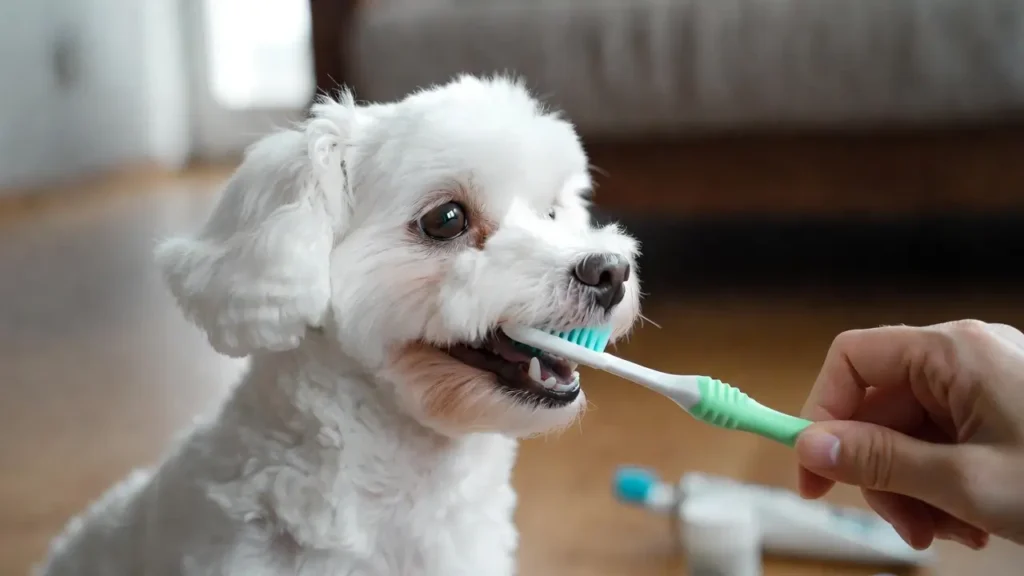
Dental control list
- Daily tooth brushing frequency target aligns with veterinary dental guidance.
- Veterinary oral exam cadence aligns with individualized risk.
- Chew selection aligns with tooth fracture risk and plaque reduction evidence, not hardness marketing.
What does airway protection mean for Maltese dogs?
Airway protection means reducing mechanical load on the trachea and rapidly triaging chronic cough patterns because small dogs can experience tracheal collapse and chronic cough persistence even with management.
What equipment choice changes?
Veterinary guidance for Maltese notes harness use as a method to keep pressure off the throat due to the risk of collapsing trachea in small dogs.
Harness procurement criteria for Maltese
- Y-front or chest-distributing harness geometry.
- Weight range rating aligned to sub-7 lb dogs.
- Strap placement that avoids neck compression.
What tracheal collapse management looks like in clinical terms?
Clinical guidance describes tracheal collapse treatment options as medical, surgical, or combined, with cough often persisting to some extent even with control, and surgical intervention typically performed by experienced surgeons.
Escalation triggers
- Persistent honking cough episodes.
- Exercise intolerance or respiratory distress patterns.
- Heat exposure causes cough intensification.
What does orthopedic risk management look like for a luxating patella?
A patella is a kneecap, and “luxating” means out of place or dislocated. So, a luxating patella is a kneecap that moves out of its normal location. Luxating patella management begins with recognizing gait patterns and controlling high-impact loads.
What do owners see first?
First observable indicators
- Skipping gait episodes.
- Intermittent hind limb lift.
- Reluctance with stairs or jumping.
Risk control actions
- Veterinary orthopedic exam when skipping gait appears.
- Weight control is important because mass increases joint load.
- Controlled play surfaces to reduce torsional stress.
What vet scheduling looks like in a Maltese lifecycle?
A Maltese lifecycle plan targets predictable risk windows: puppy hypoglycemia, dentition transition, early periodontal onset, mid-life weight drift, and later-life airway or orthopedic monitoring.
Maltese care calendar
| Lifecycle stage | Primary risks | Objective signals | Service focus |
| Puppy | Hypoglycemia, dentition transition | Appetite drop, lethargy, retained teeth | Intake monitoring, oral checks |
| Young adult | Dental disease onset, coat matting | Tartar, halitosis, and mats at friction zones | Dental hygiene routines, grooming cadence |
| Adult | Overweight status, patellar luxation signs | BCS drift, skipping gait | Weight plan, orthopedic evaluation |
| Mature and senior | Airway stress, dental progression | Cough, exercise intolerance, oral pain | Airway assessment, dental surveillance |
What does a “care truths” checklist look like for Maltese owners?
A Maltese care checklist is a control document that reduces avoidable escalations.
Daily controls
- Tooth brushing event logged.
- Eye area cleaned and dried, hair kept free of moisture traps.
- Coat detangled with a comb pass-through at friction zones.
- Food measured in grams, treats budgeted.
- Harness used for leash walking to reduce throat loading.
Weekly controls
- Full-body line-brush audit: ears, collar line, armpits, groin, tail base.
- Weight trend recorded using consistent scale conditions.
Monthly controls
- Nail trim and paw pad inspection.
- Groomer visit or home groom audit, depending on coat length.
What does a “7-day Maltese care plan” look like?
A 7-day plan supports habit formation and avoids ambiguity.
Day-by-day plan (summary)
- Day 1: baseline photos, baseline weight log, dental routine start.
- Day 2: grooming zone audit, behind-ear comb pass verification.
- Day 3: harness fit check and walk protocol.
- Day 4: tear stain hygiene protocol and hair trimming appointment if indicated.
- Day 5: treat budget setup and measured feeding workflow using WSAVA label checks.
- Day 6: gait observation log during play and stairs.
- Day 7: review logs, schedule a veterinary oral exam if tartar or odor appears.
What mistakes appear most often in Maltese ownership?
The most common Maltese care mistakes align with published risk prevalence and clinical guidance: dental neglect, calorie drift, collar use during cough patterns, delayed response to skipping gait, and inconsistent grooming that permits mat formation.
Top 10 mistakes, written as controls
- Brushing omission.
- Treat calories uncounted.
- Collar walking during cough patterns.
- Grooming gaps at friction zones.
- Tear-stain moisture retention.
- Delayed dentition checks in puppy tooth transition.
- “Picky eater” reinforcement loop.
- Weight data absent.
- Skipping gait unlogged.
- Veterinary visits triggered only by acute crises.
What do new owners misunderstand about “low shedding” and allergens?
Low shedding describes hair release patterns, not allergen elimination, because allergens relate to dander and saliva proteins rather than hair count alone. This topic requires clinician-level clarification for allergy cases and benefits from individualized assessment.
Operational takeaway: Allergy management belongs in a veterinarian-led plan, not a breed label shortcut.
Final Takeaway: Turn Maltese Care Into Simple Daily Controls
A Maltese does not fail because the breed is “difficult.” Maltese ownership fails when tiny gaps are repeated, skipping brushing because the teeth look fine, eyeballing meals because the bowl seems small, delaying grooming because the coat “still looks okay,” and clipping a leash to a collar because it is convenient. In a sub-7 lb dog, those shortcuts compound fast.
The strongest Maltese care plan is not complicated. It is consistent. Track the basics: teeth, weight trend, coat friction zones, eye-area dryness, and harness-only walks. Use food labels like a purchasing decision, not a vibe check. Escalate early when coughing, skipping gait, or oral odor shows up.
Do that, and you stop reacting to problems. You run prevention on purpose, and your Maltese stays comfortable, clean, and stable throughout puppyhood, adulthood, and the senior years.
Frequently Asked Questions
How often should I brush my Maltese’s teeth?
Daily is the best target because dental disease is common, and small mouths crowd faster.
Why is my Maltese gaining weight even with “small meals”?
Toy dogs need fewer calories, so treats and extras can quietly outweigh the whole plan.
Is a collar safe for a Maltese?
A harness is the safer default because it reduces pressure on the throat and trachea.
How do I stop coat matting in a Maltese?
Brush the skin with a comb, focusing on behind the ears, collar line, armpits, groin, and tail base.
What does “complete and balanced” mean on dog food labels?
It means the diet is intended to meet nutrient needs for a stated life stage, not just act as a topper or treat.
How many treats are limited for a Maltese?
Keep treats within a fixed daily budget so they don’t push total calories above your measured meals.
Why do Maltese dogs get tear stains?
Tear overflow keeps hair damp, and porphyrins can discolor light coats, making stains more visible.
What are the early signs of a luxating patella in Maltese dogs?
Skipping gait, sudden hind-leg lifting, or reluctance with stairs are common first signals.
What causes “picky eating” in Maltese dogs?
It often comes from treat reinforcement, schedule inconsistency, or dental sensitivity, not “being stubborn.”
What does hypoglycemia look like in Maltese puppies?
Low energy, weakness, trembling, or sudden lethargy, especially after missed meals, needs fast vet guidance.