


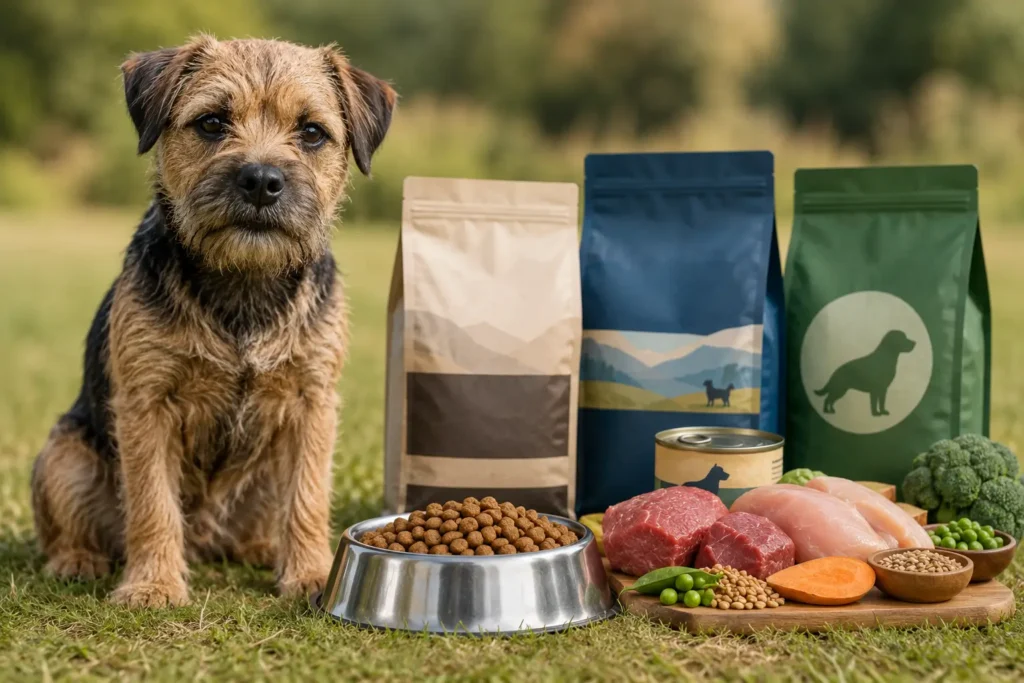
Adult Border Terriers weigh 11.5–15.5 lb, per the AKC breed standard. The breed carries a 12–15-year lifespan 4,380–5,475 days of cumulative dietary input. The correct dog food for a Border Terrier carries an AAFCO complete and balanced statement, a declared kcal/cup or kcal/can value, and a feeding trial or formulation substantiation method. These 3 label facts confirm nutritional adequacy before any brand, ingredient, or price is assessed.
What Is the Best Dog Food for a Border Terrier?
The best dog food for a Border Terrier carries an AAFCO complete and balanced statement for the correct life stage, a declared kcal/cup or kcal/can calorie value, and a substantiation method from a manufacturer with verified quality controls. Purina Pro Plan Small & Toy Breed, Hill’s Science Diet Small Paws, and Royal Canin Size Health Nutrition Small Adult meet all 3 criteria for adult Border Terriers in the USA.
3 label checkpoints determine nutritional adequacy before brand or ingredient is evaluated:
- AAFCO complete and balanced statement confirms all required nutrients exist in correct ratios for a defined life stage.
- Calorie declaration expressed as kcal/cup (dry) or kcal/can (wet); this figure controls portion size.
- Substantiation method feeding trial indicates real-animal testing; formulation reference indicates laboratory calculation from nutrient data only.
According to WSAVA Global Nutrition Guidelines (Freeman et al., Journal of Veterinary Internal Medicine, 2011, updated 2021), manufacturer transparency published nutritional expertise, quality-control documentation, and verifiable contact details predicts food safety more reliably than ingredient lists or marketing descriptors such as “premium,” “natural,” or “holistic.”
What AAFCO Statement Does Border Terrier Dog Food Require?
AAFCO recognizes 4 life stages for dogs: growth, maintenance, gestation/lactation, and all life stages. A food labeled “all life stages” meets the growth profile and is nutritionally safe for adult Border Terriers. A food labeled maintenance only does not meet Border Terrier puppy requirements.
- Growth
Border Terrier puppies under 12 months; minimum 22.5% crude protein, 1.0% calcium, and 0.8% phosphorus on a dry matter basis.
- Maintenance
Adult dogs from 12 months; minimum 18.0% crude protein on a dry matter basis.
- All life stages
Meet growth minimum thresholds; suitable from puppy through adult.
- Gestation/lactation
Breeding females only; highest nutrient density of all profiles.
A food labeled “for Border Terriers” or “small breed” without an AAFCO nutritional adequacy statement is a supplement or treat not a daily diet.
What Are the Best Dog Food Brands for Border Terriers in the USA?
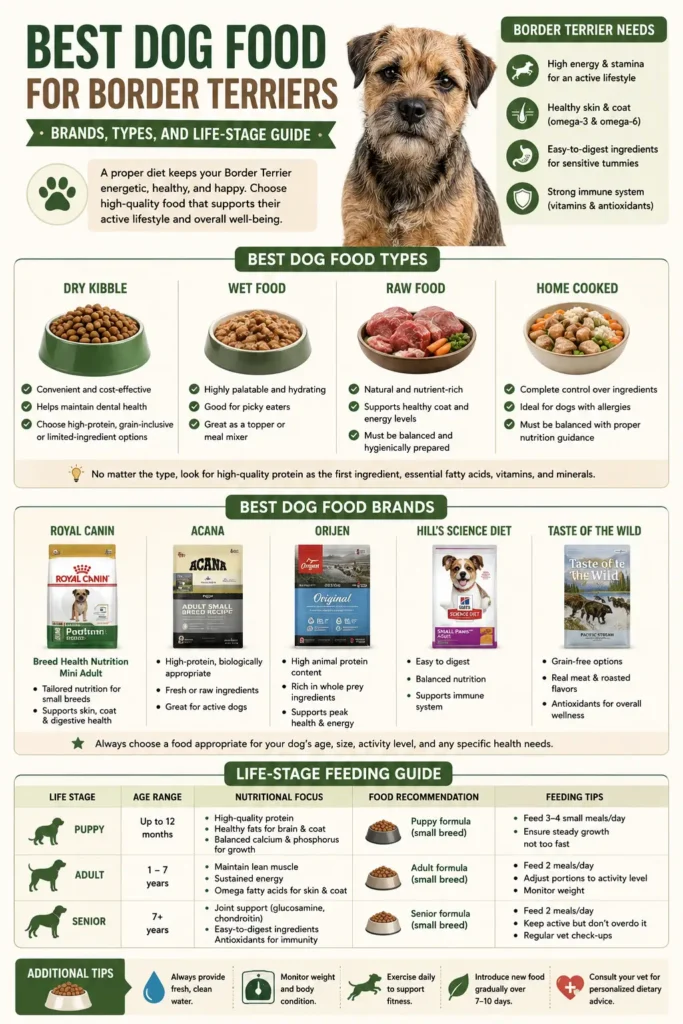
6 brands consistently meet WSAVA transparency criteria and AAFCO nutritional profiles for Border Terriers in the USA: Purina Pro Plan, Hill’s Science Diet, Royal Canin, Blue Buffalo, Wellness CORE, and Orijen. Each publishes nutritional expertise, quality-control protocols, and contact information verifiable by veterinary professionals.
| Brand | Protein % | Approx. kcal/cup | Price/lb (Chewy, 2025) | AAFCO Statement | Best For |
| Purina Pro Plan Small & Toy | 30% | ~395 | $2.80–$3.20 | Maintenance | Overall value |
| Hill’s Science Diet Small Paws | 25.3% | ~388 | $3.50–$4.00 | Maintenance | Vet-recommended |
| Royal Canin Small Adult | 28% | ~391 | $3.00–$3.50 | Maintenance | Breed-size match |
| Blue Buffalo Life Protection Small | 26% | ~370 | $2.75–$3.25 | Maintenance | Natural positioning |
| Wellness CORE Small Breed | 36% | ~396 | $4.00–$5.00 | Maintenance | High protein |
| Orijen Small Breed | 38% | ~469 | $5.00–$6.50 | Maintenance | Maximum protein |
| Pedigree Small & Toy Breed | 22% | ~340 | $1.25–$1.75 | Maintenance | Budget |
Calorie figures are approximate. Verify the declared kcal/cup value on the current product label before calculating daily portions. Formulations change between production runs.
What Is the Best Dry Dog Food for Border Terriers?
Purina Pro Plan Small & Toy Breed Adult (Chicken & Rice Formula) is the best dry dog food for Border Terriers based on AAFCO maintenance statement compliance, approximately 395 kcal/cup declared calorie density, and published feeding trial substantiation confirming nutrient bioavailability in live animals.
4 top dry dog food for Border Terriers options in the USA:
- Purina Pro Plan Small & Toy Breed Adult 30% protein, 20% fat, approximately 395 kcal/cup; feeding trial substantiation; first ingredient deboned chicken; available on Chewy at $2.80–$3.20/lb.
- Hill’s Science Diet Adult Small Paws 25.3% protein, 15.9% fat, approximately 388 kcal/cup; AAFCO maintenance statement; the most frequently recommended brand by US veterinarians in the 2022 Banfield Pet Hospital Companion Animal Health Report; $3.50–$4.00/lb.
- Royal Canin Size Health Nutrition Small Adult 28% protein, approximately 391 kcal/cup; kibble size and texture formulated for dogs under 22 lb; AAFCO maintenance statement; $3.00–$3.50/lb.
- Wellness CORE Small Breed Original 36% protein, 16% fat, approximately 396 kcal/cup; grain-inclusive formula with deboned turkey as first ingredient; AAFCO maintenance statement; $4.00–$5.00/lb.
Portion example (13 lb neutered adult, Purina Pro Plan): 426 kcal/day ÷ 395 kcal/cup = 1.08 cups per day, split into 2 meals of approximately 0.54 cups each.
What Is the Best Wet Dog Food for Border Terriers?
Wet dog food and dry dog food produce equivalent nutrition for Border Terriers when each format carries an AAFCO adequacy statement matched to the correct life stage. The decision between formats is a calorie-density and household portioning question, not a quality question.
Wet food carries 75–82% water content versus 8–12% in dry kibble. Caloric density ranges from 250–400 kcal per 13 oz can, compared to 340–469 kcal/cup for dry formats.
3 top wet food for Border Terriers options in the USA:
- Royal Canin Small Adult Wet contains approximately 378 kcal per 13.5 oz can; loaf-style texture; AAFCO maintenance statement; $2.50–$3.00/can on Chewy.
- Hill’s Science Diet Small & Toy Breed Adult Wet contains approximately 352 kcal per 12.8 oz can; AAFCO maintenance statement; feeding trial substantiation; $2.50–$3.00/can.
- Blue Buffalo Homestyle Recipe Small Breed Wet contains approximately 300 kcal per 12.5 oz can; AAFCO maintenance statement; deboned chicken as first ingredient; $2.25–$2.75/can.
Mixed feeding calorie math: A 426 kcal/day target using a 50/50 split requires 213 kcal from dry and 213 kcal from wet calculated separately from each format’s declared kcal/serving value. Applying both formats at full labeled portions produces a caloric surplus of 300–400 kcal/day. This is the most common feeding error in multi-format diets.
What Is the Best Fresh Dog Food for Border Terriers?
The Farmer’s Dog and Ollie are the 2 leading fresh dog food services for Border Terriers in the USA, delivering pre-portioned refrigerated meals formulated by board-certified veterinary nutritionists and carrying AAFCO nutritional adequacy statements for all life stages.
Fresh dog food costs $3–$6/day for a 13 lb Border Terrier compared to $0.50–$1.50/day for dry kibble at an equivalent 426 kcal/day target. Annual cost ranges from $1,095–$2,190 for fresh formats versus $180–$510 for dry formats.
Fresh food carries lower caloric density than dry kibble: approximately 90–140 kcal per 100g. Both The Farmer’s Dog and Ollie calculate and pre-portion daily meals matched to the dog’s current body weight. Portion recalculation occurs automatically when body weight is updated in the subscriber account. This removes the manual calorie calculation requirement.
Both services ship weekly or biweekly to all 50 US states. Refrigerated packaging maintains food safety during transit for up to 72 hours.
What Is the Best Border Terrier Puppy Food?
The best Border Terrier puppy food carries an AAFCO growth or all-life-stages statement confirmed on the label before any other factor is assessed. A food labeled “for puppies” without an AAFCO growth statement does not meet Border Terrier puppy nutritional requirements.
3 nutritional priorities during Border Terrier puppy growth:
- Calcium 1.0% and phosphorus 0.8% dry matter minimum established by the AAFCO growth profile. Calcium excess causes skeletal abnormalities in large breeds. Border Terriers are a small breed and are not at elevated risk from standard growth formula calcium levels.
- Crude protein minimum 22.5% dry matter versus 18.0% for maintenance. The higher threshold supports muscle and tissue development during growth.
- Energy density for growth stage puppies under 4 months require 3.0 × RER, per the Merck Veterinary Manual (11th ed., 2016). A 3 kg (6.6 lb) Border Terrier puppy requires approximately 297 kcal/day.
Border Terrier puppies reach adult weight at 9–12 months. Transition to a maintenance-labeled food at 12 months, confirmed by a veterinary body condition score assessment at that visit.
3 puppy food options meeting AAFCO growth criteria:
- Purina Pro Plan Puppy Small & Toy Breed (Chicken & Rice) 30% protein, feeding trial substantiation.
- Hill’s Science Diet Puppy Small & Toy Breed 28.1% protein, DHA from fish oil declared.
- Royal Canin Size Health Nutrition X-Small Puppy formulated for dogs under 8.8 lb at maturity; 28% protein.
What Is the Best Adult Border Terrier Dog Food?
Adult Border Terrier dog food requires an AAFCO maintenance or all-life-stages statement. The maintenance life stage applies from 12 months to approximately 7–8 years, the point at which reduced activity typically begins in Border Terriers.
Daily calorie targets for adult Border Terriers, per Merck Veterinary Manual (11th ed., 2016) MER multipliers:
| Condition | MER Multiplier | Daily kcal (13 lb) |
| Adult neutered | 1.6 × RER | 426 kcal |
| Adult intact | 1.8 × RER | 479 kcal |
| Obesity-prone adult | 1.4 × RER | 372 kcal |
Purina Pro Plan Small & Toy Breed Adult and Hill’s Science Diet Small Paws Adult meet both AAFCO maintenance requirements and WSAVA manufacturer transparency criteria for adult Border Terriers in the USA. Each carries a declared kcal/cup value and feeding trial or formulation substantiation on the product label.
What Is the Best Senior Border Terrier Dog Food?
No separate AAFCO “senior” life-stage profile exists. A food labeled “senior” must still carry an AAFCO maintenance or all-life-stages statement to qualify as complete and balanced for a senior Border Terrier.
According to the American Animal Hospital Association Nutritional Assessment Guidelines (Baldwin et al., Journal of the American Animal Hospital Association, 2010), senior dogs with reduced activity require 20–30% fewer calories than active adults. A 13 lb neutered adult Border Terrier at 426 kcal/day reduces to 298–341 kcal/day at senior reduced-activity level.
This calorie reduction is achieved through portion adjustment on the current food, not by switching to a product marketed as “senior” without verifying its AAFCO statement.
2 senior-specific options carrying AAFCO maintenance statements for Border Terriers:
- Hill’s Science Diet Adult 7+ Small & Toy Breed 25.2% protein, approximately 376 kcal/cup; AAFCO maintenance statement; L-carnitine declared for metabolic support.
- Purina Pro Plan Bright Mind Small & Toy Breed 7+ 30% protein, approximately 389 kcal/cup; enhanced botanical oil (EPA/DHA) for cognitive support; AAFCO maintenance statement.
Senior Border Terrier food portion reduction protocols and BCS monitoring schedules are detailed on the dedicated life-stage page.
What Is the Best Dog Food for Border Terriers With Skin Allergies?
Border Terriers with food-related skin symptoms require a hydrolyzed-protein or novel-protein elimination diet for a minimum of 8 weeks, per American College of Veterinary Dermatology (ACVD) diagnostic guidelines. Ingredient avoidance based on suspicion alone without completing the full elimination trial does not produce a confirmed diagnosis.
According to Verlinden et al. (Critical Reviews in Food Science and Nutrition, 2006, Vol. 46), the 3 most frequently confirmed food allergens in dogs are:
- Beef 34% of confirmed cases
- Dairy 17% of confirmed cases
- Wheat 15% of confirmed cases
Chicken ranks 4th at approximately 15% of confirmed cases. Chicken is the most common first ingredient in US commercial dog food, making it a frequent allergen candidate despite its lower overall prevalence than beef.
6 observable signs of food intolerance in Border Terriers:
- Pruritus (itching) affecting paws, groin, axillae, or face
- Erythema (skin redness) without flea or environmental allergen exposure
- Recurrent otitis externa (ear infection) without structural cause
- Loose stool or watery diarrhea within 24 hours of feeding
- Vomiting within 2–6 hours of a specific meal
- Increased stool frequency above 3 bowel movements per 24-hour period
Elimination diet protocol: A single novel protein source (venison, kangaroo, rabbit, or duck) plus a single novel carbohydrate not previously consumed by the dog. Duration: 8 weeks minimum. No treats, flavored medications, flavored toothpaste, or dental chews during the trial period.
2 hydrolyzed-protein options most prescribed by US veterinary dermatologists for small-breed dogs:
- Royal Canin Hydrolyzed Protein Small Dog requires no veterinary authorization; available on Chewy and Amazon.
- Hill’s Prescription Diet z/d Ultra Small Bites requires veterinary authorization; hydrolyzed chicken protein below the molecular weight threshold that triggers immune response.
Grain-free Border Terrier food and its connection to allergen management are addressed on the dedicated page.
Is Grain-Free Dog Food Safe for Border Terriers?
Grain-free dog food is not inherently unsafe for Border Terriers. The FDA Center for Veterinary Medicine (CVM) identified a statistical association between grain-free diets high in legumes and dilated cardiomyopathy (DCM) in dogs between 2018 and 2019. The association was not confirmed as causal. No mandatory recall or regulatory ban resulted.
The FDA CVM identified 4 legume ingredients most frequently associated with DCM case reports: peas, lentils, chickpeas, and potatoes. These ingredients appeared in positions 1 through 5 of the ingredient list in the majority of implicated diets.
Grain-free selection criteria follow the same 5-point label checklist as grain-inclusive formulas:
- AAFCO complete and balanced statement for the correct life stage
- Declared kcal/cup or kcal/can calorie value
- Substantiation method stated on the label
- Manufacturer name, address, and verifiable contact information
- Lot code present for batch traceability
Border Terriers previously diagnosed with DCM or cardiac arrhythmia require a board-certified veterinary cardiologist review before any diet is selected. Healthy Border Terriers with no cardiac history are not subject to current FDA or AAFCO dietary restrictions on grain-free food.
How Many Calories Does a Border Terrier Need Per Day?
Daily calories for a Border Terrier equal Resting Energy Requirement (RER) multiplied by a Maintenance Energy Requirement (MER) factor, per the Merck Veterinary Manual (Nutritional Requirements of Small Animals, 11th ed., 2016).
Step 1 Calculate RER: Convert body weight to kilograms (1 lb = 0.454 kg), then apply the exponential formula.
RER (kcal/day) = 70 × (body weight in kg)^0.75
Step 2 Apply MER multiplier:
| Life stage / condition | MER multiplier |
| Puppy under 4 months | 3.0 × RER |
| Puppy 4–12 months | 2.0 × RER |
| Adult intact | 1.8 × RER |
| Adult neutered | 1.6 × RER |
| Obesity-prone adult | 1.4 × RER |
| Senior (reduced activity) | 1.2–1.4 × RER |
Daily calorie reference table AKC Border Terrier weight range:
| Body weight (lb) | Body weight (kg) | RER (kcal/day) | Neutered adult 1.6× | Intact adult 1.8× |
| 11.5 lb | 5.2 kg | 242 kcal | 387 kcal | 436 kcal |
| 13.0 lb | 5.9 kg | 266 kcal | 426 kcal | 479 kcal |
| 14.0 lb | 6.4 kg | 282 kcal | 451 kcal | 508 kcal |
| 15.5 lb | 7.0 kg | 303 kcal | 485 kcal | 545 kcal |
These values are starting estimates. Body Condition Score (BCS) tracking over 4 consecutive weeks produces the accurate maintenance intake for an individual dog, per Laflamme (1997, Canine Practice, Vol. 22).
BCS adjustment protocol (9-point scale):
- BCS 4–5/9 target zone; maintain current calorie intake.
- BCS 6–7/9 excess fat deposition; reduce daily calories by 10%.
- BCS 8–9/9 obesity; reduce daily calories by 20% and schedule veterinary assessment.
- BCS 3/9 or lower undercondition; increase daily calories by 10–15%.
How Much Does Border Terrier Dog Food Cost in the USA?
Border Terrier dog food costs $1.25–$6.50/lb in the USA in 2025, with 3 price tiers defined by ingredient sourcing, manufacturing standards, and format.
| Tier | Price range/lb | Representative brands | Annual cost 13 lb neutered adult |
| Budget | $1.25–$2.00 | Pedigree, Iams Small & Toy | $180–$290 |
| Mid-range | $2.00–$3.50 | Purina Pro Plan, Blue Buffalo, Royal Canin | $290–$510 |
| Premium | $3.50–$6.50 | Wellness CORE, Orijen, Hill’s | $510–$950 |
| Fresh food | $3.00–$6.00/day | The Farmer’s Dog, Ollie | $1,095–$2,190 |
Annual cost estimates are based on 426 kcal/day for a 13 lb neutered adult Border Terrier. Fresh food costs are per-day estimates from both services for a dog of this weight and activity level. Autoship subscriptions on Chewy reduce mid-range and premium dry food costs by 5–35% per order.
Price per day by tier (13 lb neutered adult, 426 kcal/day):
- Budget: $0.49–$0.79/day
- Mid-range: $0.79–$1.40/day
- Premium: $1.40–$2.60/day
- Fresh: $3.00–$6.00/day
Where to Buy Border Terrier Dog Food in the USA?
4 primary US retailers carry the full range of Border Terrier dog food brands with verified nationwide availability: Chewy, Amazon, Petco, and PetSmart.
- Chewy the largest US online pet retailer by revenue; Autoship subscription saves 5–35% per recurring order; free shipping on orders over $49; pharmacist-staffed veterinary pharmacy for prescription diets.
- Amazon Subscribe & Save reduces recurring orders by 5–15%; Prime-eligible same-day or next-day delivery available in most US metro areas; no prescription diet availability.
- Petco buys online and picks up in-store same day available at 1,500+ US locations; Vital Care Pro membership at $9.99/month includes annual wellness exams and nutrition consultations.
- PetSmart same-day in-store pickup available; Treats loyalty program accrues points at $0.01/dollar spent; 1,650+ US locations.
Chewy Autoship and Amazon Subscribe & Save apply the subscription discount automatically on every recurring delivery. Combined with the Chewy 30-day satisfaction guarantee, both services carry zero-risk trial periods for new formula testing.
Frequently Asked Questions
What Is the Best Dog Food for a Border Terrier?
Purina Pro Plan Small & Toy Breed, Hill’s Science Diet Small Paws, and Royal Canin Small Adult are the 3 best dog foods for Border Terriers in the USA, confirmed by AAFCO compliance, declared calorie values, and WSAVA manufacturer transparency criteria.
How Many Calories Does a Border Terrier Need Per Day?
A 13 lb neutered adult Border Terrier requires 426 kcal per day RER of 266 kcal multiplied by a neutered adult MER factor of 1.6, per the Merck Veterinary Manual (11th ed., 2016).
What Does the AAFCO Statement on Dog Food Mean?
The AAFCO statement confirms if a food is complete and balanced all required nutrients exist in correct ratios for a named life stage such as growth, maintenance, or all life stages.
Is Wet Food or Dry Food Better for Border Terriers?
Wet food and dry food produce equivalent nutrition when each format carries an AAFCO adequacy statement matched to the correct life stage. The choice is a calorie-density and portioning decision, not a quality decision.
Do Border Terriers Need Grain-Free Food?
Border Terriers do not require grain-free food. Grain-free describes ingredient composition only. The AAFCO life-stage adequacy statement is the primary nutritional quality signal on any dog food label.
What Are the Most Common Food Allergens in Border Terriers?
The 3 most confirmed food allergens in dogs are beef at 34% of cases, dairy at 17%, and wheat at 15%, per Verlinden et al. (Critical Reviews in Food Science and Nutrition, 2006, Vol. 46).
How Long Does a Food Elimination Trial Take for a Dog?
A food elimination trial takes a minimum of 8 weeks using one novel protein and one novel carbohydrate not previously fed to the dog, per American College of Veterinary Dermatology diagnostic guidelines.
What Body Condition Score Is Ideal for a Border Terrier?
The ideal BCS for a Border Terrier is 4–5 on the 9-point scale ribs palpable with slight fat cover, visible waist present from above, no abdominal distension, per Laflamme (1997, Canine Practice, Vol. 22)
What Is the Difference Between a Feeding Trial and a Formulation Method?
A feeding trial tests a food on live animals over a defined period and measures bioavailability outcomes. A formulation method calculates nutrient content from ingredient data without animal testing. Feeding trials provide direct evidence that nutrients are absorbed, not just present.
Key Takeaways
Border Terrier dog food selection reduces to 3 label facts: the AAFCO life-stage adequacy statement, the declared kcal/cup or kcal/can calorie value, and the substantiation method. These 3 facts confirm nutritional completeness before brand, ingredient, or price is assessed.
Purina Pro Plan Small & Toy Breed, Hill’s Science Diet Small Paws, and Royal Canin Small Adult meet AAFCO nutritional profiles and WSAVA manufacturer transparency criteria for adult Border Terriers in the USA. Each carries a declared calorie value and feeding trial or formulation substantiation on the product label.
Daily calorie targets follow the Merck Veterinary Manual RER formula: 70 × (body weight in kg)^0.75, multiplied by 1.6 for neutered adults. A 13 lb neutered Border Terrier requires 426 kcal/day. Divide that figure by the food’s declared kcal/cup value to obtain a starting daily portion. Track Body Condition Score over 4 consecutive weeks to individualize intake.Wet food, dry food, raw food, and fresh food formats produce equivalent nutrition when each carries an AAFCO adequacy statement matched to the correct life stage. Format selection is a calorie-density and household management decision. US retailers Chewy and Amazon offer subscription discounts of 5–35% on recurring Border Terrier dog food orders, reducing the annual cost by $15–$180 for mid-range and premium brands.