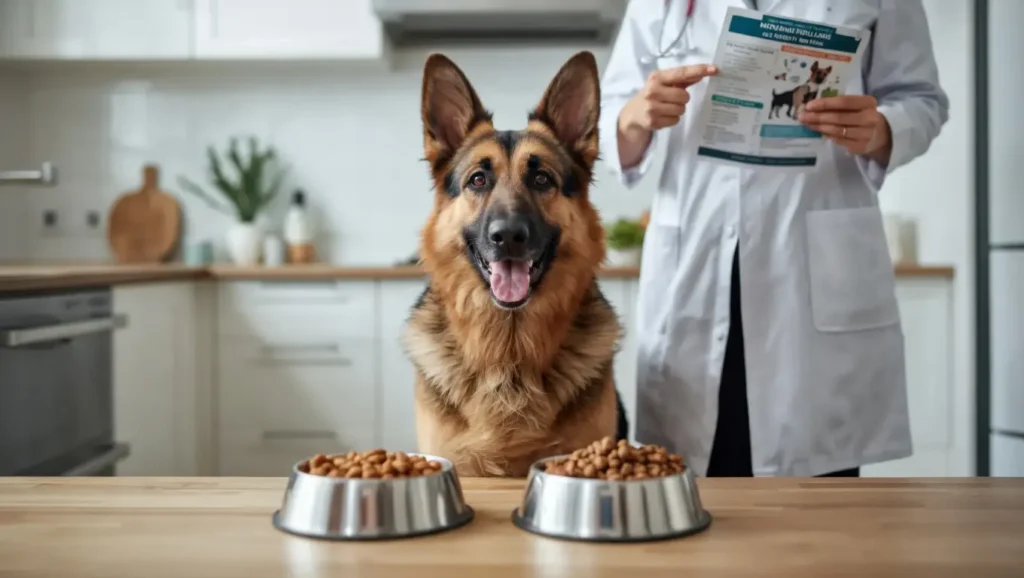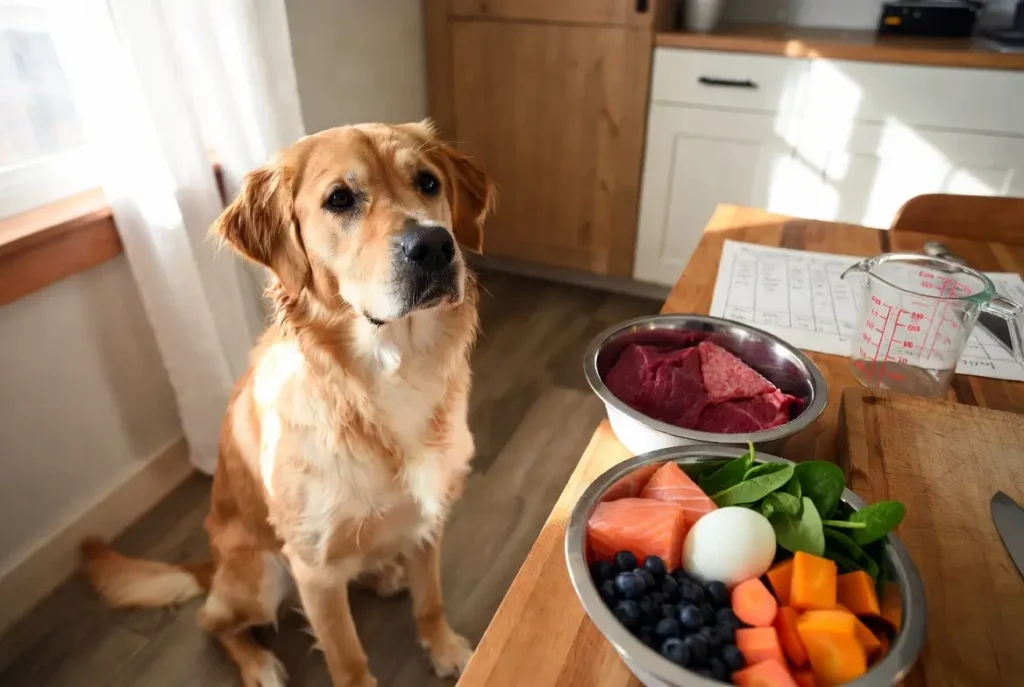


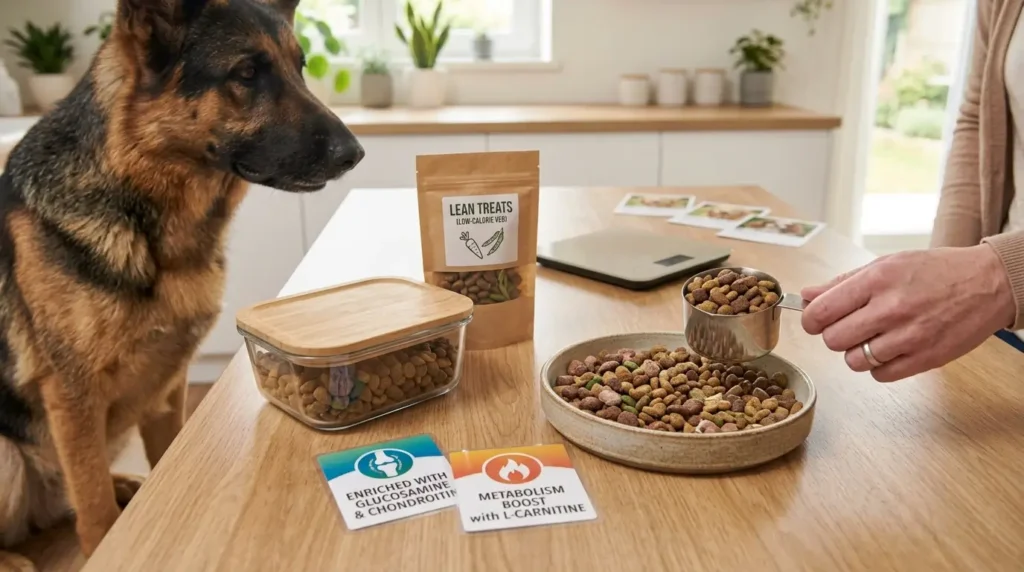
The best foods to help a dog gain weight are complete, calorie-dense diets that provide enough protein, fat, vitamins, and minerals to support gradual increases in body weight and muscle condition. Simply adding fatty table foods is not a safe substitute for balanced nutrition.
Before increasing calories, determine why the dog is underweight. The American Animal Hospital Association (AAHA) considers a body condition score below 4/9, muscle loss, or unexplained weight change a nutritional risk factor that warrants further assessment.
Healthy weight gain should therefore focus on two goals: finding the reason for low weight and increasing calorie intake in a controlled way.
How Can You Tell if a Dog Is Underweight?
An underweight dog usually has easily visible or palpable ribs, reduced fat cover, a pronounced waist, and an exaggerated abdominal tuck.
Veterinarians commonly use a 9-point body condition score (BCS) to assess body fat.
On this scale:
- 1/9: Severely underweight
- 2/9: Very thin
- 3/9: Underweight
- 4–5/9: Generally considered ideal
- 6–7/9: Overweight
- 8–9/9: Obese
Merck Veterinary Manual notes that body condition scoring evaluates fat over the ribs, waist, abdomen, and tail base.
Body condition is only part of the assessment.
A dog can maintain body fat while losing muscle. Veterinarians therefore also use a muscle condition score (MCS) to identify muscle loss.
Why Is a Dog Losing Weight?
Dogs lose weight when calorie intake is too low, calorie requirements increase, nutrients are poorly absorbed, or disease interferes with normal metabolism.
Possible causes include:
- Insufficient food intake
- Highly active lifestyles
- Poor-quality or inappropriate diets
- Dental pain
- Vomiting or diarrhea
- Intestinal parasites
- Chronic gastrointestinal disease
- Diabetes mellitus
- Kidney disease
- Liver disease
- Cancer
- Pregnancy or lactation
- Age-related muscle loss
- Stress or environmental changes
AAHA recommends an extended nutritional assessment for dogs with unexplained weight loss, a BCS below 4/9, or evidence of muscle wasting.
Unexpected weight loss should not automatically be treated by simply increasing food.
When Should an Underweight Dog See a Veterinarian?
A dog with unexplained, rapid, or continuing weight loss should receive veterinary assessment before starting a high-calorie feeding plan.
Seek veterinary advice when weight loss occurs with:
- Vomiting
- Persistent diarrhea
- Increased thirst
- Increased urination
- Reduced appetite
- Difficulty chewing
- Weakness
- Muscle loss
- Coughing
- Abdominal enlargement
- Blood in stool
- Changes in behavior
A dog eating large portions but continuing to lose weight also needs investigation.
Increasing calories cannot correct an untreated condition that prevents digestion, absorption, or normal nutrient use.
What Are the Best Foods for Helping a Dog Gain Weight?
The most useful foods for weight gain are calorie-dense complete dog foods, energy-rich wet foods, balanced growth diets when appropriate, and carefully selected supplemental foods.
The following options can increase calorie intake without relying heavily on nutritionally incomplete table food.
1. Calorie-Dense Complete Dog Food
A complete dog food with more calories per cup allows a dog to consume additional energy without requiring a dramatically larger food volume.
Calorie density is particularly useful for dogs that:
- Eat small meals
- Become full quickly
- Have high activity levels
- Need to regain weight after illness
- Have difficulty consuming large portions
Pet-food labels provide calorie information as kilocalories per kilogram and usually per cup, can, tray, or other familiar serving unit.
For example, consider two dry foods:
| Food | Calories per cup | Calories from 2 cups |
| Food A | 320 kcal | 640 kcal |
| Food B | 450 kcal | 900 kcal |
Food B supplies 260 more calories from the same two-cup volume.
That does not automatically make Food B better. Protein quality, fat content, digestibility, life stage, and nutritional adequacy still matter when choosing the best dog food for healthy weight gain.
2. Higher-Protein Dog Food
Adequate dietary protein supports maintenance and rebuilding of lean body tissue during weight gain.
Healthy weight gain should not consist exclusively of accumulating body fat.
Protein supplies amino acids used for:
- Skeletal muscle
- Enzymes
- Hormones
- Immune proteins
- Skin
- Hair
- Tissue repair
A dog that has lost both weight and muscle may require particular attention to protein intake.
Muscle condition is especially important in senior dogs because aging can reduce lean body mass even when body weight appears relatively stable.
3. Moderately Higher-Fat Dog Food
Dietary fat increases calorie density because fat provides more energy per gram than protein or carbohydrate.
This makes fat an efficient way to increase the energy concentration of dog food.
However, adding large quantities of butter, bacon grease, cooking oil, or fatty meat scraps is not a controlled weight-gain strategy.
A properly formulated higher-energy dog food is preferable because calories are provided alongside:
- Protein
- Essential fatty acids
- Vitamins
- Minerals
- Amino acids
Dogs with certain gastrointestinal disorders or a history of pancreatitis may require controlled dietary fat, so high-fat feeding is not appropriate for every underweight dog.
4. Wet Dog Food
Wet dog food can help some underweight dogs eat more because its aroma, texture, and moisture may increase palatability.
Wet food may be useful for dogs with:
- Reduced appetite
- Dental limitations
- Preference for softer food
- Difficulty eating dry kibble
Calorie density varies considerably between canned foods.
Some wet foods contain fewer calories per gram because of their high moisture content, while others are formulated to provide substantial energy.
Check calories per can or tray rather than assuming every canned food is high in calories. Portion size and meal frequency also matter when using wet dog food as part of a weight-gain plan.
5. Complete Fresh Dog Food
Complete fresh diets can support weight gain when their calorie content and portion size provide more energy than the dog currently consumes.
Fresh dog foods often contain combinations of:
- Meat
- Organ meat
- Carbohydrate sources
- Vegetables
- Added fats
- Vitamin and mineral supplements
The word “fresh” does not guarantee nutritional adequacy.
Check that the food is intended for complete feeding rather than supplemental use.
6. Appropriate Growth Diets
Growth diets are generally more nutrient- and energy-dense than adult maintenance foods, but they should only be used when appropriate for the dog’s life stage or veterinary plan.
Puppies need diets formulated specifically for growth.
Pregnant and lactating dogs also have substantially increased energy requirements.
Merck notes that puppies should continue receiving a complete and balanced growth diet until skeletal maturity. Large and giant breeds can continue developing for approximately 10–16 months.
Adult dogs should not automatically be switched to puppy food simply because they are thin.
The nutritional profile must match the individual dog’s needs.
7. Chicken as a Supplemental Food
Plain cooked chicken can provide additional protein and calories when it is used as a small supplement rather than as a replacement for complete dog food.
Use:
- Skinless cooked chicken
- Unseasoned chicken
- Boneless pieces
Avoid:
- Onion
- Garlic
- Heavy seasoning
- Fried chicken
- Cooked bones
Chicken alone is not nutritionally complete.
Using large quantities can dilute the vitamins and minerals supplied by the dog’s balanced main food.
8. Eggs
Plain cooked eggs provide protein and fat and can add calories to the diet in controlled amounts.
Eggs can be:
- Boiled
- Scrambled without butter
- Cooked without seasoning
Eggs contain high-quality protein and several micronutrients.
However, eggs should remain supplemental when the dog’s primary diet is already complete and balanced.
Dogs with food allergies or specific medical restrictions may not be suitable candidates.
9. Chicken Liver in Small Amounts
Chicken liver can add protein, calories, and concentrated micronutrients, but it requires stricter portion control than ordinary muscle meat.
Liver contains high concentrations of vitamin A and minerals.
Small amounts may improve food palatability for some dogs, but feeding large quantities repeatedly can unbalance the diet.
The nutritional benefits and limits of chicken liver dog food are particularly relevant when liver is being considered as a calorie-rich topper.
Chicken liver should not become the primary food used for weight gain.
10. Beef and Other Cooked Lean Meats
Plain cooked meat can provide supplemental protein and calories when portions remain controlled.
Possible choices include:
- Lean ground beef
- Turkey
- Chicken
- Pork prepared safely and thoroughly
Remove bones and avoid heavily seasoned preparations.
Very fatty cuts can substantially increase calorie intake but may also cause digestive upset in susceptible dogs.
Balanced commercial food should remain the primary nutrient source unless a home-prepared recipe has been formulated by a veterinary nutrition professional.
11. Rice With a Complete Protein Source
Cooked rice can add digestible carbohydrate and calories, but rice alone is not an appropriate weight-gain diet.
Rice provides energy but does not supply the complete amino acid, fatty acid, vitamin, and mineral profile dogs require.
A bowl containing only chicken and rice may be used in specific short-term feeding situations, but it is not automatically nutritionally balanced for long-term weight gain.
12. Commercial High-Calorie Veterinary Diets
Therapeutic recovery diets can provide concentrated calories and nutrients for dogs recovering from illness, surgery, or significant nutritional compromise.
These products are often:
- Energy dense
- Highly palatable
- Soft textured
- Nutritionally concentrated
They are typically used under veterinary direction.
A dog recovering from significant illness may have different nutritional needs from a healthy but naturally lean dog.
Should You Add Oil to Dog Food for Weight Gain?
Adding oil increases calories quickly, but using a properly formulated energy-dense food is usually more nutritionally controlled than pouring additional oil over meals.
Fat provides approximately 9 kcal per gram, compared with about 4 kcal per gram from protein or carbohydrate.
This explains why even a small amount of oil can substantially increase meal calories.
However, excessive added fat can:
- Cause diarrhea
- Reduce nutrient balance
- Increase total calories too rapidly
- Be inappropriate for dogs with fat-sensitive conditions
Added oil also supplies calories without the full nutrient profile found in complete dog food.
Is Peanut Butter Good for Helping Dogs Gain Weight?
Peanut butter contains substantial calories and fat, but it is better treated as an occasional food than as a primary weight-gain strategy.
Choose only products without xylitol, an artificial sweetener that is highly toxic to dogs.
Peanut butter also contributes many calories in a small serving, making accidental overfeeding easy.
Complete dog food remains a more balanced way to increase energy intake.
Should You Feed an Underweight Dog More Often?
Dividing the daily food allowance into 3 or 4 smaller meals can help some underweight dogs consume more calories comfortably.
Smaller meals can be useful when a dog:
- Has a limited appetite
- Becomes full quickly
- Is recovering from illness
- Struggles with large meals
For example, a daily portion of 3 cups could be divided into:
- 1 cup in the morning
- 1 cup in the afternoon
- 1 cup in the evening
Increasing meal frequency does not automatically increase calories.
The total daily amount still needs to be calculated and monitored.
How Many Calories Does a Dog Need to Gain Weight?
Calorie needs vary substantially among dogs, so calculated energy requirements provide a starting estimate rather than an exact feeding prescription.
Resting energy requirement (RER) is commonly estimated as:
RER = 70 × body weight in kilograms^0.75
Maintenance energy requirement then adjusts this figure according to factors such as:
- Age
- Neuter status
- Activity
- Growth
- Pregnancy
- Lactation
AAHA provides these calculations as starting points and recommends adjusting intake according to changes in body weight and condition.
Merck notes that two dogs of the same weight can differ in calorie requirements by approximately 30% above or below a calculated estimate.
For that reason, an online dog feeding calculator can provide an initial calorie estimate, but regular weighing and body-condition assessment are needed to determine whether the amount is working.
How Fast Should a Dog Gain Weight?
A dog should gain weight gradually enough to allow body condition, muscle condition, digestive tolerance, and overall health to be monitored.
There is no single ideal weekly rate for every underweight dog.
The correct pace depends on:
- Starting body condition
- Degree of muscle loss
- Age
- Underlying disease
- Activity
- Calorie intake
- Recovery status
Severely malnourished dogs require particularly careful nutritional management.
Rapidly feeding large quantities of calorie-rich food is not appropriate for every thin dog.
How Can You Increase a Dog’s Calories Safely?
Increase calories by measuring the current intake, selecting an appropriate energy-dense food, and adjusting portions according to weight and body-condition changes.
A practical approach includes:
- Record the current food intake. Include kibble, canned food, treats, toppers, chews, and table food.
- Check calories per serving. Use kcal per cup, can, tray, or gram from the food label.
- Assess body condition. Determine whether the dog is genuinely underweight.
- Increase calories gradually. Avoid sudden large dietary changes.
- Use complete food for most calories. Supplements should remain secondary.
- Weigh the dog regularly. Look for a consistent trend rather than daily fluctuations.
- Monitor stool and appetite. Reduce rapid changes if digestive problems develop.
- Reassess the plan. Persistent failure to gain requires veterinary investigation.
Should Treats Be Used to Help a Dog Gain Weight?
Treats can add calories, but relying on large quantities of treats can reduce the nutritional quality of the overall diet.
AAHA considers calories from foods that are not complete and balanced exceeding 10% of total calorie intake a nutritional risk factor.
That includes:
- Treats
- Table food
- Chews
- Foods used to give medication
Most additional calories should therefore come from nutritionally complete food.
Is Homemade Dog Food Good for Weight Gain?
Homemade dog food can support weight gain only when the recipe is nutritionally complete and provides an appropriate number of calories.
Adding more meat, rice, eggs, or oil does not guarantee nutritional balance.
Long-term homemade diets can be deficient or excessive in nutrients such as:
- Calcium
- Phosphorus
- Zinc
- Copper
- Iodine
- Essential fatty acids
- Vitamins
A homemade recipe used as the primary diet is best formulated specifically for the dog rather than assembled from high-calorie ingredients alone.
Can Senior Dogs Gain Weight Safely?
Senior dogs can gain weight safely, but unexplained weight or muscle loss in an older dog warrants particular attention.
AAHA notes that senior dogs can experience changes in body weight and muscle condition because of aging or disease.
A senior dog may need:
- More palatable food
- Adjusted calorie density
- Adequate protein
- Softer texture
- Smaller frequent meals
However, simply adding body fat does not correct age-related muscle loss.
Monitoring both BCS and muscle condition is important.
Can Puppies Be Fed Extra Food to Gain Weight?
Thin puppies require enough calories for normal growth, but intentionally accelerating growth through excessive feeding is not desirable.
Puppy nutrition should support steady development.
Large and giant-breed puppies require particular attention because excessive energy intake can accelerate growth and contribute to orthopedic problems.
Use a complete food formulated for the appropriate growth stage and adjust the amount according to growth rate and veterinary assessment.
What Foods Should You Avoid When Trying to Make a Dog Gain Weight?
Avoid using unsafe foods, excessive fat, or nutritionally incomplete meals as the main method of increasing body weight.
Foods and feeding practices to avoid include:
- Chocolate
- Grapes and raisins
- Xylitol-containing foods
- Onion
- Garlic
- Alcohol
- Cooked bones
- Large amounts of fatty table scraps
- Excessive butter or grease
- Unbalanced meat-only diets
- Excessive liver
- Large quantities of treats
Healthy weight gain requires complete nutrition, not simply the maximum number of calories possible.
Can Too Much Weight Gain Become a Problem?
Yes. Continuing a calorie surplus after a dog reaches an appropriate body condition can result in overweight or obesity.
The feeding plan therefore needs to change as the dog approaches its target condition.
Merck describes an ideal dog as having ribs that are easily felt with slight fat cover, a visible waist, and an abdominal tuck.
Once those features are restored, continued high-calorie feeding can become counterproductive.
The health consequences associated with obesity in dogs are why weight-gain plans need an endpoint rather than unlimited feeding.
How Do You Choose a High-Calorie Dog Food?
Choose high-calorie dog food by comparing calorie density, protein, fat, life-stage suitability, nutritional adequacy, and the dog’s medical needs.
Check these 5 features:
1. Calories Per Cup or Can
Higher numbers indicate greater energy density.
Compare products using the same unit.
2. Complete and Balanced Statement
Most calories should come from food formulated to meet the dog’s complete nutritional requirements.
3. Protein Content
Adequate protein is important for supporting lean tissue.
4. Fat Content
Fat contributes substantial energy but needs to suit the dog’s digestive and medical status.
5. Feeding Directions
Use manufacturer directions as an initial reference rather than a fixed rule.
Merck emphasizes that feeding instructions are general recommendations. Body weight and body condition still need monitoring.
Frequently Asked Questions
What is the best food to help a dog gain weight?
A calorie-dense, complete and balanced dog food that provides adequate protein and fat is usually the best nutritional foundation for healthy weight gain.
The specific food depends on life stage, health, appetite, and calorie needs.
How can I fatten up my dog quickly?
Rapid fat gain is not the goal; controlled increases in calories combined with monitoring of body and muscle condition are safer.
Unexpected low weight should also be investigated.
What human foods help dogs gain weight?
Plain cooked chicken, eggs, lean beef, and small amounts of other safe foods can add calories, but they should remain supplements rather than replace complete dog food.
Are eggs good for weight gain in dogs?
Cooked eggs can provide additional protein, fat, and calories when offered in controlled portions.
Avoid heavily seasoned or butter-rich preparations.
Is wet food good for an underweight dog?
Wet food can help when its palatability encourages greater food intake, but calorie density varies substantially among products.
Check calories per can or tray.
Does puppy food help adult dogs gain weight?
Puppy food is often more energy dense, but it is formulated for growth and is not automatically appropriate for an underweight adult dog.
Ask a veterinarian before using a growth diet for an adult.
Why is my dog skinny even though it eats a lot?
Weight loss despite a good or increased appetite can occur with parasites, gastrointestinal disease, metabolic disorders, and other medical conditions.
Veterinary assessment is appropriate when the pattern persists.
How many times a day should an underweight dog eat?
Three or four smaller meals can help some underweight dogs consume sufficient calories more comfortably than one or two large meals.
Total daily calories remain the key factor.
Can I add oil to my dog’s food to increase weight?
Oil adds calories efficiently, but excessive fat can cause digestive problems and may not be suitable for dogs with certain medical conditions.
A calorie-dense complete food is generally a more balanced approach.
Final Takeaway
The best foods to help a dog gain weight are complete, calorie-dense diets that provide sufficient protein, fat, vitamins, and minerals while supporting gradual improvement in both body condition and muscle condition.
High-calorie dog food, appropriate wet food, cooked eggs, plain meats, and small quantities of nutrient-rich toppers can increase calorie intake. Supplemental foods should remain secondary because they do not provide the complete nutritional balance of a properly formulated diet.
More calories are not always the first solution. A body condition score below 4/9, muscle wasting, or unexplained weight loss can indicate a nutritional or medical problem that requires further assessment.
For a healthy but lean dog, measure current intake, compare calorie density, increase food gradually, divide meals when helpful, and monitor body weight consistently. Once an ideal body condition is reached, calorie intake should be adjusted again to prevent healthy weight gain from progressing into excess weight.