


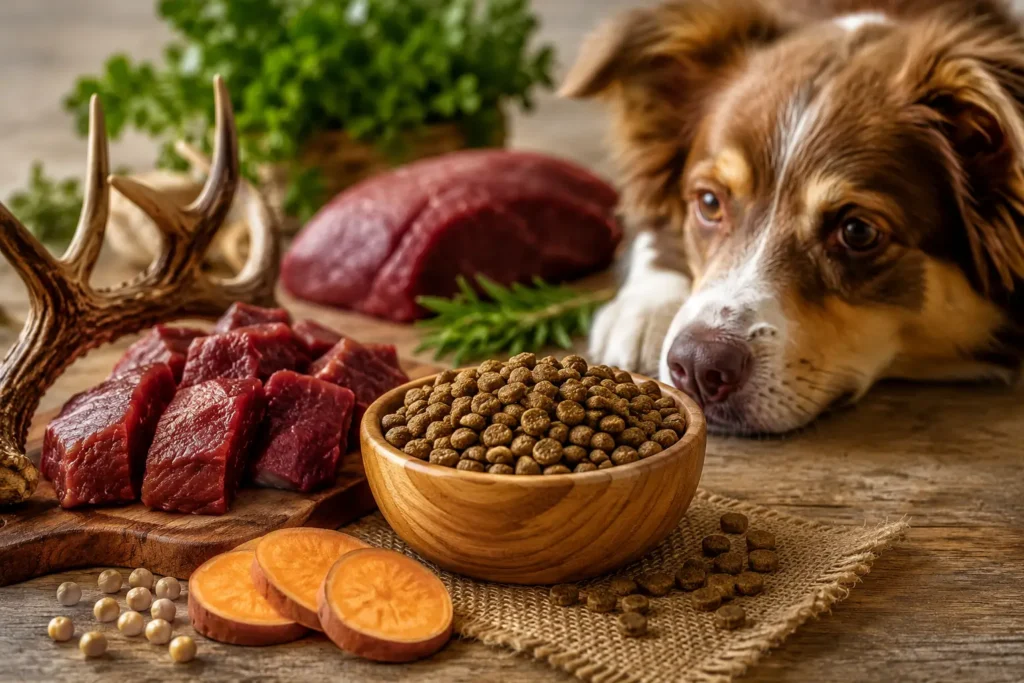
Beef heart dog food provides animal protein, iron, B vitamins, phosphorus, potassium, zinc and copper when beef heart forms part of a complete canine diet. Beef heart is nutrient-dense, but plain beef heart does not provide complete and balanced nutrition by itself.
Beef heart appears in commercial dog food, homemade diets, fresh food, freeze-dried products, raw diets and single-ingredient treats. The nutritional effect depends on how much beef heart a dog eats, how it is prepared and what nutrients come from the rest of the diet.
Beef heart also requires an important distinction. The heart is anatomically an organ, but much of its edible structure consists of cardiac muscle. Its nutrient profile therefore differs substantially from liver, kidney and other organ tissues.
This guide examines beef heart nutrition for dogs, feeding amounts, beef heart versus liver, raw versus cooked heart, puppies, kidney disease, food allergies, homemade diets and commercial beef heart dog food.
What Is Beef Heart Dog Food?
Beef heart dog food is canine food, a topper or a treat containing heart tissue from cattle as an animal-derived ingredient.
Beef heart can appear in at least 6 forms:
- Complete dry dog food
- Complete wet dog food
- Fresh or gently cooked dog food
- Raw meat-based dog food
- Freeze-dried or dehydrated beef heart
- Homemade dog food
These products are not nutritionally equivalent.
A commercial food can serve as the primary diet when its label establishes nutritional adequacy for the dog’s life stage. A beef-heart treat or topper does not automatically provide all required nutrients.
The AAFCO nutritional adequacy statement identifies whether a product is complete and balanced and specifies the life stage for which it is intended. AAFCO defines “complete” as containing all required nutrients and “balanced” as providing those nutrients in appropriate proportions.
A complete beef-heart formula also needs the correct life-stage statement, calorie density and nutrient balance, which are central factors when deciding how to choose the best dog food for an individual dog.
Is Beef Heart Good for Dogs?
Beef heart can be a nutritious ingredient for healthy dogs because it supplies substantial protein together with iron, zinc, B vitamins and other minerals while containing relatively little fat in trimmed raw tissue.
A 2024 peer-reviewed nutrient analysis of U.S. beef offal examined heart, liver, kidney, tongue and several other beef tissues. Testing took place in USDA Agricultural Research Service-approved laboratories using validated analytical methods.
The researchers measured approximately:
- 17.48 g protein per 100 g
- 3.21 g total fat per 100 g
- 78.70 g moisture per 100 g
- 1.19 g ash per 100 g
- 116 mg cholesterol per 100 g
These measurements apply to raw separable lean beef-heart tissue. They do not represent a recommended feeding amount for a dog.
That distinction is important.
Nutrient composition describes what beef heart contains. Feeding guidance determines how much fits into an individual dog’s complete diet.
What Nutrients Are in Beef Heart?
Beef heart contains protein plus iron, phosphorus, potassium, magnesium, sodium, zinc, copper and several B vitamins.
The following table uses values from the 2024 laboratory analysis of raw U.S. beef offal.
| Nutrient | Amount per 100 g raw beef heart |
| Protein | 17.48 g |
| Total fat | 3.21 g |
| Moisture | 78.70 g |
| Ash | 1.19 g |
| Cholesterol | 116 mg |
| Calcium | 4.32 mg |
| Copper | 0.37 mg |
| Iron | 4.64 mg |
| Magnesium | 22.33 mg |
| Phosphorus | 200 mg |
| Potassium | 261 mg |
| Sodium | 95.13 mg |
| Zinc | 1.80 mg |
The researchers also measured several B vitamins and classified beef heart as an excellent source of protein, riboflavin, niacin, vitamin B12 and iron under U.S. human-food nutrient-label criteria. Beef heart qualified as a good source of pantothenic acid, vitamin B6, copper and zinc under those same criteria.
Those classifications describe human FDA nutrient-label thresholds, not canine feeding requirements.
Why Do Beef Heart Nutrition Values Differ Between Sources?
Beef-heart nutrition values differ because cattle, trimming practices, laboratory methods, tissue composition and moisture content vary between datasets.
The 2024 study measured separable lean tissue. A retail beef heart may retain more exterior fat or connective tissue.
Cooking changes the comparison further because water is lost during heating. Freeze-drying removes even more water. As moisture declines, nutrients and calories become more concentrated per gram.
For this reason, comparing 100 g of raw heart with 100 g of dehydrated heart is misleading.
The nutrient values in this article use one primary dataset consistently rather than combining several databases.
Is Beef Heart an Organ Meat or Muscle Meat?
Beef heart is anatomically an organ, but the heart wall consists largely of specialized cardiac muscle tissue.
This distinction explains why heart does not have the same nutritional profile as liver.
In practical feeding discussions, heart is often grouped with organ meats because it is an internal organ. Nutritionally, however, its composition is closer to muscular tissue for several nutrients than highly concentrated organs such as liver.
The terms therefore describe different attributes:
- Organ describes anatomy.
- Cardiac muscle describes tissue type.
- Nutrient profile describes chemical composition.
These categories are connected but not interchangeable.
Is Beef Heart the Same as Beef Liver for Dogs?
No. Beef heart and beef liver contain substantially different concentrations of several nutrients and should not be treated as gram-for-gram substitutes.
The 2024 analysis provides a direct comparison.
| Nutrient per 100 g | Beef heart | Beef liver |
| Protein | 17.48 g | 19.57 g |
| Total fat | 3.21 g | 4.50 g |
| Iron | 4.64 mg | 5.15 mg |
| Zinc | 1.80 mg | 3.89 mg |
| Copper | 0.37 mg | 11.95 mg |
| Phosphorus | 200 mg | 355 mg |
The largest difference is copper. Beef liver contained approximately 11.95 mg copper per 100 g, compared with 0.37 mg in beef heart. Liver therefore contained about 32 times more copper in these samples.
This difference matters when formulating homemade dog food.
Beef heart also differs from chicken liver for dogs because liver supplies a different concentration of micronutrients and requires separate portion control.
What Are the Main Nutritional Benefits of Beef Heart for Dogs?
The nutritional value of beef heart comes primarily from animal protein, iron, B vitamins and essential minerals.
Does Beef Heart Provide Protein?
Yes. Raw separable beef heart contained 17.48 g of protein per 100 g in the 2024 analysis.
Protein supplies amino acids used to maintain muscles, enzymes, structural proteins and numerous metabolic functions.
A high protein number alone does not make a food nutritionally complete. Dogs require an appropriate balance of amino acids, fats, vitamins and minerals in relation to calorie intake.
Does Beef Heart Contain Iron?
Yes. Raw beef heart contained approximately 4.64 mg iron per 100 g.
Iron participates in oxygen transport and multiple enzyme systems. Beef heart therefore contributes dietary iron as part of its overall nutrient profile.
A dog diagnosed with anemia still requires veterinary investigation because anemia has multiple causes. Feeding additional beef heart does not identify or treat the underlying cause.
Does Beef Heart Contain Zinc?
Yes. Raw beef heart contained approximately 1.80 mg zinc per 100 g.
Zinc participates in enzyme activity, skin function, protein metabolism and other physiological processes. The dog’s overall zinc intake depends on the entire diet rather than one meat ingredient.
Does Beef Heart Contain Copper?
Yes. Beef heart contains copper, although considerably less than beef liver in the analyzed samples.
Beef heart contained approximately 0.37 mg copper per 100 g. Beef liver contained approximately 11.95 mg.
This illustrates why the broad phrase “organ meat” does not describe one uniform nutrient profile.
Does Beef Heart Contain Taurine?
Beef and other animal tissues can contain taurine, but the 2024 beef-heart study did not measure taurine and therefore cannot support a precise taurine value for beef heart.
This distinction prevents a common nutritional overstatement.
Dogs also differ from cats in taurine metabolism. The Tufts Cummings School of Veterinary Medicine guidance on canine heart nutrition explains that dogs generally synthesize taurine when adequate amounts of the precursor amino acids methionine and cysteine are available. Certain breeds and dietary circumstances can increase the risk of low taurine status.
Beef heart therefore should not be promoted as a treatment for taurine deficiency.
A dog with suspected taurine deficiency or dilated cardiomyopathy requires veterinary assessment.
Is Beef Heart Good for a Dog’s Heart?
Beef heart is a nutritious animal tissue, but eating beef heart has not been established as a treatment or preventive therapy for canine heart disease.
The anatomical origin of a food does not prove that it therapeutically benefits the same organ in the animal eating it.
For example, beef heart contains compounds associated with energy metabolism, including CoQ10. However, Tufts veterinary cardiology notes that definitive studies evaluating CoQ10 in dogs or cats with heart disease are lacking.
The evidence therefore supports 2 separate statements:
- Beef heart contains nutritionally useful compounds.
- Beef heart has not been established as a cardiac treatment.
Those statements should not be combined into an unsupported health claim.
Is Beef Heart a Complete and Balanced Dog Food?
No. Plain beef heart does not provide all nutrients required for long-term canine nutrition in appropriate quantities and ratios.
AAFCO reports that its dog nutrient profiles include 37 nutritional parameters, with different requirements and ratios according to life stage.
A complete food must account for the whole nutrient system rather than simply containing protein-rich ingredients.
The FDA also explains that a pet food carrying a complete and balanced nutritional statement is intended to provide the nutritional profile required for use as the sole diet, while most treats and supplements are not.
Beef heart can therefore function as:
- An ingredient in complete commercial dog food
- Part of a professionally formulated homemade recipe
- A controlled meal topper
- A training or recreational treat
Plain beef heart should not become the entire diet.
Can Beef Heart Be Used in Homemade Dog Food?
Yes. Beef heart can be used in homemade dog food when the complete recipe has been formulated to meet the dog’s nutritional requirements.
Recipe balance is more important than whether every individual ingredient sounds nutritious.
A University of California, Davis analysis evaluated 200 homemade dog-food recipes. Only 9 of 200 met all AAFCO minimum nutrient standards for adult dogs, while 5 of 200 met the National Research Council minimum requirements.
The study demonstrates why meat, vegetables, grains and supplements cannot safely be combined by intuition alone.
Beef heart can be included in homemade dog food, but the complete recipe still requires balanced calcium, phosphorus, vitamins, trace minerals and essential fatty acids.
Beef heart can be useful within such a formulation. It does not make an otherwise incomplete recipe balanced.
Can Beef Heart Replace Regular Beef in Homemade Dog Food?
Do not replace another meat with beef heart gram-for-gram in a balanced recipe unless the formulation is recalculated.
Ingredient substitutions change:
- Protein
- Fat
- Calories
- Phosphorus
- Iron
- Copper
- Zinc
- Moisture
- Amino-acid contribution
- Vitamin concentrations
A formulated recipe works because the nutrients from several ingredients complement one another.
Changing one ingredient can alter those relationships even when the replacement ingredient is nutritious.
How Much Beef Heart Can a Dog Eat?
The appropriate amount of beef heart depends on the dog’s calorie requirement and whether beef heart is part of a balanced recipe or an extra treat.
When beef heart is used as a topper or treat, WSAVA treat-feeding guidance recommends keeping all treats combined at no more than about 10% of daily calories for an average healthy adult dog in ideal body condition.
WSAVA provides the following examples:
| Dog weight | Maximum calories from all treats/day |
| 2 kg | 14 kcal |
| 4 kg | 24 kcal |
| 6 kg | 32 kcal |
| 8 kg | 40 kcal |
| 10 kg | 47 kcal |
| 15 kg | 64 kcal |
| 20 kg | 79 kcal |
| 25 kg | 94 kcal |
| 30 kg | 108 kcal |
| 35 kg | 121 kcal |
| 40 kg | 134 kcal |
| 45 kg | 146 kcal |
These numbers are total treat calories, not recommended beef-heart calories.
Daily energy requirements vary with body weight, age and activity, so a dog food calculator can provide a calorie starting point before the 10% treat allowance is calculated.
Why Is There No Universal Beef Heart Serving Size?
A universal serving size is unreliable because dogs and beef-heart products vary substantially.
Four variables change the amount:
- Dog body weight
- Daily energy expenditure
- Preparation method
- Calorie density of the product
Fresh heart contains substantial water.
Cooked heart loses water.
Dehydrated and freeze-dried heart contains much less water.
Therefore, 20 g fresh beef heart and 20 g freeze-dried beef heart do not provide equivalent amounts of food or calories.
Commercial products should be portioned according to their calorie declaration rather than visual size alone.
Can Dogs Eat Beef Heart Every Day?
Dogs can eat beef heart regularly when its quantity remains compatible with the nutritional balance and calorie content of the complete diet.
The word “daily” does not establish whether feeding is safe.
A dog receiving 5 g as part of a balanced diet presents a different nutritional situation from a dog receiving several hundred grams of plain heart every day.
Evaluate:
- Total daily calories
- Quantity of complete dog food
- Other treats
- Body condition
- Life stage
- Medical conditions
- Medication
- Therapeutic diet restrictions
Amount and dietary context matter more than frequency alone.
Can Dogs Eat Raw Beef Heart?
Raw beef heart introduces microbiological risks because it has not undergone a pathogen-reducing cooking step.
The FDA raw pet food safety investigation analyzed 196 commercial raw dog and cat food samples.
The FDA detected:
- Salmonella in 15 samples — 7.7%
- Listeria monocytogenes in 32 samples — 16.3%
The FDA concluded that raw pet food was more likely than several other tested pet-food types to contain disease-causing bacteria.
Raw food can also contaminate:
- Hands
- Cutting boards
- Knives
- Bowls
- Worktops
- Refrigerators
- Floors
- Other foods
The same pathogen and nutrient-balance concerns apply to raw food diets for dogs that combine uncooked heart with other meats, organs or bones.
Is Cooked Beef Heart Safer Than Raw Beef Heart?
Cooking provides a direct pathogen-reduction step that raw beef heart does not provide.
The USDA Food Safety and Inspection Service guidance for beef heart recommends cooking heart and other beef organ or variety meats to an internal temperature of 160°F or 71.1°C.
Use a food thermometer in the thickest part.
Color alone does not reliably establish internal temperature.
How Do You Cook Beef Heart for Dogs?
Cook beef heart plain until the center reaches at least 160°F/71.1°C, cool it and divide it into portions appropriate for the dog’s diet.
Use the following 7-step method:
- Trim excess exterior fat.
- Remove very tough connective tissue where practical.
- Cut the heart into evenly sized pieces.
- Cook without sauces or seasoning mixes.
- Check the thickest piece with a food thermometer.
- Reach at least 160°F/71.1°C internally.
- Cool before feeding.
Do not season beef heart with onion, garlic, leeks or shallots. WSAVA identifies these foods among ingredients that are unsafe for dogs.
Is Freeze-Dried Beef Heart Good for Dogs?
Freeze-dried beef heart can serve as a concentrated treat or topper, but the label determines whether the product is complete food or supplemental food.
Freeze-drying removes water. This makes nutrients and calories more concentrated by weight.
A small dried piece can therefore contain more calories than its size suggests.
Check:
- Calories per piece or gram
- Ingredient list
- Feeding directions
- Nutritional adequacy statement
- Life-stage declaration
- Storage instructions
- Manufacturer contact details
A product containing “100% beef heart” can be a simple single-ingredient treat while still being nutritionally incomplete as a sole diet.
Can Puppies Eat Beef Heart?
Puppies can eat appropriately prepared beef heart when it fits into a complete diet formulated for growth.
Puppies have specific nutrient requirements during skeletal and muscular development. AAFCO recognizes growth separately from adult maintenance because nutrient concentrations and ratios differ by life stage.
Beef heart cannot supply the entire puppy nutrient profile by itself.
Beef heart remains an extra food in a puppy diet; how much to feed a puppy depends on age, body weight, expected adult size and the calorie density of the complete growth diet.
Large-breed puppies require particularly controlled mineral and calorie intake during development.
Can Senior Dogs Eat Beef Heart?
Healthy senior dogs can eat beef heart when the food fits their calorie requirement and medical status.
Age alone does not determine suitability.
One senior dog may remain active with normal kidney function. Another may have chronic kidney disease, pancreatitis, obesity or a therapeutic dietary requirement.
Body condition, laboratory results, activity and existing disease provide more useful feeding information than chronological age alone.
Is Beef Heart Good for Dogs With Kidney Disease?
Beef heart is not automatically appropriate for dogs with chronic kidney disease because beef heart contains phosphorus and may conflict with a phosphorus-restricted renal diet.
Raw beef heart contained approximately 200 mg phosphorus per 100 g in the 2024 analysis.
The International Renal Interest Society guidance for chronic kidney disease identifies dietary phosphorus restriction as an important nutritional modification for dogs and cats with CKD. IRIS also maintains current staging and treatment recommendations for canine CKD.
Adding substantial quantities of beef heart to a veterinary renal diet can change the phosphorus intake the therapeutic food was designed to control.
Dogs with CKD therefore require an individualized feeding decision.
Can Dogs With Beef Allergies Eat Beef Heart?
Dogs with a confirmed beef allergy should not be assumed to tolerate beef heart because beef heart still contains proteins derived from cattle.
The Merck Veterinary Manual guidance on canine food allergy identifies beef among the more common food allergens reported in dogs. Merck also describes a strict elimination diet followed by dietary challenge as the reference method for confirming food allergy.
A beef-heart treat can therefore interfere with an elimination diet.
During a diagnostic food trial, avoid unapproved:
- Treats
- Toppers
- Table scraps
- Flavored supplements
- Flavored medications
- Chews containing excluded proteins
Ingredient consistency is essential during an elimination trial.
Can Beef Heart Cause Diarrhea?
Beef heart can contribute to digestive upset when introduced abruptly, fed in a large quantity or poorly tolerated by an individual dog.
Possible signs include:
- Soft stool
- Diarrhea
- Vomiting
- Increased gas
- Reduced appetite
Introduce a new food in a small amount rather than replacing a substantial portion of the regular meal immediately.
Introduce beef heart gradually because abrupt food changes can affect stool quality and dog gut health, particularly in dogs with an existing sensitive digestive tract.
Persistent vomiting, repeated diarrhea, blood in stool, abdominal pain, marked lethargy or dehydration requires veterinary attention.
What About Beef Heart for Dogs With Pancreatitis?
Dogs with pancreatitis or clinically important fat intolerance require an individualized dietary fat target rather than assuming every trimmed meat is suitable.
Raw separable beef heart measured only 3.21% fat in the 2024 study, but the fat content of an actual serving changes with trimming and preparation. Dried products can also concentrate nutrients by weight.
Dogs requiring strict fat control are better managed according to the nutrient content of the complete diet.
| Dogs with pancreatitis often require carefully controlled dietary fat, making low-fat foods for dogs with pancreatitis more relevant than choosing beef heart simply because trimmed raw heart appears relatively lean. |
How Do You Choose Commercial Beef Heart Dog Food?
Choose beef heart dog food by evaluating the complete formulation rather than assuming a product is superior because beef heart appears prominently on the package.
There are 6 useful checks.
1. Check Nutritional Adequacy
Find whether the product is complete and balanced or intended only for intermittent or supplemental feeding.
AAFCO describes the nutritional adequacy statement as one of the most important sections of a pet-food label.
2. Match the Life Stage
Choose a formula intended for the dog’s actual life stage.
AAFCO recognizes:
- Growth
- Adult maintenance
- Gestation/lactation
- All life stages
Different life stages require different nutrient quantities and ratios.
3. Read the Ingredient List Correctly
Ingredients are listed in descending order by weight at formulation.
A high position for beef heart indicates greater inclusion by pre-processing weight, but it does not prove that the final food is nutritionally superior.
4. Check Calories
Compare calories with the dog’s energy requirement.
This becomes especially important for:
- Small dogs
- Weight-control diets
- Freeze-dried products
- Training treats
- Dogs receiving several food toppers
5. Distinguish Treats From Complete Food
A beef-heart treat does not become a complete diet because it contains a nutritious animal ingredient.
AAFCO notes that treats are generally not required to meet complete nutritional adequacy standards when clearly labeled as snacks or treats.
6. Consider the Complete Feeding Pattern
Evaluate everything the dog eats during the day.
That includes:
- Primary food
- Beef-heart treats
- Dental chews
- Training rewards
- Table food
- Supplements
- Other toppers
A balanced primary diet can become less balanced when large quantities of extras repeatedly displace it.
What Are the Most Common Beef Heart Feeding Mistakes?
The most common mistakes involve quantity, nutritional substitution and unsupported health assumptions.
There are 8 major errors:
- Feeding beef heart as the entire diet
- Treating heart and liver as nutritionally identical
- Ignoring calories from dried beef-heart treats
- Replacing ingredients in a formulated homemade recipe without recalculation
- Feeding raw heart without considering pathogen exposure
- Adding beef heart to a therapeutic renal diet without checking phosphorus
- Using beef heart during a beef-elimination food trial
- Assuming beef heart treats or prevents canine heart disease
Avoiding these errors allows beef heart to function as an ingredient rather than disrupting the dog’s overall feeding plan.
Beef Heart vs Beef Liver for Dogs
Beef heart is a relatively lean muscular organ, whereas beef liver is a metabolically active organ with much higher concentrations of several micronutrients.
| Attribute | Beef heart | Beef liver |
| Anatomical category | Organ | Organ |
| Major tissue characteristic | Cardiac muscle | Metabolic organ tissue |
| Protein per 100 g | 17.48 g | 19.57 g |
| Fat per 100 g | 3.21 g | 4.50 g |
| Iron per 100 g | 4.64 mg | 5.15 mg |
| Copper per 100 g | 0.37 mg | 11.95 mg |
| Phosphorus per 100 g | 200 mg | 355 mg |
| Nutritionally interchangeable | No | No |
These differences demonstrate why individual animal tissues need ingredient-specific evaluation rather than being grouped under the single term “organ meat.”
Frequently Asked Questions
Can dogs eat beef hearts?
Yes. Dogs can eat beef heart when it is safely prepared and incorporated into an appropriate overall diet.
Is cooked beef heart good for dogs?
Plain cooked beef heart can provide protein, iron and several micronutrients as a treat, topper or formulated ingredient.USDA recommends cooking beef heart to at least 160°F/71.1°C internally.
Can dogs eat raw beef heart?
Raw beef heart introduces greater microbiological risk because it has not undergone a pathogen-reducing cooking step.
Is beef heart high in protein?
Raw lean beef heart contained 17.48 g protein per 100 g in the 2024 U.S. beef-offal analysis.