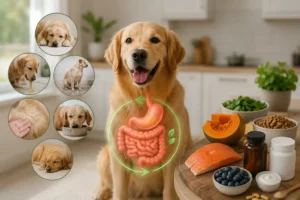

Low purine dog food is primarily used for dogs with urate urinary stones, hereditary hyperuricosuria, or selected disorders of uric-acid metabolism. It reduces dietary purine exposure and is usually combined with increased water intake, urine monitoring, and treatment of the underlying cause.
Low-purine food is not a universal urinary diet. Struvite, calcium oxalate, cystine, urate, and other urinary stones have different causes and nutritional targets.
The stone type should therefore be identified before choosing a therapeutic urinary diet.
What Is Low Purine Dog Food?
Low purine dog food limits ingredients that contribute large amounts of purines while maintaining adequate overall nutrition.
Purines are compounds found in DNA and RNA. When purines are metabolized, uric acid is produced.
Most dogs process uric acid efficiently. Dogs with hereditary hyperuricosuria or certain liver vascular abnormalities can excrete excessive uric acid into the urine, increasing the risk of urate crystals and stones.
UC Davis explains that organ meats contain particularly high concentrations of purines, while dairy and vegetable proteins generally contain much less. Egg-based and cottage-cheese-based protein strategies are therefore commonly used in low-purine nutritional management.
The goal is controlled purine intake, not elimination of all dietary protein.
Which Dogs Need Low Purine Dog Food?
Low purine diets are most appropriate for dogs with confirmed urate urolithiasis, hereditary hyperuricosuria, or certain metabolic disorders that increase uric-acid excretion.
Merck identifies two major causes of canine urate stones:
- inherited hyperuricosuria
- portovascular abnormalities such as portosystemic shunts
A dog with generic urinary signs should not automatically receive a low-purine diet.
Different urinary disorders require different nutritional approaches. The relationship between urine concentration, minerals, pH, and dog food for urinary health depends on the actual diagnosis.
What Are Urate Stones?
Urate stones are urinary calculi composed of uric-acid-related compounds, most commonly ammonium urate in dogs.
Merck identifies urate as the third-most-common type of canine urolith, after struvite and calcium oxalate.
Urate stones can develop because the dog produces or excretes excessive uric acid.
Two important mechanisms are:
- inherited abnormal uric-acid transport
- abnormal liver circulation, particularly portosystemic shunts
The distinction matters because a dog with a liver shunt may require treatment of the vascular abnormality in addition to dietary management.
Why Are Dalmatians Prone to Urate Stones?
Dalmatians have a well-documented hereditary defect in uric-acid transport that causes hyperuricosuria.
Merck identifies a mutation involving the SLC2A9 uric-acid transporter in Dalmatians with hyperuricosuria. The same mutation also occurs in some English Bulldogs and Black Russian Terriers.
UC Davis confirms that hyperuricosuria is inherited as an autosomal recessive trait.
When two carrier dogs are bred:
| Possible puppy genotype | Probability |
| Affected | 25% |
| Carrier | 50% |
| Genetically clear | 25% |
These probabilities apply to each offspring independently.
UC Davis also notes that some affected dogs never develop clinical stones, while others experience recurrent urolithiasis.
Genetic status therefore establishes susceptibility, not the exact clinical course.
Does Every Dalmatian Need a Prescription Low Purine Diet?
Not every Dalmatian automatically requires the same therapeutic food, but affected dogs with previous urate stones often require long-term purine control.
UC Davis states that affected dogs can be maintained on low-purine diets to reduce stone formation and that increased water intake is commonly recommended.
The clinical decision depends on:
- genetic status
- previous stone formation
- urine findings
- imaging
- urinary concentration
- concurrent liver disease
- medication use
- overall nutritional needs
Breed alone does not define the entire treatment plan.
Which Foods Are High in Purines?
Organ meats, certain seafoods, meat extracts, and yeast are among the highest-purine foods.
The University of Minnesota Urolith Center provides a clinical purine classification adapted from veterinary nutrition references.
The table below separates foods by relative purine concentration.
| High purine | Moderately high | Negligible purine |
| Liver | Most meats | Eggs |
| Kidney | Most fish not otherwise listed | Cheese |
| Heart | Beans and peas | Milk |
| Brain | Lentils | Refined cereals |
| Anchovies | Asparagus | Many fruits |
| Sardines | Cauliflower | Many vegetables |
| Mackerel | Mushrooms | Bread |
| Tuna | Spinach | Fats |
| Mussels | Water | |
| Scallops | ||
| Shrimp | ||
| Meat extracts | ||
| Brewer’s yeast | ||
| Baker’s yeast |
The key distinction is that purine content depends on the ingredient and tissue, not simply whether a food contains protein.
Is Low Purine Dog Food the Same as Low Protein Dog Food?
No. Low purine and low protein describe different nutritional characteristics.
Purines occur at different concentrations in different protein sources.
Egg and dairy proteins can provide useful amino acids while contributing relatively little purine. Organ meats can provide substantial purines even when the overall food does not appear extremely high in protein.
UC Davis warns that simply reducing total protein to lower purines can lead to protein malnutrition when the dog does not consume enough food or when the restriction becomes excessive.
The better nutritional objective is:
adequate protein from appropriately selected lower-purine sources.
What Are the Best Low Purine Dog Food Brands?
The most directly targeted commercial options are veterinary diets specifically formulated for urate and related metabolic urinary stones.
Two current examples are Hill’s Prescription Diet u/d and Royal Canin Canine Urinary UC.
The table compares their verified purposes.
| Veterinary diet | Low-purine strategy | Verified use |
| Hill’s Prescription Diet u/d | Controlled highly digestible protein and urine-pH modification | Urate and cystine management |
| Royal Canin Canine Urinary UC | Low-purine proteins and urine alkalinization | Urate-risk reduction and cystine support |
These diets are not interchangeable with every food carrying the word “urinary.”
Is Hill’s Prescription Diet u/d Low in Purines?
Hill’s Prescription Diet u/d is a veterinary therapeutic diet formulated for urate and cystine stone management.
Hill’s currently lists the following features:
- controlled high-quality, highly digestible protein
- low sodium
- desirable urine-pH support
- antioxidants including vitamin E
Hill’s states that u/d helps dissolve urate and cystine stones and reduces their recurrence risk.
The product is complete and balanced for adult maintenance according to animal feeding tests using AAFCO procedures.
Stone composition still matters before a dissolution protocol is attempted.
Is Royal Canin Urinary UC Low in Purines?
Yes. Royal Canin Canine Urinary UC is specifically formulated with low-purine proteins to reduce urate-stone risk.
The current U.S. formula lists:
| Nutrient | Current value |
| Crude protein | Minimum 18% |
| Crude fat | Minimum 13% |
| Crude fiber | Maximum 3% |
| Methionine + cystine | Minimum 0.74% |
| Energy | 3,729 kcal/kg |
| Energy per cup | 339 kcal |
Royal Canin states that low-purine proteins support urinary health and may help prevent urate stones.
The current U.S. ingredient list includes egg product, corn gluten meal, and wheat gluten among its ingredients.
Ingredient lists and formulations can differ between countries, so regional product specifications should be checked before publication or feeding.
Is Ordinary Urinary Dog Food Low in Purines?
No. A standard urinary diet is not automatically a low-purine diet.
Different stone types require different urine chemistry.
For example, Royal Canin Urinary SO is designed primarily around struvite dissolution and calcium oxalate risk reduction. It is not the same product as Urinary UC, which is specifically formulated around low-purine proteins and urate control.
This distinction is clinically important.
A struvite diet may intentionally alter urine chemistry in a way that differs from a urate-management diet.
The words “urinary care” alone do not reveal the intended stone type.
Can Low Purine Dog Food Dissolve Urate Stones?
A low-purine, urine-alkalinizing diet can form part of medical dissolution for selected urate stones, but successful dissolution is not guaranteed.
Merck states that dissolution can be attempted for urate stones that are not caused by liver disease.
A standard dissolution strategy includes:
- feeding a low-purine diet
- increasing dietary water
- raising urine pH above 7
- using allopurinol in selected dogs
Merck reports that complete dissolution was successful in approximately half of treated Dalmatians in cited evidence.
In dogs that responded successfully, dissolution occurred in approximately one month in that study.
That does not mean every urate stone dissolves within one month.
Why Is Water Important for Urate Stones?
Higher water intake dilutes urine and lowers the concentration of substances involved in stone formation.
The University of Minnesota Urolith Center describes increased water intake as one of the most effective strategies for reducing urinary-stone recurrence risk.
Food format can make a substantial difference.
| Food format | Approximate water content |
| Canned food | 70% to 80% |
| Dry food | 9% to 12% |
Minnesota recommends canned food, adding water to dry food, fountains, or other strategies that increase voluntary water intake.
The same source gives urine specific gravity below 1.020 as a useful urine-dilution target for dogs prone to stones.
Hydration and purine restriction address different aspects of stone formation and can complement each other.
What Urine pH Is Used for Urate Dissolution?
Urate dissolution generally requires neutral to alkaline urine, with Merck recommending urine pH above 7 during dissolution protocols.
Urate becomes more soluble as urine becomes more alkaline.
Potassium citrate may be used when additional alkalinization is necessary.
Merck’s broader urine-pH guidance notes that potassium citrate can alkalinize urine in dogs with ammonia-associated stones such as urates.
Urine alkalinization should not be attempted blindly because other stone types have different pH targets.
Why Does Allopurinol Require a Low Purine Diet?
Allopurinol can reduce uric-acid production, but feeding excessive purines during treatment increases the risk of xanthine stones.
Allopurinol inhibits xanthine oxidase.
Merck states that strict adherence to low-purine feeding is necessary during allopurinol therapy because xanthine uroliths can develop.
This interaction is clinically important.
Allopurinol is therefore not a substitute for the dietary component of treatment.
Dosage, duration, urinary monitoring, and diet should be managed together.
Can Low Purine Dog Food Prevent Urate Stones From Returning?
Low-purine feeding is a core recurrence-management strategy for dogs with persistent hyperuricosuria.
Merck describes urate stones as highly recurrent in dogs with hyperuricosuria. Low-purine food, urine alkalinization, water intake, and sometimes medication can reduce recurrence risk.
UC Davis also states that dietary management is essential for affected dogs that have previously developed clinical stones.
Some dogs require long-term management because the underlying genetic defect cannot be removed.
Can Liver Disease Cause Urate Stones?
Yes. Portosystemic vascular abnormalities are an important non-genetic cause of urate stones.
A portosystemic shunt allows blood from the gastrointestinal tract to bypass normal liver processing.
This disrupts normal handling of compounds involved in ammonia and uric-acid metabolism.
Merck recommends investigating for a portosystemic shunt when urate stones occur in a breed that is not known to have hereditary hyperuricosuria.
Treating the underlying liver abnormality can therefore be as important as changing the diet.
Can Chicken Be Used in a Low Purine Diet?
Chicken is not considered a negligible-purine protein in the same way as eggs or dairy, and purine concentration varies substantially by tissue.
The University of Minnesota categorizes meats generally as moderately high in purines. Organ tissues such as liver, kidney, and heart fall into the high-purine group.
That means plain chicken muscle and chicken liver should not be treated as nutritionally equivalent.
A veterinary low-purine formulation provides more reliable control than trying to estimate purine exposure from individual meat ingredients.
Are Eggs Good for Low Purine Dog Food?
Eggs are relatively low in purines and can provide useful protein in appropriately formulated low-purine diets.
The University of Minnesota lists eggs among foods with negligible purine concentration.
UC Davis similarly identifies egg-based diets as one strategy for supplying protein while lowering dietary purine exposure.
Eggs alone do not make a complete canine diet. Minerals, vitamins, essential fatty acids, calories, and other amino acids still require balancing.
Can Dogs on Low Purine Diets Eat Treats?
Yes, but treats should avoid concentrated purine sources and remain a small percentage of the total diet.
The University of Minnesota states that treats comprising less than approximately 5% to 10% of total intake are less likely to interfere with urolith-prevention strategies. Ingredient choice still matters.
Foods to avoid in strict urate management include:
- liver
- kidney
- heart
- sardines
- anchovies
- tuna
- mackerel
- meat extracts
- brewer’s yeast
- baker’s yeast
Lower-purine possibilities include appropriately portioned egg, selected dairy, and certain fruit or vegetable options when compatible with the dog’s full medical plan.
Can Homemade Low Purine Dog Food Work?
A homemade low-purine diet can work when it is professionally formulated, but choosing only low-purine ingredients does not guarantee balanced canine nutrition.
A recipe based on eggs, rice, vegetables, and dairy can reduce purine exposure while still being deficient in other essential nutrients if it is not formulated correctly.
UC Davis specifically warns that reducing protein too aggressively can create protein malnutrition.
Long-term home-prepared diets therefore require professional formulation and periodic reassessment.
What Symptoms Do Urate Stones Cause?
Urate stones can cause blood in urine, frequent urination, straining, discomfort, urinary accidents, or obstruction.
UC Davis lists difficulty urinating, frequent urination, hematuria, and inappropriate urination among signs of hyperuricosuria-related stones.
These signs do not prove that the dog has urate stones.
Similar dog UTI symptoms can occur with bacterial cystitis or other urinary conditions.
Urinalysis, imaging, culture where appropriate, and stone analysis can distinguish these disorders.
When Are Urate Stones an Emergency?
Complete inability to urinate is a veterinary emergency because a stone can obstruct urinary outflow.
VCA notes that complete urinary obstruction can prevent bladder emptying and become life-threatening without immediate treatment.
A dog that is not peeing despite repeated attempts requires emergency assessment rather than a change of food.
Dietary dissolution is not appropriate when a partial or complete urinary obstruction is present.
Frequently Asked Questions
What is the best low purine dog food?
Hill’s Prescription Diet u/d and Royal Canin Canine Urinary UC are two current veterinary diets specifically relevant to urate management. The appropriate choice depends on stone composition, urine findings, liver function, other diseases, and veterinary assessment.
Is chicken low in purines for dogs?
Chicken is not a negligible-purine protein like egg or dairy. Ordinary meat is categorized as moderately high in purines, while organs such as liver, kidney, and heart contain substantially more.
Are eggs low in purines?
Yes. Eggs are classified as a negligible-purine food and are commonly used as a protein source in properly formulated low-purine diets.
Are organ meats bad for dogs with urate stones?
Organ meats such as liver, kidney, heart, and brain contain high purine concentrations and are generally avoided in strict urate-management diets.
Does low purine food cure hyperuricosuria?
No. Hereditary hyperuricosuria is a genetic disorder. Low-purine nutrition reduces the dietary substrate contributing to urate formation but does not correct the underlying genetic mutation.
How long does a dog need low purine food?
Dogs with irreversible hereditary hyperuricosuria and previous urate stones may require long-term dietary management. Duration differs when urate stones result from a potentially correctable liver abnormality.
Bottom Line
Low purine dog food is a targeted nutritional strategy for dogs with urate stone risk, not a general urinary-health food.
The strongest indications include confirmed urate urolithiasis, hereditary hyperuricosuria, and selected disorders of uric-acid metabolism.
Current targeted veterinary options include Hill’s Prescription Diet u/d and Royal Canin Canine Urinary UC. Hill’s u/d uses controlled highly digestible protein and urine-pH modification. Royal Canin UC uses low-purine proteins and urinary management designed to reduce urate-stone risk.
Effective management also involves water intake. Canned foods contain approximately 70% to 80% water compared with about 9% to 12% in dry food, making dietary moisture one practical method for diluting urine.
When medical dissolution is appropriate, Merck describes a combination of low-purine food, increased water intake, urine pH above 7, and sometimes allopurinol.
The most important step comes before food selection: identify the stone type and underlying cause. Urate, struvite, calcium oxalate, and cystine stones do not share the same nutritional treatment.