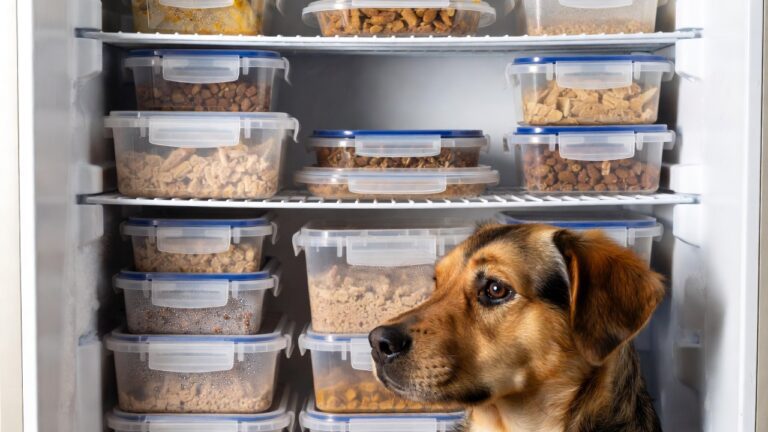
Chickens can eat small amounts of ordinary commercial dog food, but dog food is not formulated to meet a chicken’s nutritional requirements and cannot replace complete poultry feed. Any dog food offered as an extra also counts toward the total treat allowance, which poultry veterinary guidance limits to about 10% of the diet.
The nutritional difference matters because dogs and chickens belong to different species and require different concentrations of protein, amino acids, minerals, vitamins, and energy. A diet described as complete for a dog is therefore not automatically complete for a chicken.
The University of Illinois College of Veterinary Medicine recommends feeding chickens a complete ration suited to their age and production type. Scratch grains, vegetables, and other treats should make up no more than 10% of the total diet.
Is Dog Food Safe for Chickens?
Dog food is suitable only as an occasional extra, not as a regular replacement for chicken feed. Fresh processed dog food does not provide the poultry-specific nutrient balance required for growth, maintenance, or egg production.
Commercial dog food labeled “complete and balanced” has a specific meaning. The U.S. Food and Drug Administration states that dog food carrying this nutritional adequacy claim must meet an AAFCO dog nutrient profile or pass a feeding trial conducted under AAFCO procedures. The claim refers to nutritional adequacy for dogs at specified life stages.
Dog-food manufacturers therefore formulate products around canine requirements. The AAFCO nutrient standards used for dog foods do not represent poultry nutrient requirements.
Chicken diets are formulated differently. University of Georgia poultry nutrition guidance explains that chickens require appropriate amounts of essential amino acids, fatty acids, carbohydrates, vitamins, minerals, energy, and water. No single food ingredient supplies every nutrient in the concentrations chickens require.
Why Can’t Chickens Live on Dog Food?
Chickens cannot rely on dog food because poultry nutrient requirements change substantially according to age, growth rate, and egg production.
This difference is particularly clear when protein and calcium requirements are compared.
The following table summarizes typical poultry nutrient concentrations published by the University of Georgia Cooperative Extension.
| Chicken stage | Crude protein | Calcium |
| Broiler starter, 1–3 weeks | 22% | 0.95% |
| Broiler grower, 4–6 weeks | 20% | 0.90% |
| Broiler finisher, 7+ weeks | 18% | 0.85% |
| Pullet starter, 1–6 weeks | 20% | 1.00% |
| Pullet grower, 7–18 weeks | 17% | 0.95% |
| Laying hen, 19+ weeks | 16–18% | 3.50–4.50% |
Even chickens of the same species require different nutrient concentrations at different stages.
A laying hen commonly receives 3.5–4.5% calcium, while a young broiler ration may contain about 0.95% calcium. Layer feed contains considerably more calcium because eggshell formation creates a major calcium demand.
Dog food is not formulated around these poultry-specific ratios.
Is the Protein in Dog Food Good for Chickens?
Protein alone does not make dog food nutritionally appropriate for chickens. Chickens need specific amino acids in addition to the correct amount of total protein.
Proteins contain amino acids that chickens use for muscle growth, feather formation, tissue maintenance, enzymes, and egg production. University of Georgia explains that chickens can synthesize 10 amino acids, while another 10 must be supplied through dietary protein. Methionine and lysine are among the amino acids commonly considered when poultry diets are formulated.
A dog food with a high crude-protein percentage can therefore still have an inappropriate nutritional profile for poultry.
Chicken diets require balanced amounts of:
- protein;
- methionine;
- lysine;
- calcium;
- available phosphorus;
- sodium;
- fat;
- vitamins;
- trace minerals; and
- metabolizable energy.
More protein does not compensate for an inadequate amount of another essential nutrient.
How Much Dog Food Can Chickens Eat?
There is no research-based dog-food serving size specifically established for chickens. The safest practical limit is to count dog food among all dietary extras and keep those extras at 10% or less of the total diet.
The Oklahoma State University Extension recommends that scratch grains, kitchen scraps, and other supplemental foods make up no more than 10% of a chicken’s daily diet. The same guidance states that a mature hen may consume about 0.25 lb of feed per day.
A quarter-pound is approximately 113 grams. Ten percent of 113 grams is about 11 grams.
That calculation does not mean 11 grams of dog food is a scientifically recommended daily serving. It means a hen eating around 113 grams of food has only a small dietary margin for all non-complete foods combined.
Dog food, vegetables, grains, mealworms, table scraps, and other treats all compete for the same limited portion of the diet.
Can Chickens Eat Dry Dog Food?
Chickens can consume a small amount of ordinary dry dog kibble, but kibble remains an extra rather than a poultry ration.
Dry pet food typically contains about 10–12% moisture, according to FDA information on pet-food composition. Canned pet foods commonly contain approximately 75–78% moisture.
Chickens eating dry foods require unrestricted access to clean water. University of Georgia reports that birds typically drink about twice the amount they eat, although temperature and environmental conditions influence water consumption. Feed intake also decreases when adequate drinking water is unavailable.
Discard dry dog food that becomes:
- damp;
- moldy;
- rancid;
- contaminated with pests;
- unusually discolored; or
- affected by a product recall.
Fresh kibble does not become nutritionally complete for chickens simply because it is safe for dogs.
Can Chickens Eat Wet Dog Food?
Chickens can consume a small amount of fresh wet dog food, but opened wet food requires careful handling because of its high moisture content and shorter storage life.
FDA guidance states that unused canned or pouched pet food should be refrigerated promptly or discarded. Refrigerated leftovers need to remain at 40°F (4.4°C) or below.
These storage requirements are also important when handling wet dog food around a household that keeps both dogs and backyard poultry.
Wet food left in a chicken run can:
- spoil;
- attract flies;
- attract rodents or wildlife;
- contaminate feeding surfaces; and
- become mixed with litter or droppings.
Offer only a small quantity that is consumed promptly. Remove uneaten wet food rather than leaving it in the coop or run.
Can Chickens Eat Raw Dog Food?
Raw dog food is best avoided around chickens because raw pet food has a higher documented risk of bacterial contamination than processed pet food.
The FDA states that raw pet food is more likely than processed pet food to contain pathogens such as Salmonella and Listeria monocytogenes.
FDA’s Center for Veterinary Medicine tested 196 commercially available raw dog and cat food samples. Salmonella was detected in 15 samples, while Listeria monocytogenes was detected in 32 samples.
Those figures equal approximately:
- 7.7% positive for Salmonella; and
- 16.3% positive for Listeria monocytogenes.
Bacterial contamination is one of the main safety concerns associated with raw food diets for dogs, and the same contamination can reach bowls, feeders, storage containers, hands, clothing, floors, and outdoor animal areas.
Raw dog food therefore creates an unnecessary hygiene risk in a chicken-feeding environment.
Can Chickens Carry Salmonella?
Chickens can carry Salmonella and other harmful germs while appearing healthy and clean.
The Centers for Disease Control and Prevention states that backyard poultry can carry germs capable of causing human illness. Germs can spread through poultry, droppings, feed containers, waterers, equipment, and surfaces within the birds’ environment.
CDC recommends washing hands with soap and running water after:
- touching poultry;
- collecting eggs;
- handling poultry food;
- handling water containers; or
- touching equipment used in the poultry area.
Poultry equipment also needs to remain outside rather than being cleaned in areas where human food is prepared.
Adding raw animal food to the same environment can create another potential contamination route.
Can Baby Chicks Eat Dog Food?
Baby chicks should receive complete chick starter rather than dog food because early growth requires a tightly controlled nutrient balance.
University of Georgia management guidance recommends a starter ration from day 1 to about 6 weeks of age, followed by grower feed from approximately 6 to 18 weeks. Layer ration begins at around 18 weeks for laying-type birds approaching egg production.
Starter feed is not simply “high-protein food.” It contains protein, amino acids, minerals, vitamins, energy, and other nutrients at concentrations designed for developing poultry.
Young birds also have greater sensitivity to excessive sodium. The Merck Veterinary Manual reports that birds younger than 21 days are more susceptible to sodium toxicity because immature kidneys cannot excrete sodium as efficiently as those of older birds.
Chick starter is therefore a more appropriate food than dog kibble or canned dog food during early growth.
Can Laying Hens Eat Dog Food?
Laying hens can consume occasional extras, but dog food cannot replace layer feed because egg production creates particularly high mineral requirements.
Calcium provides the clearest example.
University of Georgia lists typical calcium concentrations of:
- 0.95% in broiler starter feed;
- 0.95% in pullet grower feed; and
- 3.5–4.5% in laying-hen feed.
Layer feed therefore contains roughly four times as much calcium as some grower diets.
A hen that regularly fills up on dog food consumes less complete layer ration. That dietary displacement can reduce intake of calcium, amino acids, vitamins, trace minerals, and other nutrients formulated specifically for egg production.
The nutritional risk comes primarily from repeated displacement of complete feed, not from one accidental bite of kibble.
Can Chickens Eat Dog Food During Molting?
Dog food is not required during molt when chickens receive an appropriate complete poultry ration.
Feathers contain substantial protein, so amino-acid nutrition matters during feather replacement. However, crude protein percentage alone does not determine whether a food meets poultry requirements.
Methionine and lysine are among the important amino acids considered in chicken-feed formulation, and a complete poultry ration supplies amino acids together with energy, minerals, vitamins, and other nutrients.
Persistent feather loss, weight loss, reduced appetite, abnormal droppings, or unusual behavior during molt can also reflect health or management problems rather than a simple need for additional protein.
Can Moldy Dog Food Harm Chickens?
Moldy dog food should never be fed to chickens because mold-contaminated food can contain mycotoxins.
The Merck Veterinary Manual identifies several mycotoxins associated with disease in poultry, including:
- aflatoxins;
- fumonisins;
- ochratoxins;
- zearalenone; and
- trichothecenes such as deoxynivalenol and T-2 toxin.
Mycotoxin exposure can occur through contaminated feed or bedding. Some toxins remain present even after the feed has become a finished product because mycotoxins can be chemically stable.
Merck recommends removing contaminated feed when mycotoxicosis is suspected.
Dog food that smells rancid, feels damp, contains visible mold, or has been improperly stored belongs in the trash rather than the chicken feeder.
Is Salt in Dog Food Dangerous for Chickens?
A few pieces of ordinary dog food do not automatically cause salt poisoning, but excessive sodium exposure can harm poultry.
Merck explains that the sodium ion is responsible for salt toxicosis in poultry. Young birds are particularly susceptible, and excess exposure can produce increased thirst, watery droppings, lethargy, breathing difficulty, fluid accumulation, and other abnormalities.
Merck reports that poultry rations containing more than 2% added salt are generally considered dangerous, although actual toxicity depends on factors including species, age, total sodium exposure, and water availability.
This does not establish ordinary dog kibble as a poisoning risk at treat quantities. Instead, it reinforces why poultry diets need controlled nutrient concentrations rather than uncontrolled supplementation with foods formulated for another species.
Clean drinking water needs to remain available continuously.
What Happens If a Chicken Accidentally Eats Dog Food?
A chicken that eats a small amount of ordinary commercial dog food can usually be returned to its normal poultry ration and observed, while larger or unusual exposures require more caution.
Assess four factors:
- Identify the dog food. Determine whether the food was dry, canned, raw, spoiled, moldy, or a veterinary therapeutic diet.
- Estimate the amount eaten. A few pieces differ substantially from prolonged access to an entire dog bowl.
- Restore normal nutrition. Provide complete poultry feed and unrestricted clean water.
- Monitor the chicken. Watch activity, appetite, water intake, droppings, breathing, and coordination.
Seek veterinary advice when the bird eats a large or unknown quantity, consumes spoiled or contaminated food, or develops significant clinical changes.
Marked lethargy, breathing difficulty, severe diarrhea, neurological signs, inability to stand, or sudden deterioration warrants prompt veterinary attention.
Should Dog Food Be Mixed With Chicken Feed?
Dog food should not routinely be mixed into complete chicken feed because additional foods change the nutrient concentration of the formulated ration.
University of Georgia makes the same point about scratch grain. Scratch is not nutritionally complete, and mixing substantial amounts into complete feed increases calories while reducing the proportional concentration of protein, vitamins, and minerals.
The same dilution principle applies to dog food.
Oklahoma State University recommends using complete poultry feeds that do not require supplementation with other ingredients because imbalanced diets can cause mineral or vitamin deficiencies and reduce growth or production.
Keep poultry feed as the nutritional base rather than creating a homemade dog-food-and-chicken-feed mixture.
What Types of Dog Food Should Chickens Avoid?
Raw, moldy, spoiled, recalled, and improperly stored dog food present greater safety concerns and should not be fed to chickens.
The table summarizes the main differences.
| Dog food type | Use for chickens | Main concern |
| Fresh dry kibble | Small occasional extra only | Displaces balanced poultry feed |
| Fresh canned food | Small occasional extra only | Nutrient displacement and rapid spoilage |
| Raw dog food | Best avoided | Higher bacterial-contamination risk |
| Moldy dog food | Do not feed | Mycotoxins |
| Spoiled dog food | Do not feed | Microbial contamination and deterioration |
| Recalled dog food | Do not feed | Identified product-safety problem |
| Therapeutic dog diet | Do not use as poultry feed | Formulated for specific canine health needs |
The table separates food-safety risk from nutritional suitability. Fresh processed dog food can still be nutritionally inappropriate as a major part of a chicken’s diet.
What Should Chickens Eat Instead of Dog Food?
Chickens should eat complete poultry feed formulated for their age and purpose.
For laying-type backyard chickens, University of Georgia provides a general feeding sequence:
- Starter feed: day 1 to approximately 6 weeks.
- Grower feed: approximately 6 to 18 weeks.
- Layer feed: from about 18 weeks as hens approach egg production.
Different commercial products can use slightly different age ranges, so the feed manufacturer’s instructions remain important.
Complete feed provides the nutritional base. Treats provide variety but do not replace it.
The 90-to-10 concept is a useful practical rule: approximately 90% or more complete ration and 10% or less treats and dietary extras.
Can Dog Food Improve Egg Production?
Dog food is not an evidence-based method for increasing egg production.
Egg production depends on several interconnected factors:
- genetics;
- hen age;
- daylight exposure;
- energy intake;
- amino-acid supply;
- calcium;
- phosphorus;
- vitamin status;
- water availability;
- health; and
- environmental conditions.
Adding a high-protein dog food does not automatically improve any of these factors.
The more relevant nutritional objective is maintaining adequate intake of a complete layer ration with the approximately 3.5–4.5% calcium and balanced nutrient profile required for laying hens.
Frequently Asked Questions
Can chickens eat dog kibble every day?
Dog kibble should not become a routine part of a chicken’s daily ration. Complete poultry feed needs to provide the great majority of daily food intake, while treats and extras stay at approximately 10% or less.
Can chickens eat canned dog food?
A small amount of fresh canned dog food can fall within the treat allowance, but leftovers require prompt removal and refrigeration. FDA recommends keeping refrigerated opened pet food at 40°F or below.
Can chickens eat puppy food?
Puppy food cannot replace chick starter. Puppy food is formulated for canine growth, while chick starter contains poultry-specific levels of protein, amino acids, minerals, vitamins, and energy.
Can chickens eat senior dog food?
Senior dog food is not formulated for poultry and offers no nutritional advantage over appropriate chicken feed. Its nutrient profile is designed around canine rather than poultry requirements.
Can chickens eat expired dog food?
Do not feed dog food that has spoiled, become moldy, developed a rancid odor, or deteriorated during storage. Mycotoxins produced by certain molds can cause disease in poultry.
Can chickens eat raw dog food?
Raw dog food is best avoided because FDA testing found substantially more microbial contamination concerns in raw pet foods than processed products. Of 196 raw pet-food samples tested, 15 contained Salmonella and 32 contained Listeria monocytogenes.
Can chickens eat dog food for extra protein?
Dog food is not an appropriate way to balance poultry protein intake. Chickens require specific essential amino acids together with appropriate energy, minerals, vitamins, and other nutrients.
Can chickens eat cat food?
Cat food also cannot replace poultry feed. Foods described as complete and balanced are formulated according to nutrient profiles for the animal species and life stage stated on the product.
Can Chickens Eat Dog Food Safely?
Chickens can eat small amounts of fresh commercial dog food, but dog food should remain an occasional extra rather than a regular part of the flock’s diet.
The strongest evidence-based feeding principle is not a specific number of pieces of kibble. No authoritative poultry source establishes such a serving. Instead, complete chicken feed needs to provide the nutritional foundation, while treats and other dietary extras remain at approximately 10% or less of total intake.
Dry or canned dog food creates fewer microbial concerns than raw dog food when handled correctly, but neither type is formulated as chicken feed. Raw dog food is best avoided because FDA testing documents a greater risk of bacterial contamination. Moldy, spoiled, contaminated, or recalled products should not be fed.
Age also matters. Chicks require starter feed, growing birds require grower diets, and laying hens require the higher calcium concentration of a layer ration.
The practical answer is therefore straightforward: dog food can be an occasional extra for chickens, but nutritionally complete poultry feed should remain about 90% or more of the diet.