

What is a Bernedoodle?
A Bernedoodle is a Bernese Mountain Dog × Poodle crossbred dog developed for companionship and trainability. Bernedoodle outcomes vary because Poodle size line, breeding generation, and coat genetics change adult size, shedding, and grooming workload.
- Bernese Mountain Dog: large-frame conformation, deep-chest risk profile, slower skeletal maturity.
- Poodle (Standard or Miniature): high trainability, curl-coat genetics, lower visible-shedding probability.
What are the Bernedoodle facts at a glance?
A Bernedoodle is a variable-size companion dog with coat-dependent shedding and high grooming frequency.
The table below lists planning attributes used for housing, handling, feeding, grooming, and preventive care.
| Attribute | Typical values used in veterinary counseling |
| Size types | Toy / Mini / Standard |
| Adult weight band | 10–100+ lb (line-dependent) |
| Adult height band | 12–29 in (type-dependent) |
| Lifespan band | 10–18 years (size-dependent) |
| Shedding | Low–moderate (coat-dependent) |
| Grooming cycle | 6–12 weeks (coat-dependent) |
| Common behavior risk | separation distress in people-attached lines |
The largest prediction errors occur in “mini” labels without parent-size documentation.
How big do Bernedoodles get?
Bernedoodles reach 10–100+ lb because Poodle size selection sets the size ceiling. Toy, mini, and standard categories describe adult planning ranges.
What is the Bernedoodle size chart?
The Bernedoodle size chart groups adults by height, weight, and growth completion age.
The table below connects size category to adult range and maturation timeline used for feeding targets and safe activity planning.
| Type | Adult height | Adult weight | Growth completion window |
| Toy/Tiny Bernedoodle | 12–17 in | 10–24 lb | 9–12 months |
| Mini Bernedoodle | 18–22 in | 20–45 lb | 12–15 months |
| Standard Bernedoodle | 23–29 in | 60–100+ lb | 18–24 months |
Standard Bernedoodles show the longest skeletal development window, which changes exercise selection and growth-rate control.
How big is a mini Bernedoodle full grown?
A mini Bernedoodle full grown commonly ranges from 20–45 lb and 18–22 inches. Variance increases when Miniature Poodle lines range from 10–20 kg and when breeding lines lack size standardization.
Mini-size qualifiers
- 20–30 lb: Smaller mini lines
- 30–40 lb: Mid mini lines
- 40–55 lb: Oversized “mini” labels
When do Bernedoodles stop growing?
Toy Bernedoodles stop growing earlier than standard Bernedoodles because larger frames mature later. Growth completion tracks growth-plate closure and muscle fill.
- Toy: 9–12 months
- Mini: 12–15 months
- Standard: 18–24 months
Frame width, ribcage expansion, thigh musculature, and shoulder mass continue after peak height.
What determines Bernedoodle size?
Bernedoodle size is set by parent size genetics, sex, and generation structure.
Determinant list
- Define parent size: Adult weight and height of sire and dam set range.
- Define Poodle line: Standard Poodle vs Miniature Poodle shifts category.
- Define sex effect: Males trend heavier than females in the same line.
- Define generation: Backcrossing toward Poodle shifts size distribution toward the Poodle line used.
What is the Bernedoodle temperament?
Bernedoodles are social companion dogs with high trainability and high human attachment frequency. Temperament reflects Poodle learning speed and Bernese social steadiness.
Are Bernedoodles good family dogs?
Bernedoodles fit family settings when socialization and handling rules remain consistent. Standard Bernedoodles add handling-force risk because body mass amplifies pulling and jumping.
Family-fit attribute set
- Increase tolerance: Child-safe handling training and calm greetings.
- Reduce reactivity: Controlled exposure to noise, surfaces, and unfamiliar people.
- Improve obedience: Reward-based drills with short sessions.
Do Bernedoodles develop separation anxiety?
Bernedoodles show separation distress patterns more often than independent breeds because many lines are people-attached. Separation distress presents as vocalization, destructive chewing near exits, and hyper-attachment.
Conditional proposition: Use structured alone-time conditioning, if Bernedoodle follows owners room-to-room and escalates at door cues.
Do Bernedoodles shed?
Bernedoodles shed from low to moderate levels because coat type determines hair release and mat formation. Curly coats trap loose hair; straight coats release more loose hair.
What are Bernedoodle coat types?
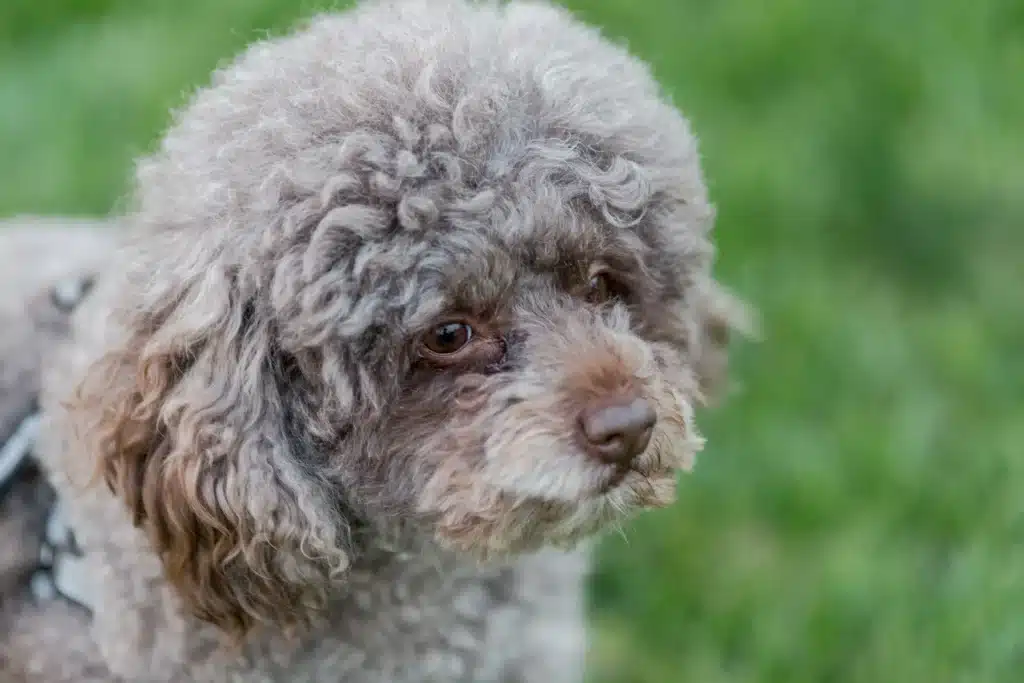
Bernedoodles express three functional coat types: curly, wavy, and straight.
- Curly coat: Lowest visible shedding; highest matting probability.
- Wavy coat: Low-to-moderate shedding; moderate matting probability.
- Straight coat: Moderate shedding; lower matting probability than curly.
Example set: Curly coats require daily detangling; wavy coats require 3–5 sessions per week; straight coats require 2–3 sessions per week.
Are Bernedoodles hypoallergenic?
No dog is fully hypoallergenic because allergen exposure includes dander and saliva proteins in addition to hair. Curly Bernedoodles reduce visible shedding in many lines, but allergy tolerance remains individual.
Evidence expansion: Veterinary allergy counseling treats “hypoallergenic” as a probability claim because immune sensitivity varies by person and indoor allergen load.
What is an F1 Bernedoodle vs F1B Bernedoodle?
F1 is a first cross and F1B is a backcross toward Poodle, which increases curly-coat probability.
- F1 (50/50): Wider coat variability; wavy is common.
- F1B (often higher Poodle proportion): Higher curly probability; lower visible shedding probability.
- Multigen (F2/F3): Trait variance depends on selection consistency and screening discipline.
What is the Bernedoodle lifespan?
Bernedoodle lifespan usually falls between 10 and 18 years because size category correlates with longevity bands. Smaller dogs trend longer-lived than larger dogs in population-level patterns.
The table below translates lifespan planning into size categories used in preventive-care scheduling.
| Size type | Typical lifespan band |
| Toy | 14–18 years |
| Mini | 13–16 years |
| Standard | 10–14 years |
Lifespan variance increases with obesity, chronic dental disease, and unmanaged orthopedic disease.
What health problems occur in Bernedoodles?
Bernedoodles show orthopedic, eye, skin, and ear risks because both parent breeds carry inheritable conditions. Crossbreeding does not remove genetic risk without parent screening.
Is hybrid vigor guaranteed in Bernedoodles?
Hybrid vigor is not guaranteed because inherited disorders occur in both mixed-breed and purebred populations. A large JAVMA dataset reported mixed-breed dogs did not show uniform advantage across inherited disorders, and risk varied by condition.
What orthopedic problems matter most in Bernedoodles?
Hip dysplasia and elbow dysplasia matter most because large size and fast growth increase joint disease probability. Orthopedic disease increases lameness risk, activity limitation, and long-term pain management burden.
Orthopedic risk control list
- Control growth rate: Use size-appropriate puppy feeding targets for standard lines.
- Control body condition: Maintain visible waist and palpable ribs.
- Control screening proof: Request OFA or PennHIP documentation for parents.
- Control exercise type: Use low-impact activity during growth-plate phase.
What eye problems matter in Bernedoodles?
Inherited ocular disease risk remains possible because Poodle lines carry documented inherited eye disorder profiles. Eye risk control relies on parent eye exam documentation and periodic veterinary assessment.
Example set: Progressive retinal atrophy screening, cataract evaluation, and ophthalmology certification records improve risk visibility.
What skin and ear problems occur in Bernedoodles?
Hot spots and otitis externa occur because dense coats retain moisture and floppy ears trap humidity. Matting increases skin microtrauma and bacterial overgrowth probability.
Prevention list
- Dry coat after swimming and bathing.
- Brush coat to prevent mats and occlusion.
- Inspect ears weekly for odor and debris.
- Treat itch early to reduce hot spot escalation.
What is GDV and does it affect standard Bernedoodles?
Gastric dilatation–volvulus is a deep-chested large-breed emergency risk pattern that includes Standard Poodles in higher-risk research cohorts. Standard Bernedoodles inherit deep-chest traits in many lines, which increases relevance of GDV prevention routines.
Risk-factor examples after plural noun: Risk factors include deep thorax conformation, large body size, and feeding-pattern variables in cohort research.
What is the best feeding approach for a Bernedoodle?
A complete-and-balanced diet that meets AAFCO nutrient profiles or AAFCO feeding trials is the baseline nutrition standard for dogs. Feeding targets change by life stage and size category.
What is the Bernedoodle feeding schedule by age?
Bernedoodle feeding frequency shifts from 3–4 meals to 2 meals as age increases.
- Puppy (8–16 weeks): 3–4 meals/day
- Puppy (4–12 months): 3 meals/day
- Adult: 2 meals/day
- Senior: 2 meals/day with calorie adjustment
Conditional proposition: Use smaller meals, if the dog is a standard-sized deep-chested line with fast eating behavior.
How is portion size set accurately?
Portion size is set by body condition score and calorie density, not by cups-per-day labels. Calorie density varies across kibble, canned diets, and fresh diets, which changes portion volume.
BCS control signals
- Score lean: Ribs palpable with light fat cover; waist visible from above.
- Score overweight: Ribs difficult to feel; waist absent.
How much exercise does a Bernedoodle need?
Bernedoodles require daily aerobic activity and daily mental work because the crossbreed carries learning drive and social energy. Exercise targets scale with size category.
The table below links size category to daily activity minutes used for weight control and behavior stability.
| Size | Daily walking + play | Daily mental work |
| Toy | 20–40 minutes | 15–20 minutes |
| Mini | 45–60 minutes | 20–30 minutes |
| Standard | 60–90 minutes | ~30 minutes |
Mental work includes scent games, food puzzles, obedience drills, and structured retrieval tasks.
What grooming schedule fits a Bernedoodle coat?
Bernedoodles require routine brushing and periodic professional grooming because matting changes skin microclimate and infection probability. Grooming frequency rises with curl density and coat length.
Grooming frequency set
- Brush: 3–7 sessions/week (coat-dependent)
- Professional grooming: Every 6–12 weeks
- Trim nails: Every 2–4 weeks
- Clean ears: Veterinarian-directed frequency, especially after water exposure
- Brush teeth: Daily target frequency for periodontal risk control
What breeder proof reduces risk in Bernedoodle puppies?
Documented parent screening reduces inherited-risk probability more than marketing terms. Screening proof is a document set, not a verbal claim.
Breeder document list
- Provide hip/elbow screening: OFA or PennHIP reports.
- Provide eye exam records: Veterinary ophthalmology evaluation.
- Provide genetic test panels: Parent-line relevant tests with report IDs.
- Provide contract terms: Return policy and health guarantee language.
What are the key takeaways for Bernedoodle ownership?
- A Bernedoodle is a Bernese × Poodle cross with size and coat variability by line.
- A mini Bernedoodle full grown commonly ranges 20–45 lb, and standard lines reach 60–100+ lb.
- Bernedoodle shedding changes by coat type, not by breed label.
- Hybrid vigor is not guaranteed, and parent screening drives risk control.
- GDV risk concentrates in deep-chested large-breed patterns, which increases relevance for standard-sized lines.
- Complete-and-balanced feeding claims rely on AAFCO nutrient profiles or AAFCO feeding trials.